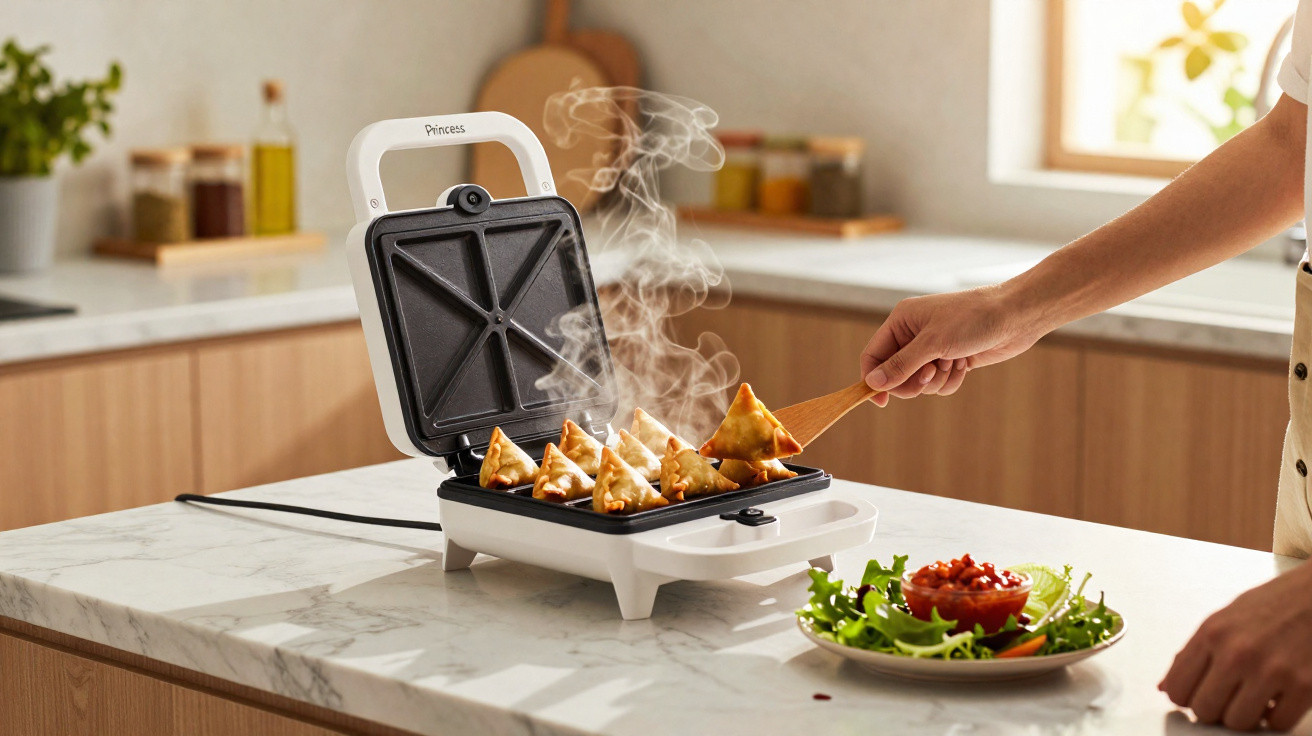
Entertaining is enjoyable-until you are trapped in the kitchen, managing hot oil, greasy pans and snacks that cook unevenly.
French retailer Boulanger is promoting a compact appliance designed to remove much of that hassle: an electric samosa maker that produces 10 crisp triangles in one batch with virtually no added fat, priced at €17.99. It is aimed at time-pressed home cooks seeking street-food-inspired snacks without deep-frying or heating a full-sized oven.
What this samosa maker actually does
Made by the Dutch brand Princess, the appliance resembles a slim sandwich toaster, except it has triangular moulds. When shut, it is roughly 25 x 28 x 8.5 cm, making it easy to keep in a cupboard or on a compact worktop.
Its fixed cooking plate, measuring about 24.5 x 19 cm, contains 10 triangular compartments. Place pastry sheets or dough inside, add the filling, close the lid, and the machine forms and seals 10 samosas at the same time.
Up to 10 samosas in a single batch, without turning on the oven or heating a pan of oil.
Heat is distributed evenly over the plate to help prevent the usual issue of scorched edges and undercooked middles. The non-stick surface means no extra fat is necessary, although a very light brushing of oil over the pastry can deliver a slightly richer finish.
Why people care about “oil-free” samosas
Conventional samosas are deep-fried. While that makes them delicious, it can also make them heavy. This appliance is intended to retain the crispness while reducing the grease.
Choosing baking rather than frying brings three immediate advantages:
- Less oil is absorbed by the pastry and filling
- There are no hot-oil splashes on your hands or hob
- Cleaning up is far simpler, without a pan of used oil to dispose of
You still get crisp pastry, but your kitchen won’t smell of frying for hours.
For people monitoring their fat consumption, or those simply fed up with handling frying oil, this compromise may be attractive. The result is more akin to an oven-baked snack than a deep-fried street-stall version, but plenty of home cooks are willing to make that change for weeknight dinners and informal get-togethers.
A €17.99 deal at Boulanger
In France, the Princess samosa maker is normally advertised at around €30.29. Boulanger is currently offering it for €17.99, placing it firmly in impulse-purchase territory for kitchen appliances.
At this price point, it competes with mid-range sandwich toasters, although it serves a more specialised purpose: making portioned, bite-sized food. As the offer may not remain available, potential buyers should consider how regularly they serve finger food or weekend brunches.
From around €30 down to €17.99, the device targets anyone tempted to “test” homemade samosas without a big investment.
How it works in practice
Straightforward controls and automatic temperature
The appliance manages its temperature automatically. With no thermostat to adjust, operation remains simple: plug it in, wait for the light, fill the moulds and close the lid.
Two indicator lights show that the machine has power and is preheating. Once the preheat light switches off or changes colour, the plate is ready and the temperature has stabilised. This consistency is useful when you are also preparing other food.
A latch secures the lid and keeps pressure on the samosas as they cook. This helps seal the pastry and stops the lid springing open should the filling expand a little.
Handling and safety details
Its handle is heat-insulated, allowing you to open the appliance without oven gloves. Although this may sound basic, it reduces the risk of brief-contact burns for a gadget likely to be used around children or visitors.
As it is an enclosed appliance with no exposed heating element, there is no visible flame and very little risk of splashing. The exterior still becomes warm, so it should sit on a stable, heat-resistant surface, but in safety terms it is closer to a waffle maker than a frying pan.
Beyond samosas: what else you can cook
Although samosas are the focus of its marketing, the triangular compartments allow for other sweet and savoury options. Each triangle can effectively be treated as a miniature mould.
Potential uses include:
- Mini stuffed breads with cheese and herbs
- Individual brioche-like buns
- Chocolate cakes with soft centres
- Small meringue-like treats
- Leftover vegetable parcels wrapped in filo or thin pastry
The device is closer to a multipurpose snack press than a single-use “samosa only” machine.
Thanks to the non-stick coating, most of these foods need very little fat. A light oil spray or a brush of butter on the pastry should be sufficient to release them easily and improve browning.
Cleaning and storage: the unglamorous but crucial part
Once cooking is finished, allow the plate to cool before cleaning it. Crumbs and residue can generally be removed with a soft sponge or damp cloth. Abrasive scourers should be avoided because they may harm the non-stick coating.
The appliance has no removable plates. That helps keep its price lower, but it means the plates must be cleaned in place. For most people, this should be manageable because the surface is relatively flat and lacks the baked-on oil associated with frying.
Its compact design is another benefit. It can be stored upright in a narrow cupboard gap. This is particularly useful in European kitchens, where worktop space is often limited and multi-purpose appliances compete for storage.
How it fits into a modern kitchen setup
With air fryers, multi-cookers and compact ovens already filling worktops, a samosa maker may appear to be another niche appliance. Its dimensions and price change that calculation: it functions more as a specialist tool for people who often make snacks than as a major appliance purchase.
| Feature | Benefit for users |
|---|---|
| 10-piece capacity | Feeds several people in a single batch |
| Non-stick plate | Low-fat cooking and easier cleaning |
| Automatic temperature | No settings to adjust, fewer mistakes |
| Locking lid | Better sealing of pastry and safer handling |
| Vertical storage | Takes minimal cupboard space |
For those who regularly host aperitif-style evenings, family brunches or children’s parties, being able to make tray after tray of uniform bites without difficulty can be a genuine benefit. The machine reduces preparation time while leaving the oven available for larger dishes.
Healthy-ish snacking and portion control
The promotion of this appliance reflects a broader move towards lighter takes on comfort food. Although “oil-free” samosas are still pastries often containing rich fillings, skipping deep-frying lowers the overall fat content.
Practically, each triangle is an individual serving, which may make portion control easier. You can choose beforehand how many to cook and put out, rather than presenting a large tray that can lead to serving too much.
For parents, this also simplifies managing children’s snacks. A plate of two or three small samosas with salad or raw vegetables can look generous while remaining within sensible energy levels.
Small risks and trade-offs to consider
There are limitations, naturally. As there is no manual temperature setting, users depend entirely on the factory configuration. Cooks who prefer precise control over browning may find this frustrating.
The non-stick coating is convenient but must be treated carefully. Metal utensils and aggressive scourers can scratch it and reduce the appliance’s lifespan. Anyone accustomed to cast iron or stainless steel will need to alter their routine.
Texture is a further consideration: baked samosas have a drier, firmer crunch than fried versions. Some people favour that texture, while others may miss their distinctive flakiness. Lightly brushing the outside with oil before cooking can help narrow the difference.
Practical use cases and recipe ideas
The 10-slot design encourages experimentation beyond traditional spiced potato fillings. For a weekday meal, leftover roast chicken, a handful of frozen peas, grated cheese and a spoonful of soured cream could become quick mini pies.
For brunch, line the compartments with thin bread or tortilla, then add beaten egg, chopped vegetables and a little cheese before briefly closing the lid. You get neatly divided omelette triangles that are simple to serve and eat by hand.
Desserts are also possible. Pouring a basic chocolate batter into the compartments makes small cakes, while a spoonful of chocolate spread or caramel in the middle gives them a soft, molten centre. As cooking takes place in a closed appliance, the filling remains contained instead of spilling onto a baking tray.
For shoppers in France or nearby markets considering the Boulanger offer, this €17.99 accessory combines convenience, somewhat lighter cooking and food designed for sharing. It will not take the place of a full oven or air fryer, but it may become the appliance you use whenever friends announce a last-minute visit and you have 20 minutes to make something that looks-and tastes-as though it took effort.

















Comments
No comments yet. Be the first to comment!
Leave a Comment