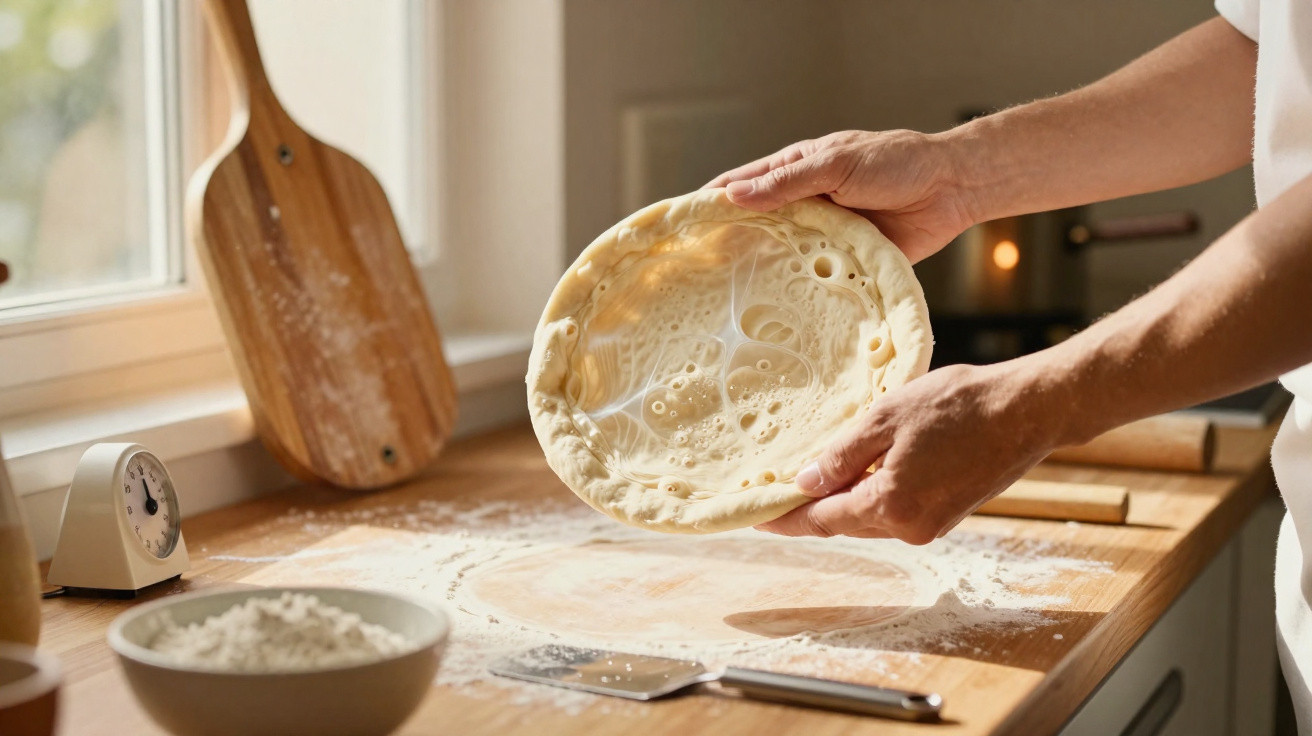
At Tony’s Pizzeria, the kitchen quietens until only the low drone of the ovens can be heard. Marco, the head pizza chef whose fingernails are always dusted with flour, walks over to a bowl of dough that has been proving for precisely three hours. Rather than looking at a clock or reaching for a recipe, he pushes two fingers gently into its pale, cloud-like surface. The dough slowly and lazily rises back, prompting an approving nod. “Perfect,” he says under his breath as he wipes his hands on his apron. That small movement is what distinguishes amateur pizza makers from professionals.
The Secret Language of Pizza Dough
Experienced pizza chefs do not depend on timers or intuition alone to decide whether pizza dough is oven-ready. Instead, they use the “poke test”, an apparently straightforward method that reveals the state of the dough’s fermentation. To do it, press two fingers roughly 1.3 cm into the dough and watch its response.
At Lombardi’s in New York, master pizzaiolo Giovanni Santangelo carries out this check dozens of times each day. Last Tuesday, I saw him discard three batches that appeared identical to my inexperienced eye. “This one springs back too fast,” he said while demonstrating on one especially lively batch. “Not ready. This one? Doesn’t spring back at all – overproofed.”
The poke test works because of gluten development and yeast activity. As the dough ferments, yeast feeds on sugars and releases carbon dioxide, forming the much-prized air pockets. At the same time, the gluten network becomes stronger while also relaxing, until it reaches the right equilibrium. Dough at this ideal stage recovers from pressure gently and steadily, signalling that it is ready.
Mastering the Pizza Dough Poke Test at Home
To try the test in your kitchen, lightly flour two fingers, then press them about 1.3 cm into the dough ball. Keep them there for two seconds before removing them. Properly proved dough should rise back gradually, with a shallow mark that slowly disappears over 10-15 seconds.
In truth, many home bakers hurry through this stage because they are keen to shape their pizzas. The most common error is pushing too hard or testing with only one finger. The aim is not to pierce the dough; approach it as you would when checking how firm a pillow is. Light pressure gives the clearest indication.
“The dough will tell you everything if you know how to listen. It’s like reading a person’s pulse – you need patience and practice to interpret what you’re feeling.” - Chef Maria Rossi, Neapolitan Pizza Academy
Look out for the following clear indicators:
- Ready dough: Returns slowly, while a small indentation lingers briefly
- Under-proofed: Springs back rapidly and fully
- Over-proofed: The indentation remains, with no return movement
- Perfect timing: The surface feels lively without being overly active
Beyond the Kitchen Timer
Most of us have stood in the kitchen wondering whether the dough ball on the worktop has achieved its full potential. Using the poke test replaces nervous guesswork with assured pizza-making skill. It also links you with centuries of bread-making knowledge, handed down by generations of Italian nonnas who never needed a kitchen timer.
| Key point | Detail | Value for the reader |
|---|---|---|
| Finger pressure technique | Two fingers, 1.3 cm depth, 2-second hold | Removes uncertainty and delivers reliable results |
| Timing interpretation | A 10-15 second spring-back signals readiness | Avoids undercooked or overproofed disappointments |
| Professional validation | The same approach is used in leading pizzerias around the world | Encourages confidence and an authentic technique |

















Comments
No comments yet. Be the first to comment!
Leave a Comment