The recipe card was faded to yellow and worn smooth at the edges, as though the same patient hands had picked it up a thousand times. I found it at the bottom of my grandmother’s old metal tin, hidden behind 1980s grocery receipts and a recipe for something called “party salad” that, thankfully, never returned. Across the front, in curling blue handwriting, were the words: “Bread pudding – use stale bread (don’t waste).”
After scrolling past countless glossy, excessively styled desserts online, the small card almost seemed funny. Stale bread, milk, sugar. No caramel fragments, no pistachio sprinkle, no kitchen blowtorch. Only… leftovers and optimism.
Even so, I made it.
When I pulled the dish from the oven, I understood at last why this traditional dessert has never disappeared.
Why a bowl of “leftovers” still beats half of Instagram
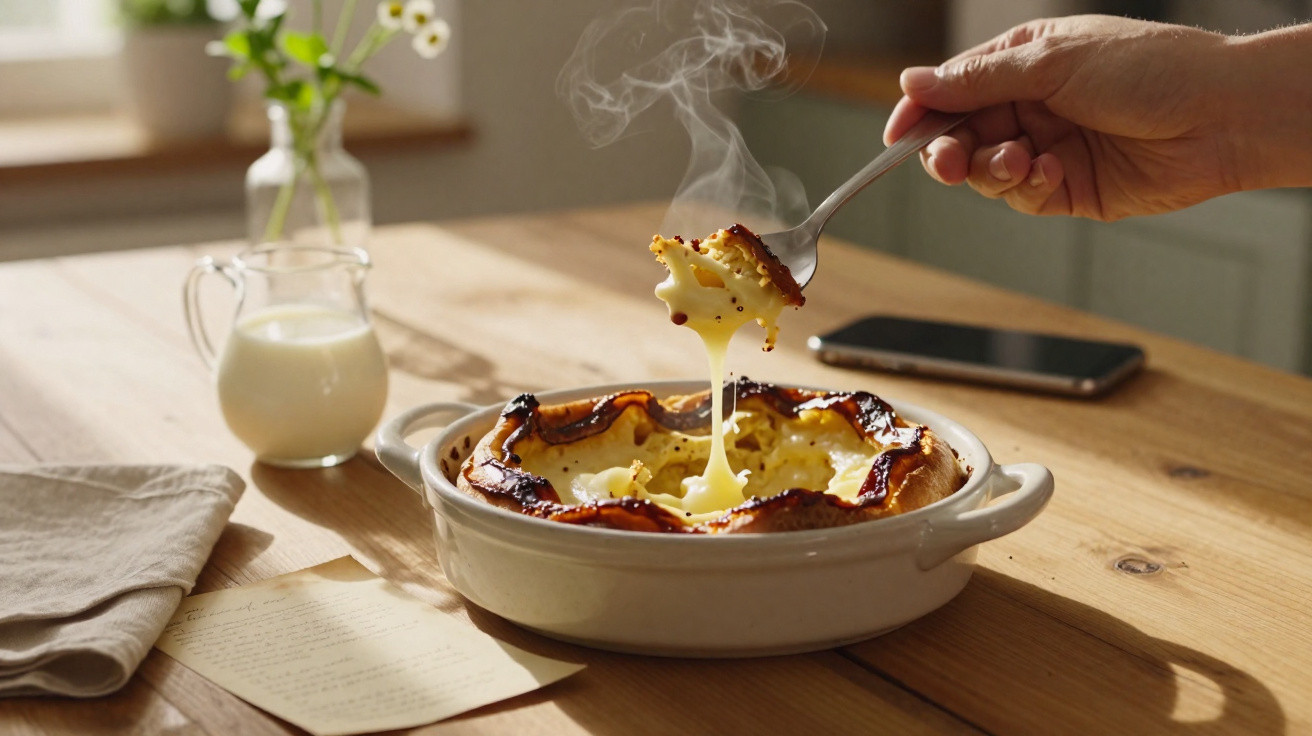
The first spoonful delivered the sort of understated drama that never photographs particularly well. Its surface was browned and craggy; beneath it sat a soft, custardy middle, dotted with raisins swollen as though given another chance at life. Steam drifted upwards in slow curls, bringing vanilla and cinnamon and taking me straight back to a kitchen that no longer exists.
It did not impress me through novelty. It did something more unusual: it made me feel calm.
Nothing in that bowl was unexpected, but it felt like discovering cash in a coat you had nearly thrown away.
Bread pudding is like the dessert version of a classic song your parents played in the car. You might roll your eyes at the opening notes, but five seconds later, you know every word.
Recipes like this endured wars, rationing and lean student years because they excelled at one thing: transforming “not enough” into “plenty”. Old bread, milk that needed using up, one or two eggs, and sugar when it was available.
We have all faced that moment when the fridge looks like a scattered collection of regrets. Those are exactly the circumstances that created bread pudding, rice pudding, apple cobblers and all the other “make do” desserts that quietly nourished whole generations.
Its lasting appeal is not only about flavour. It lies in the practical thinking built into the recipe.
Nothing goes to waste. The texture allows for mistakes. The technique is simple enough to hand down without writing a single word. A child can whisk the custard, a tired parent can assemble it after supper, and a grandparent can make it from muscle memory while repeating the same story for the tenth time.
Food that survives a century usually isn’t fancy - it’s reliable, repeatable, and forgiving when life isn’t.
That is the real reason these desserts never vanish entirely from our tables.
Bread pudding: the small steps that turn “meh” into magic
The card instructed me to “let stand 10 minutes”, a direction I used to ignore in modern recipes. This time, I followed it. I poured the sweet milk-and-egg mixture over the torn bread, then left it alone.
Those ten minutes were when the alchemy took place. Gradually, the bread soaked up the custard, becoming soft around the edges while remaining a little firm at its centre. When I lightly pressed the top with the back of a spoon, it had the feel of damp sponge cake.
Starting with a hot oven before reducing the temperature created the ideal contrast: a golden, gently crisp top and a tender, custardy centre. There was nothing technical about it. Only heat and patience.
If you have tried a traditional dessert and found it dull, you are not alone. Many of us hurry past the steps that seem unimportant because we are accustomed to speed and spectacle.
With too much liquid, you get sweet scrambled eggs. With too little soaking time, it becomes merely warm bread with a grudge. Leave out a pinch of salt and every flavour tastes muted, however much sugar you add.
Honestly, nobody manages this properly every day. We race through recipes between work, children, phones and exhaustion. That is why these old notes, written in faded ink, seem like gentle guidance from someone who cooked when time passed differently.
As the pudding cooled, I spotted a small note at the base of the card: “Good warm. Best next day (if any left).” It sounded exactly like my grandmother, who regarded leftovers as both a warning and a promise.
“The thing about these ‘poor people’s desserts’,” my mother told me on the phone, “is that nobody felt poor when they were eating them.”
She was right. When it offers comfort whenever you need it, a humble recipe can feel like abundance.
- Let the bread soak properly – Hand-torn dry cubes take on flavour more effectively than tidy slices.
- Add a tiny pinch of salt – It subtly brings out the vanilla, cinnamon and butter.
- Use whatever you have.
- Do not pursue perfection.
- Serve it informally, rather than presenting it as a museum piece.
The quiet rebellion of keeping old desserts alive
Something changed after I made that dish of bread pudding. Instead of scrolling for the next major dessert trend, I began asking people about the one recipe their family refuses to lose. That is how you encounter arroz con leche that carried someone through winter, lemon pudding cake that works only in grandmother’s dented tin, and chocolate custard served at every birthday and every break-up.
Making these dishes feels slightly like travelling through time, though not in the polished, cinematic way. It means sticky worktops, burnt fingertips and a few overbaked corners that nobody minds. It is food that does not ask to be photographed, yet somehow makes the whole room feel full.
The enduring recipes always achieve the same three things: they bring comfort, make what you have go further, and leave enough room for your own variation without losing what makes them work.
| Key point | Detail | Value for the reader |
|---|---|---|
| Use “imperfect” ingredients | Stale bread, ageing fruit and leftover rice can all become the foundations of dessert | Transforms possible waste into something warm, nostalgic and satisfying |
| Respect the slow steps | Soaking, resting and gentle heat build depth of flavour and texture | Helps a basic recipe taste like a family secret kept for years |
| Adapt without overcomplicating | Change spices, milks or extras while retaining the central method | Makes a classic dessert feel like your own, rather than only your grandmother’s |
FAQ:
- Question 1 What exactly qualifies as an “old-fashioned dessert” in this context?
- Question 2 Can I make a traditional bread pudding lighter without losing its soul?
- Question 3 My first attempt was soggy. What most likely went wrong?
- Question 4 Is very old bread safe to use in this type of recipe?
- Question 5 How can I make a family recipe into my own “timeless” version?

















Comments
No comments yet. Be the first to comment!
Leave a Comment