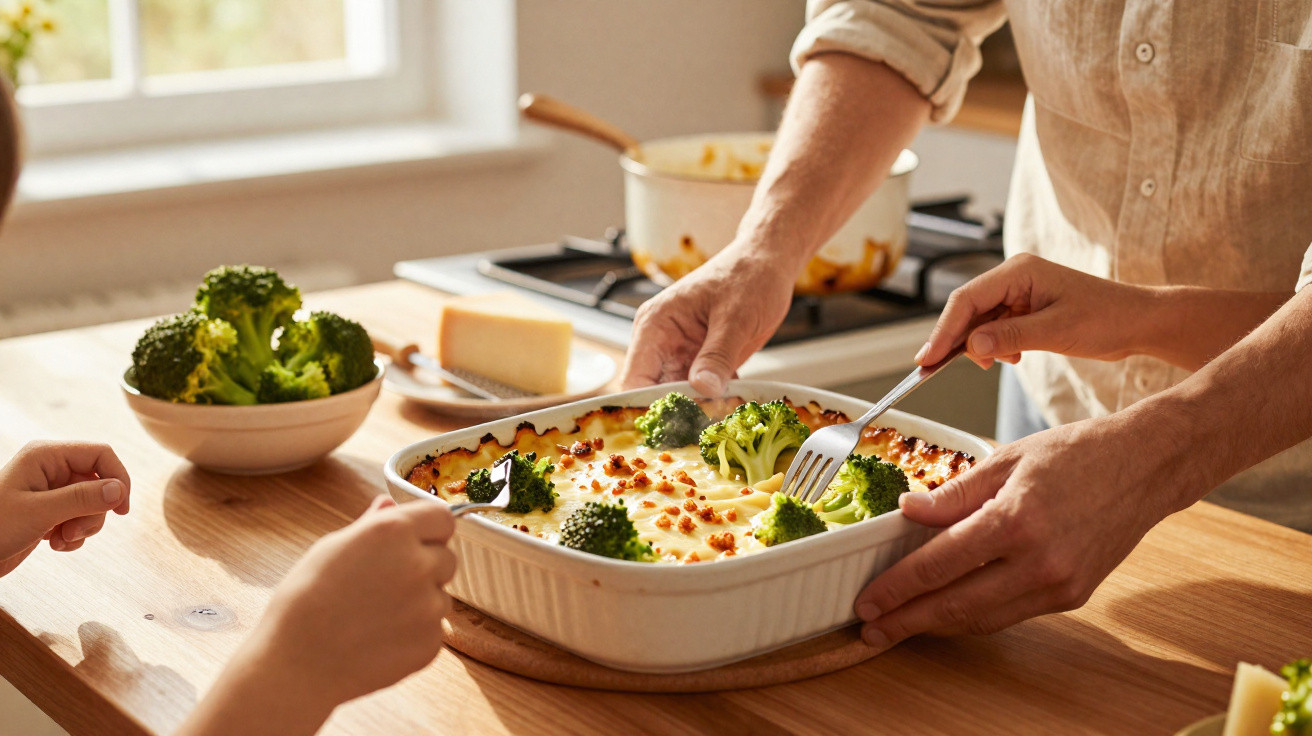
Rainy nights, exhausted children and a nearly forgotten broccoli in the fridge: this time, the ending is not what you expect.
Rather than serving another bowl of limp, overcooked vegetables, you bring a steaming bake to the table, fragrant with cheese and buttery breadcrumbs. Green florets sit in a velvety sauce beneath a crisp golden topping that crackles under the spoon. Somehow, the children are even asking for more.
A comforting answer to the “eat your greens” battle
Parents know this ritual all too well: steamed broccoli is shuffled to the side of the plate, bargaining begins, and the familiar “do I really have to?” expression appears. This gratin rewrites the routine, replacing the sense of obligation with the appeal of comfort food.
Instead of forcing vegetables, the gratin strategy makes broccoli the co-star of a dish people actually want to eat.
The principle is straightforward: let the vegetable remain the main feature, while pairing it with recognisable flavours and satisfying textures. A delicate béchamel coats every floret, cheese adds savouriness and richness, and the oven creates a gently crunchy finish. It feels like a warming winter bake rather than the chore of eating a “healthy side”.
What goes into this melting broccoli gratin
This recipe uses everyday ingredients that may already be in your kitchen. To serve four, you will need:
- 800 g broccoli, fresh or frozen
- 40 g butter, plus a little extra for greasing the dish
- 40 g plain flour
- 500 ml semi-skimmed milk
- 120 g grated cheese (such as Emmental, Cheddar or Comté)
- Salt and freshly ground black pepper
- A pinch of grated nutmeg, if you like
The balance matters: enough sauce and cheese to feel indulgent, but still clearly a vegetable-based dish.
These quantities make a hearty family bake, equally suitable for a weekday supper or as an accompaniment to Sunday lunch. The recipe can also be increased easily for a bigger family or for batch cooking.
Perfectly cooked broccoli: soft, not soggy
One stage determines whether this gratin succeeds: cooking the broccoli beforehand. The florets should become tender while retaining their vivid colour and a slight bite.
Preparing the broccoli step by step
- Divide the broccoli into small florets of a similar size, then rinse them in cold water.
- Bring a large saucepan of salted water to a vigorous boil.
- Add the florets and boil for 6–7 minutes.
- Test with the point of a knife: the stems should be soft but still have a little firmness.
- Drain immediately, then briefly rinse under cold water to halt the cooking and preserve the colour.
Butter an ovenproof dish lightly, then arrange the florets in one even layer. Do not squeeze them in too closely. Small spaces allow the sauce to run between them, creating that “all coated, nothing dry” result.
A light béchamel that still feels indulgent
Béchamel is often thought of as a heavy sauce, but it remains reasonably light in this dish. The key is to use sufficient butter and flour to thicken the milk without making the sauce overly dense.
Hob method
- Melt 40 g butter in a saucepan over a low heat.
- Tip in 40 g flour all at once, then whisk until it forms a smooth paste known as a roux.
- Slowly add 500 ml milk, whisking continuously so no lumps form.
- Bring the mixture to a low simmer and cook for several minutes, until it lightly coats the back of a spoon.
- Add salt, pepper and nutmeg to season.
When the sauce is finished, pour it evenly across the broccoli in the dish. Each floret needs to be partly covered, allowing the surface to brown while the bottom stays creamy.
Microwave shortcut
On especially hectic evenings, the microwave method is quicker.
- Melt 40 g butter in a large microwave-safe bowl.
- Whisk in 40 g flour until the mixture is smooth.
- Pour in the milk gradually, whisking after every addition.
- Microwave on full power for 2 minutes, whisk, then cook in further 1-minute intervals, whisking each time, until thick.
- Season in the same way as the hob version.
A simple white sauce turns steamed broccoli from “side dish duty” into something closer to a creamy pasta bake.
Cheese and oven time: where the magic happens
After the broccoli has been covered with sauce, finish it with a generous blanket of grated cheese. The topping supplies savouriness, aroma and the lightly chewy crust that has everyone returning to the dish.
- Smooth the sauce evenly across the broccoli.
- Scatter 120 g grated cheese over the top.
- Bake at 200°C (about 400°F) for 20–25 minutes.
The gratin is done once the top is richly golden and little bubbles are visible around the edges. Leave it to stand for five minutes before serving, so it sets slightly and is easier to cut into portions.
Smart twists to suit different tastes
When you have mastered the standard recipe, it is easy to tailor it for fussy eaters or to make use of fridge leftovers. Try these variations:
- More crunch: sprinkle crushed nuts or seeds over the cheese before baking to add texture.
- Protein boost: tuck strips of cooked ham, shredded chicken or leftover roast meat among the florets.
- Stronger flavour: replace some of the mild cheese with blue cheese, mature Cheddar or soft goat’s cheese.
- Extra veg: include cooked leeks, peas or finely sliced carrots for added colour and fibre.
One base recipe, several personalities: from simple weekday bake to richer weekend centrepiece.
How to serve broccoli gratin for a complete meal
This broccoli gratin can be served as either a main dish or an accompaniment. Here are several ways to present it:
- As a main: serve it with a crunchy green salad and crusty bread.
- With meat: offer it alongside roast chicken, grilled pork chops or baked fish.
- In smaller portions: use individual ramekins for an easy-going dinner-party starter.
| Occasion | Serving style |
|---|---|
| Busy weeknight | One big dish in the centre, with salad and bread |
| Family Sunday lunch | Side dish with roast meat and seasonal vegetables |
| Kids’ table | Smaller squares served with carrot sticks or cucumber |
Why children suddenly stop fighting the broccoli
From a sensory perspective, this gratin tackles several objections at once. Milk and cheese temper broccoli’s bitterness. Instead of being watery or stringy, the texture becomes creamy with a gentle firmness. Its aroma moves away from boiled-cabbage notes and towards something more like cheese on toast.
Getting children involved can make a difference, too. Letting them scatter the cheese, arrange the florets or taste the sauce for seasoning gives them a sense of participation. Many parents find that children who have helped prepare the food are more willing to try the final dish, even when its main ingredient is a “difficult” vegetable.
Nutrition, balance and a few practical tips
Nutritionally, this broccoli gratin is an appealing middle ground. Broccoli provides fibre, vitamin C and vitamin K, as well as plant compounds associated with a lower risk of some chronic diseases. Milk and cheese contribute calcium and protein, making the meal more filling.
Combining vegetables with protein and fat can make family meals both more filling and less confrontational.
For families keeping an eye on saturated fat or salt, a few simple adjustments help: choose semi-skimmed or skimmed milk, use a naturally flavoursome cheese so a smaller amount is needed, and be sparing with added salt. A side salad with olive oil and lemon juice brings freshness and balances the richness.
Any leftovers reheat successfully the following day, either in the oven or in a covered pan over a low heat. They will become a little denser in texture, which some people may prefer. You can freeze the dish too, as long as it is reheated gently and not frozen and thawed repeatedly.
From broccoli fear to broccoli habit
Once this gratin is a familiar favourite, many families use it as a starting point for reshaping views of other green vegetables. The same approach can be used with cauliflower, leeks, or broccoli combined with spinach. In time, it helps remove the idea that “green equals punishment”, making vegetables part of everyday comfort food rather than a category apart.
For parents caught in a battle over the vegetable drawer, moving away from plain steamed sides and towards a composed dish such as this may lower the tension at mealtimes. The broccoli is still there; it simply arrives in a more tempting outfit. That calm, unusual moment when nobody objects to the greens may well justify every minute spent whisking the sauce.

















Comments
No comments yet. Be the first to comment!
Leave a Comment