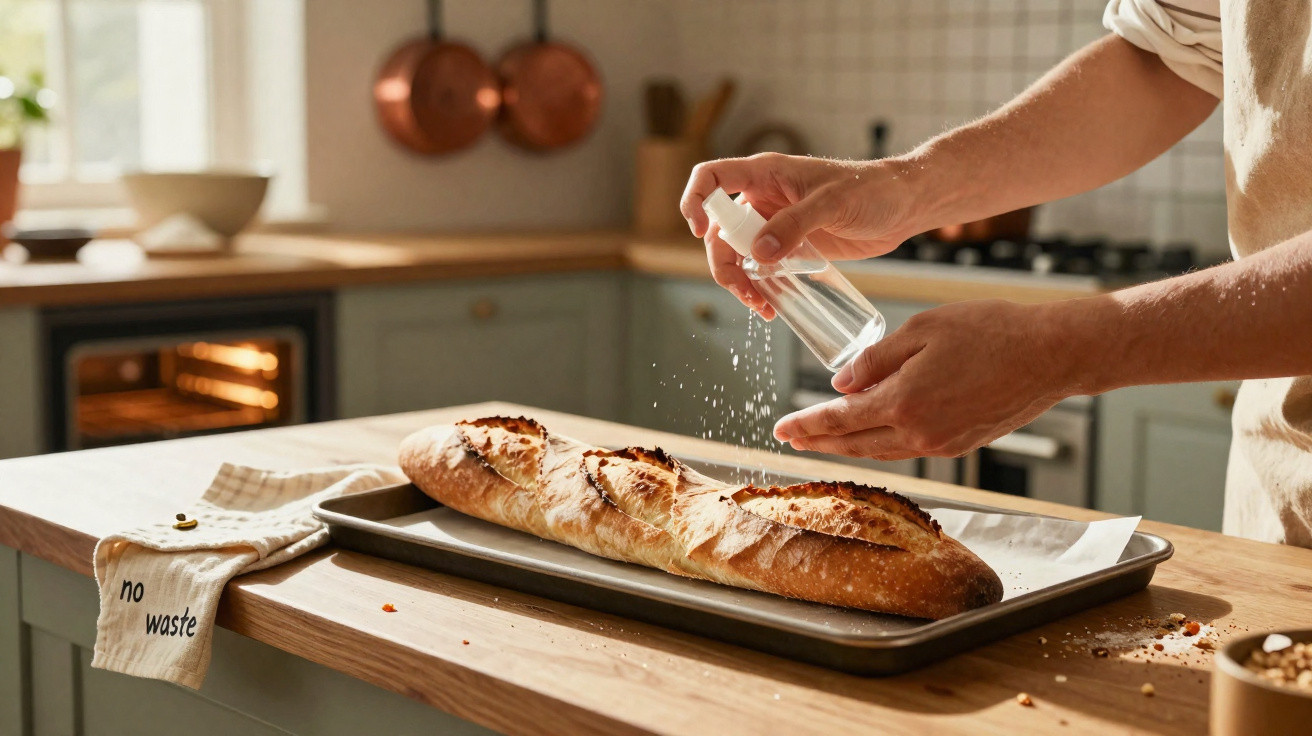
Last night, it was golden, crackly and full of promise. By this morning, it has become the sort of bread that could double as a doorstop. You pause, pressing the hard crust with your fingers, already aware of the result if you take a bite: crumbs everywhere and a serious workout for your jaw.
You think about the money lost, the meal you had planned and the small pleasure that fresh-bread crunch was meant to bring. Then something unusual happens. The baker at the end of the road notices you through the shop window, baguette in hand, and smiles as though he has witnessed this scene countless times.
He leans across the counter, drops his voice and reveals a technique you were probably never shown at home. It is a sort of understated magic trick.
The harsh reality of a “yesterday’s” baguette
The first surprise is usually the sound. Tap the baguette on the table and it sounds wrong: overly dry and almost hollow. Its crust no longer has that delicate crackle, while the crumb feels dense rather than light. When you cut it, the knife does not glide through; it has to saw.
At that point, most people surrender, choosing either the toaster or the bin. It can feel like a defeat. The romance of a French loaf is reduced to an everyday issue: bread that is slightly too old, slightly too miserable, and unwanted by everyone at the table.
One Parisian baker told me he can recognise the situation from the other side of the street. “You can see the shoulders fall from here,” he laughed, as he watched a customer prod a day-old baguette as though it might attack. During a busy weekend, he says that up to twenty people a day quietly ask whether there is a secret way to ‘save’ their bread.
He insists there is. His regular customers already know it, while others never ask and continue throwing their bread away. Supermarkets are not much help, either: wrapped baguettes go stale even more quickly, making a straightforward dinner a minor household let-down.
Technically, your baguette is not “dead”; it is dehydrated. As bread cools, water within the crumb moves around and the starches begin to recrystallise. This is what changes soft bread into firm bread, and eventually something rock-hard. Meanwhile, the once-proud, crisp crust becomes leathery as moisture leaves it.
The best bakers know that the process is not entirely irreversible. With warmth and the faintest touch of water, you can encourage the bread back towards its first-day texture. It is not everlasting youth, but it is a remarkably persuasive impression.
That is when this subtle little method comes into play.
The little-known baguette method: water, heat and restraint
This is what the baker does, and you can do the same in your kitchen. He takes the stale baguette and quickly runs it beneath a thin stream of cold water. It should not be bathed or soaked, only given a light rinse over the crust as you turn the loaf, much as you would rinse a piece of fruit.
For a moment, the baguette looks rather absurd: glossy and wet, like a dog caught out in the rain. He then puts it directly on the oven rack - not on a baking tray - and places it in a hot oven. A temperature of around 180–200°C (350–390°F) is suitable, using the centre of the oven with no fan required.
After seven to ten minutes, the loaf emerges changed. Its crust sings again under your touch, the crumb is warm and yielding, and a gentle bakery scent fills the kitchen. It’s not exactly day-one fresh, but it’s flirting with the memory of it.
There are pitfalls, naturally. The most common error is saturating the baguette. When it is soaked rather than lightly dampened, the crust may become rubbery before it can crisp up, while the middle remains strangely wet. Aim for a “fine mist”, not a “storm.”
Another mistake comes from worrying about the oven. People often fear burning the loaf, so they choose a low temperature and bake it for too long. This only dries the bread further. What you need is a brief, intense burst of heat, like a baker placing loaves in a hot deck oven and removing them just as they reach golden perfection.
The technique does have its limits. A baguette that is three days old and has been left uncovered in a dry kitchen will not return like Lazarus. This method is most effective on bread that is 12–36 hours old and still retains a little life. Let’s be honest: nobody really does this every day.
“Bread isn’t ruined when it stales,” says François, a Lyon baker with flour permanently on his forearms. “It’s just waiting for a second baking. People forget that baguettes meet the oven twice in their lifetime.”
His words may sound poetic, but they are also scientifically accurate. The small amount of water on the crust becomes steam in the oven, rehydrating its outer surface and restoring the delicate balance between crunch and softness. Inside the loaf, mild heat relaxes the starches and loosens the crumb.
- Use cold water for the quick rinse - warm water makes it easier to over-wet the bread.
- Put the baguette directly on the rack to allow heat to circulate around the entire loaf.
- Begin with 7 minutes, then inspect it every 2 minutes; your nose will tell you when it is ready.
More than a method: a small ritual against waste
Watching a dull, neglected baguette come back to life in the oven changes how you see leftover bread. The pressure in the kitchen eases. That rigid choice between “fresh or nothing” suddenly has another possibility.
On a weeknight, it can revive a soup that seemed too modest, or make a simple cheese plate feel like a proper dinner. On a Sunday, it can spare the final baguette from the bin and extend a meal for one extra friend who arrives unexpectedly.
On a deeper level, this small technique reduces the quiet guilt associated with wasting food. A single rinsed and rebaked baguette will not save the planet. However, it teaches your eyes and hands to attempt something before giving up: to test, restore and adapt.
We have all looked at leftover bread and thought, “I’ll deal with it later,” while knowing that we will not. This small baker’s hack does more than restore a crisp crust; it gives you one quick, practical action during the in-between moment when so much food is quietly wasted. It could be the start of a different kitchen habit, one crunchy loaf at a time.
| Key point | Detail | Benefit for the reader |
|---|---|---|
| Lightly rinse the baguette | Quickly run cold water over the entire crust | Turns a hard baguette into crisp bread again with minimal effort |
| Return it to a hot oven | Bake for 7–10 minutes at 180–200°C, directly on the rack | Restores a crunchy crust and a soft crumb, close to its “fresh from the bakery” state |
| Avoid common mistakes | Do not wet it too much or cook it for too long at a low temperature | Keeps the bread pleasant to eat and reduces food waste at home |

















Comments
No comments yet. Be the first to comment!
Leave a Comment