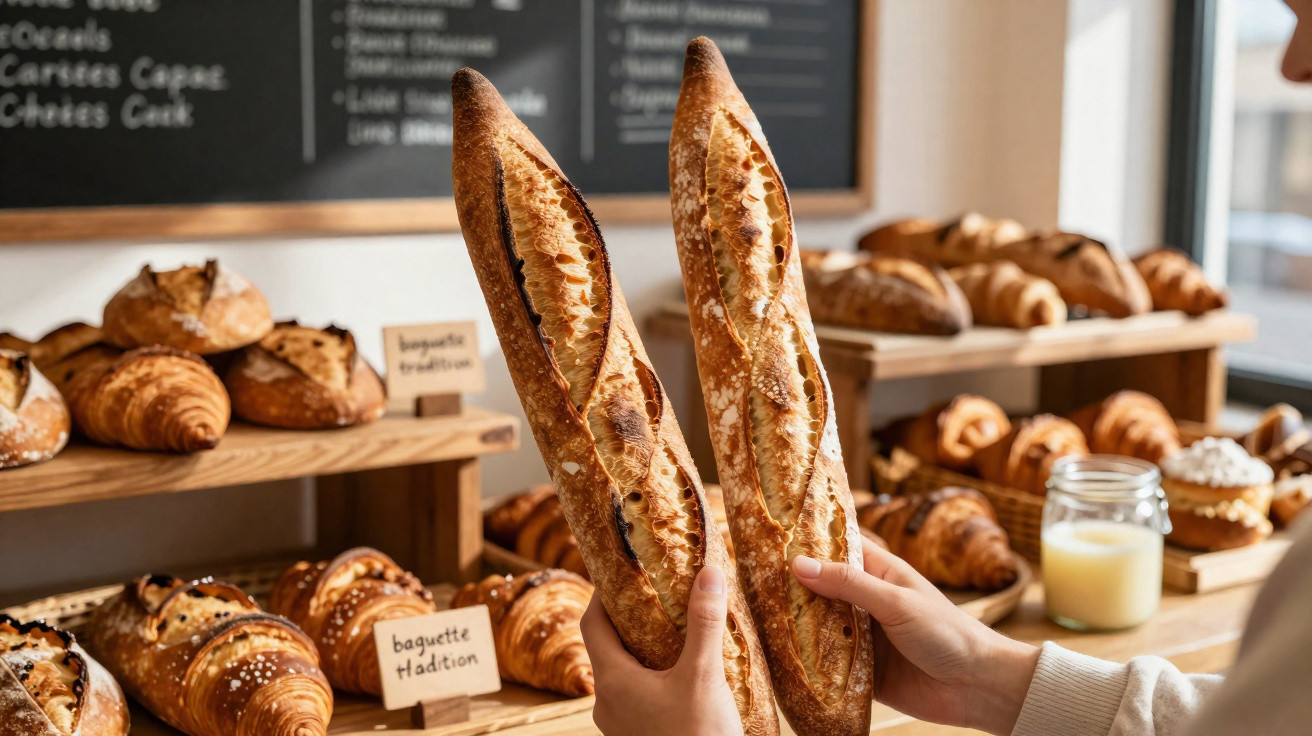
At the bakery counter, the two loaves can appear virtually indistinguishable.
But one slender baguette costs a little more, leaving regular customers to ask what justifies the difference.
On paper, the gap is small, yet it is noticeable: a standard baguette costs about €1.10, while the “tradition” version is €1.30. For people buying bread daily, those extra cents can add up, particularly when household food budgets are stretched. This seemingly minor difference reflects a tightly defined French legal rule, a distinct bakery process and genuine implications for flavour and health.
What “tradition” means in French bakeries
In France, pain de tradition française is more than an evocative description: it is a legally defined category established by decree n°93‑1074 of 13 September 1993.
The word “Tradition” on the label is protected by law and refers to a specific recipe and method, not a marketing mood.
The decree requires the dough to contain only:
- breadmaking wheat flour
- drinking water
- table salt
- yeast and/or natural sourdough (levain)
Tiny quantities of fava bean flour, soya flour or malted wheat flour may also be used. Nothing further is permitted: no additives intended to make dough easier to process, no preservatives to extend storage life and no artificial colours intended to create a golden-looking crust.
There is another important requirement: the dough must never be frozen or deep-frozen. Mixing, shaping and baking all have to be carried out on the premises. This differs sharply from many standard baguettes, which can be made industrially, frozen, transported nationwide and completed in a basic bake-off oven in a supermarket or petrol station.
Terms such as “farmhouse”, “rustic”, “country-style” and “old-fashioned” may sound attractive, but they offer no assurance about freezing or additives. Only “Tradition” and pain de tradition française are governed by the 1993 rules.
Why a tradition baguette costs more
French artisan bakers commonly price a standard white baguette at €1 to €1.10, whereas a tradition baguette generally costs €1.25 to €1.40. A difference of 20–30 cents may seem limited, but becomes more significant over time.
| Consumption | Extra cost for tradition (approx.) |
|---|---|
| 1 baguette per day | €6 to €9 per month |
| 2 baguettes per day | €12 to €18 per month |
What, then, do those additional cents pay for?
Most of the price difference comes from time and labour, not from more expensive ingredients.
Broadly, the price of a baguette is divided as follows:
- around 42% for wages and social charges
- about 24% for ingredients, including flour, yeast, salt and water
- roughly 16% for rent, equipment and other fixed expenses
- around 6% for energy, such as electricity and gas
- about 2% for packaging
- close to 10% for the bakery’s margin
Flour for a tradition baguette is not necessarily vastly more expensive. Time is the key distinction. Its dough often undergoes a long fermentation known as pointage long, resting for 15 to 20 hours at a low temperature. By comparison, a standard baguette may go from mixing to baking in just 3 to 4 hours.
This longer production timetable demands greater planning, more handling at different dough stages and more regular baking runs to keep fresh bread available through the day. Employees may start earlier or work later, while ovens remain in use for longer. These practical demands are reflected in the price.
How long fermentation changes flavour and texture
Slow fermentation is not merely a traditional touch: it alters the bread itself. During the resting period, natural enzymes and yeasts break down some of the starch and gluten. Flavours develop, while organic acids form and gently reshape the taste.
A well-made tradition baguette tends to be more aromatic, easier to digest and slower to go stale than a standard baguette.
Inside the loaf, known as the crumb, you will usually find:
- a creamy or pearly shade rather than stark white
- uneven air holes, with both large and small pockets instead of a uniform sponge-like structure
- a lightly springy texture that pushes back when bitten before softening
The crust is generally thicker, well caramelised and distinctly crisp, ranging from golden brown to deep brown. This results from both the prolonged fermentation and proper baking, rather than simply reheating frozen dough.
Many people say they feel “less heavy” after eating a tradition baguette. Some nutritionists suggest that the partial gluten breakdown during lengthy fermentation may help explain this. It is not suitable as a solution for coeliac disease, but it may be more tolerable for people with mild sensitivities.
Checking that a tradition baguette lives up to its name
Not every loaf sold as “tradition” will be exceptional. Some may be rushed or insufficiently baked. If you are paying more, several simple checks can help establish whether it is worthwhile.
Visual and sensory signs
Assess the loaf with your eyes and hands before buying:
- Crumb colour: off-white and faintly creamy, never bright paper-white.
- Structure: an active, irregular spread of air holes rather than a close, consistent grid.
- Crust: thick, crackly and properly firm, not soft or rubbery.
- Aroma: a noticeable scent of wheat with mild acidity, rather than a neutral or strongly yeasty smell.
Naturally, check the label too: it should specifically state “Tradition” or pain de tradition française. In a supermarket, that wording on the shelf label is the legal point of reference. At an artisan bakery, it is worth asking how long the dough is fermented and whether all baking takes place on site.
When a classic baguette remains the sensible option
For certain meals, the extra spend is not always needed. If you are making a large batch of ham-and-cheese toasties for hungry teenagers, a more basic baguette may do the job perfectly well. It absorbs sauces readily, toasts easily and costs less when bought in volume.
A tradition baguette comes into its own when bread is a main part of the meal: alongside cheese, charcuterie, a quality soup, or simply butter and jam. Its fuller flavour and robust crust are particularly valuable in those situations.
Health considerations: additives, fullness and blood sugar
The legal prohibition on additives in tradition baguettes is another reason buyers may deliberately choose them. Standard industrial baguettes can include authorised “improvers”, which are used to make dough more stable, bread softer or its shelf life longer.
Although these ingredients are considered safe at regulated levels, many consumers favour a shorter list of ingredients. Tradition bread provides that reassurance: flour, water, salt, yeast or levain, with nothing else of significance.
Bread fermented slowly also usually produces a slightly lower glycaemic response than loaves raised very quickly. The change is not substantial, but alongside a balanced meal it may help reduce sharp blood sugar rises. Having bread with fat or protein, such as cheese, olive oil or eggs, slows absorption further.
Bakery terms worth knowing
French bakers frequently use technical language that may sound unfamiliar. These terms can be useful when choosing bread:
- Levain (sourdough starter): flour and water fermented naturally by wild yeasts and bacteria, adding acidity and complex flavour.
- Pointage: the principal fermentation stage after kneading and before shaping.
- Apprêt: the final proof before baking, during which shaped loaves rise.
- Hydration: the proportion of water to flour in dough. Higher hydration generally creates a more open, airier crumb.
A baker using a tradition recipe alongside natural levain and long pointage is putting substantial skill and time into an apparently simple loaf. That is what your 20 cents help to cover.
When the price difference becomes significant
For a French family purchasing two tradition baguettes every day, choosing them over classic baguettes can readily increase the food budget by €15 each month. Across a year, that approaches €180 - enough for a short break or a generous restaurant meal.
Some households take a mixed approach:
- tradition baguettes for weekend meals and visitors
- standard baguettes for weekday sandwiches and toast
- bigger country loaves, which are often better value per kilo, for bread that lasts longer
Thinking about bread in this way makes the 20 cents a deliberate decision rather than an automatic expense. You can choose when flavour and craftsmanship matter most, and when a simpler loaf will do.

















Comments
No comments yet. Be the first to comment!
Leave a Comment