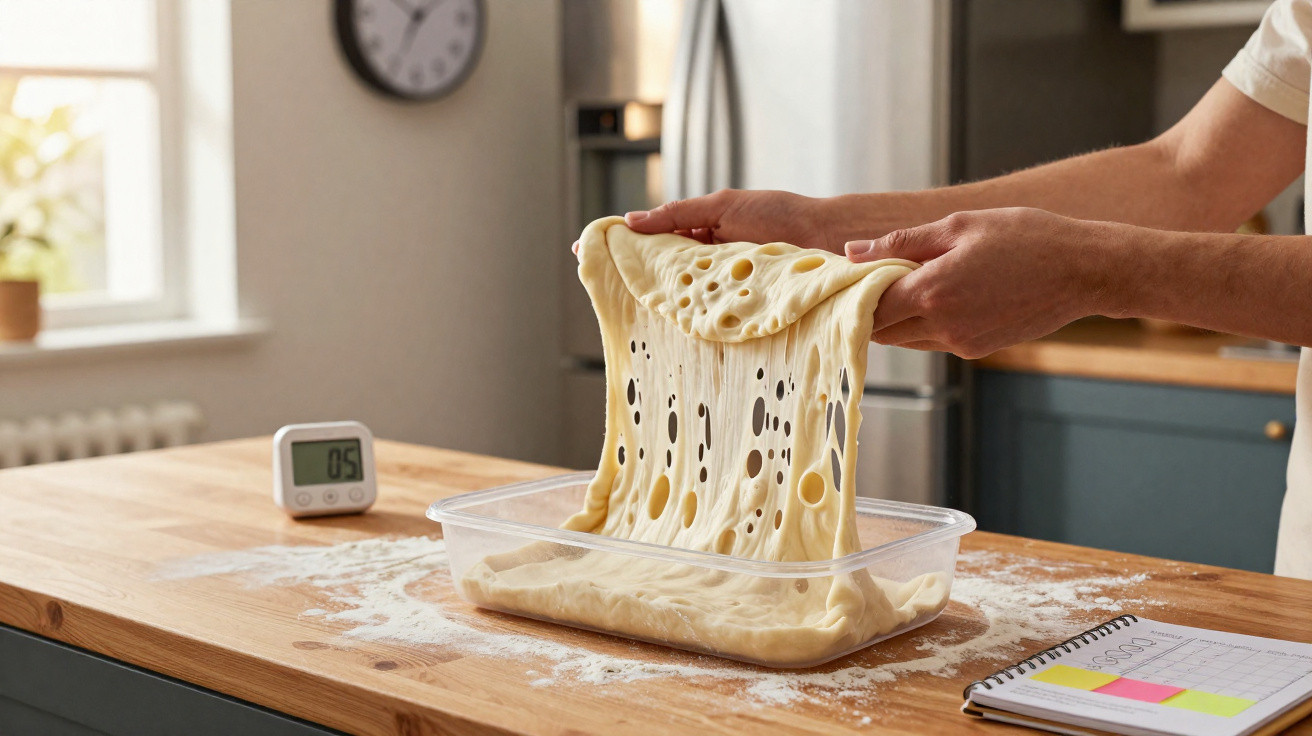
The dough felt… wrong. You followed the recipe, weighed the flour and even treated yourself to that posh Italian yeast. Yet the dough beneath your fingertips was obstinate and heavy, like an exhausted rubber band.
You pull it out and it snaps back. You leave it alone and it splits. The baked pizza is pale and bread-like, with none of the airy, leopard-spotted character of the slices from your favourite local place.
Soon, you begin to wonder whether you are simply “bad at baking”, or whether those flawless Instagram pizzas are some filter-assisted con.
Then one evening, you alter the dough schedule by a few hours.
Something subtly magical follows.
Why pizza dough feels wrong when the recipe seems right
Most homemade pizza dough problems begin well before the oven is switched on. They arise during the quiet stretch between mixing and baking, when the dough should be resting, loosening and gradually changing.
In theory, it all appears correct. The recipe calls for a “1 hour rise” or says to wait “until doubled”, and the dough in your bowl more or less does that. You can tick it off and carry on.
But when you handle it, the dough is firm and almost stressed, as though it has no interest in cooperating. It pushes back as you stretch it, tears around the edges and will not puff up as you hoped.
That difference between its appearance in the bowl and its feel on the worktop is the important clue.
Imagine it is Friday evening, you are worn out and you want pizza quickly. You combine the dough at 6 p.m., knead it for a few minutes and leave it somewhere warm; by 7:15, it has become soft and noticeably enlarged.
You think, “Great, that was quick”, form it into a round, add your toppings and bake it. The crust colours, the cheese blisters and the kitchen smells brilliant.
Then you take a bite.
Rather than a light, open crumb, the base is compact and slightly chewy in an unpleasant way. The edge appears puffed up, but tastes bready and nearly raw in the centre. You have fallen into the familiar trap: rapid volume, no flavour and a structure that did not have time to form.
The explanation is straightforward: the dough’s timetable is not the same as the recipe’s timetable. Yeast acts quickly, while gluten takes longer to relax. A warm kitchen and vigorous yeast can make dough visibly rise at speed, even though its interior is still insufficiently developed.
You see a large, inflated ball and assume it is ready, but the gluten network has not yet had time to arrange itself, soften and turn elastic.
Flavour also relies on a gradual fermentation. Aromas develop across hours rather than minutes. A dough that rises too fast is like a story with no middle - it goes straight from beginning to end without depth.
You are not bad at making pizza; your timing is simply out of step.
The simple pizza dough timing trick that changes everything
The understated change that turns disappointing homemade dough into the sort that makes you ask “did I actually make this?” is to prepare it early and slow it down in the fridge.
Rather than beginning an hour before dinner, make the dough in the morning. Better still, make it the previous night. Add only a very small amount of yeast, knead or fold it briefly, then place it in a lightly oiled, covered container and leave it in the cold.
Cold fermentation allows the dough to rise gradually and gently. The gluten can relax, the yeast can create flavour, and the resulting dough is smooth and extensible rather than tense and irritable.
The contrast beneath your hands the following day can be remarkable.
There is a second, smaller timing adjustment within this larger one: allow the dough to rest immediately before stretching it. Remove the chilled dough from the fridge 60–90 minutes before baking. Split it into balls and leave them on the worktop under a light cover.
This brief proof brings the dough closer to room temperature and lets it relax. Shape it directly from the fridge and it will resist you. Leave it out for too long and it will spread and become slack.
That period when the dough is supple, pulls out without splitting and does not spring back too sharply? That is the sweet spot you have been missing.
Honestly, no one manages this every single day.
But when you do, the dough no longer feels wrong.
The most frequent error is to treat proving time as an exact figure rather than an adaptable range. Dough that doubles in 1 hour in a hot August kitchen may require 3 hours in January.
Another issue is hurrying because you are hungry or visitors are about to arrive. The dough starts to grow and feels a little sticky, and you worry: “If I don’t use it now, it’ll collapse.” You then shape it too early, bake it too early and blame yourself.
Try to be kind to yourself here. You are not running a pizzeria with a dough timetable on the wall and a proving cabinet humming nearby. You are someone trying to coordinate dinner, work, children and a ball of flour and water with a personality of its own.
That is why a fridge and a useful timing window protect your sanity.
Sometimes, a pizzaiolo in Naples will touch a dough ball for half a second and say, “Not yet, it’s still nervous.”
That’s really what we’re chasing at home: a dough that’s no longer nervous.
- Start early – Prepare the dough 12–24 hours before baking and reduce the yeast to a pinch.
- Let the fridge do the work – Allow the dough to rise slowly in the cold rather than speeding along at room temperature.
- Give it a pre-bake rest – Remove it 60–90 minutes before shaping so that it can relax.
- Touch, do not only look – Judge it by feel: soft, airy and slightly wobbly is better than “perfectly doubled.”
- Trust the dough’s mood – If it springs back firmly, let it rest; if it spreads excessively, chill it for a short time.
Let pizza dough follow its own clock
When you stop making pizza dough obey a rigid timetable and begin paying attention to what it is actually telling you, the process feels much easier.
You start to notice how properly rested dough quivers faintly when the tray is shaken. You recognise the way it stretches like warm chewing gum rather than ripping like dry paper. Its scent changes too, from plain flour into something almost yoghurt-like: softly fermented and alive.
Over time, you develop your own internal clock. Instead of fixating on a “1 hour rise”, you begin thinking, “I’ll mix it tonight, shape it tomorrow, and we’ll eat when the dough feels happy.”
We have all experienced that point when dinner is delayed, everyone is hungry and the dough refuses to cooperate.
The straightforward timing trick of starting sooner, slowing the process and giving the dough space to breathe does more than improve texture. It changes how you relate to this small mixture of flour, water, salt and time.
You may begin to wonder what else could change if you stopped rushing the rise.
| Key point | Detail | Value for the reader |
|---|---|---|
| Cold fermentation | Rest dough in the fridge for 12–24 hours using less yeast | Enhances flavour and makes the dough simpler to stretch |
| Room-temperature window | Take the dough out 60–90 minutes before shaping | Avoids tearing and stubborn spring-back |
| Feel over recipe timing | Assess softness, stretch and a gentle wobble, rather than only “doubling” | Produces more reliable results across different kitchens and seasons |

















Comments
No comments yet. Be the first to comment!
Leave a Comment