The first time I made this light apple cake with oil and yogurt, it was a Tuesday night and everybody was weary and slightly irritable. It was one of those evenings when you look in the fridge at a couple of forlorn apples and half a tub of yogurt, thinking, “Well, that’s not dinner.” The oven was cold, the washing-up was piling up, and beating butter and sugar for ten minutes sounded like an especially unfunny joke.
Instead, I combined oil, yogurt, eggs and flour in a single bowl, cut the apples straight over the mixture and put the lot in the oven.
By the end of the news, the kitchen had the scent of an autumn market. Nobody questioned what it contained. They simply ate it.
That is when the story behind this “effortless” cake becomes rather more interesting.
Why this light apple cake replaces more complicated desserts
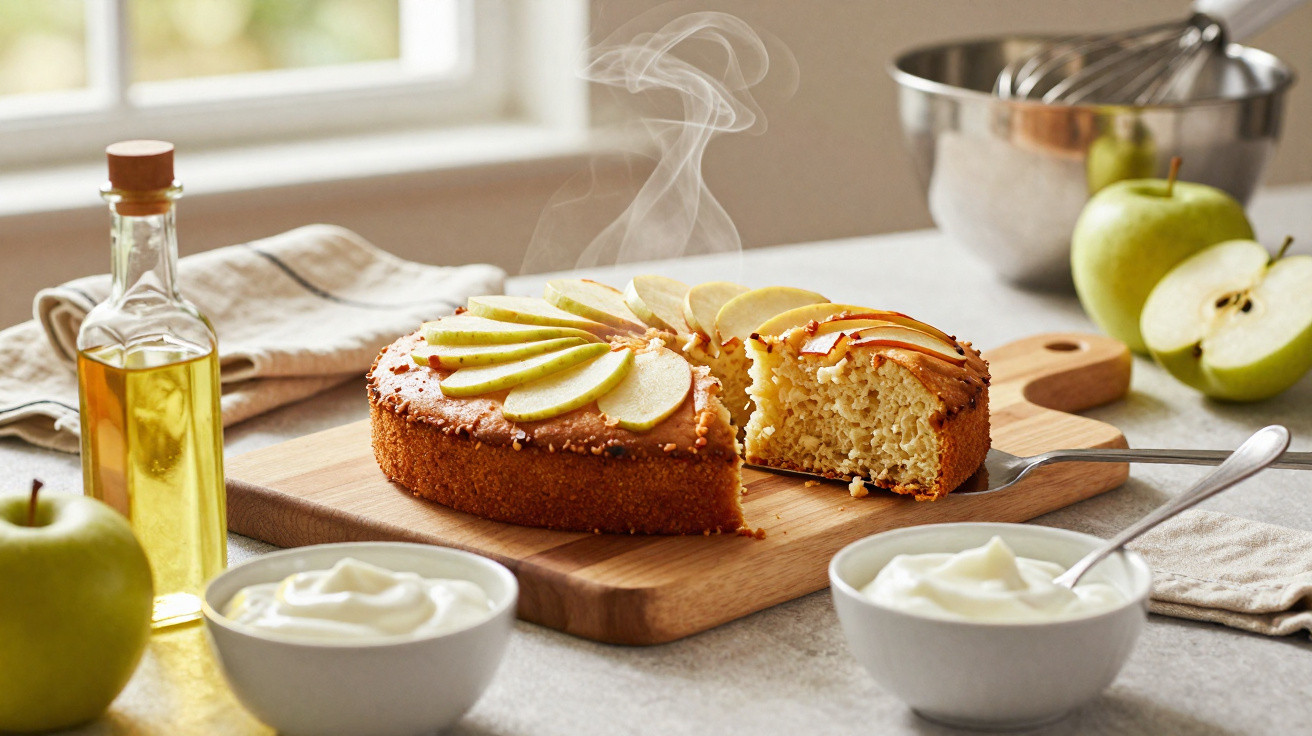
This cake makes no grand entrance. It does not bake into a flawless dome, come in three tiers or wear a shiny mirror glaze. Instead, it emerges looking almost modest: pale golden, with fine apple slices gently curled at the edges as though waking from a nap.
Cut into it while it is warm and you will find a tender, airy crumb, close to a yogurt sponge. It is sweet enough without being overly so, subtly sharp, and scattered with soft apple pockets that melt rather than squeak under your teeth. It is the sort of pudding people eat quietly, before returning for “just a sliver”.
Its appeal lies in how naturally it fits into ordinary life. There is no need for softened butter, specialist kit or a free afternoon. All you need is one bowl, a whisk and the kinds of ingredients found in a typical kitchen: plain yogurt, neutral oil, sugar, eggs, flour and whichever apples happen to be in the fruit drawer.
One friend says she prepares it while her Sunday-morning coffee is brewing. Another makes it at 11 pm, using up bruised apples before going on holiday. It slots into the gaps in real-life routines, which is why people bake it repeatedly, long after the “Pinterest cakes” are forgotten.
There is also a little unobtrusive food science behind its simplicity. Oil creates a tender texture without the waiting period required by butter, while helping the crumb remain soft for days. Yogurt contributes moisture and mild acidity, allowing the cake to rise lightly rather than becoming dense, even with less fat.
Apples offer more than flavour, too. Their own juices and pectin form small creamy pockets throughout the crumb. The result is that “how can this be so moist and airy at once?” quality usually associated with bakery cakes. It feels lighter to eat but remains unexpectedly satisfying, much like a good breakfast cake.
The simple method that makes this light apple cake hard to get wrong
The core process is almost absurdly simple: whisk the wet ingredients, fold in the dry ones, then add apples. Begin by briefly whisking together the eggs and sugar until they become slightly paler and looser. You are not trying to make a meringue; you are merely bringing them to life. Then gradually add the oil, followed by the yogurt and a little vanilla or lemon zest.
Once the wet mixture is smooth and creamy, sieve the flour, baking powder and a pinch of salt directly into the bowl. Use a spatula to fold everything together with broad, gentle strokes, stopping as soon as no dry patches remain. Transfer the batter to a lined tin, arrange the apple slices over the surface or stir them in, and the job is essentially done.
Most problems arise not from the recipe but from overlooked details. Mixing until the batter becomes elastic, using very wet apples without drying them first, or raising the temperature to “speed things up” can all take away its lightness. When you are tired, it is easy to turn up the oven and hope for the best.
Be gentle with both yourself and the batter. If possible, use yogurt at room temperature so that the mixture does not seize. Keep the apple slices fairly thin, allowing them to soften at the same pace as the crumb bakes. If the top colours before the middle has set, a loosely placed sheet of foil is a discreet and useful ally.
There is something particularly reassuring about a recipe that does not punish slightly relaxed measuring. This is one of those cakes that tolerates an additional spoonful of yogurt or an egg that is a little smaller than usual. As one home baker said after making it for five consecutive weekends:
“It tastes like I tried hard, on a day when I honestly didn’t.”
That sensation is part of the recipe as well. You notice the softness and the lightness, but also the relief of making a dessert that asks you to prove nothing.
- Choose a neutral oil, such as sunflower, rapeseed or light olive oil, for a clean and delicate flavour.
- Pick firm apples, such as a mix of Gala, Pink Lady and Granny Smith, so they retain their shape rather than turning mushy.
- Mix only until the ingredients come together; a few tiny lumps are preferable to a tough, overworked crumb.
- Leave the cake to stand for 10 minutes after baking, allowing the moisture to redistribute and the slices to hold their shape.
A cake made for weekday life
In practical terms, this light apple cake becomes less of a “recipe” and more of a routine. You might bake it for a child’s lunchbox, take something to a colleague who has just had a baby, or eat it with yogurt on a hurried morning. A batch can sit in a tin on the worktop and stay soft and fresh enough for two or three days, without any fuss.
There is a quiet emotional element in it as well. On a dull afternoon, when the house feels stuffy and the to-do list seems demanding, whisking oil, yogurt and flour together becomes a small act of resistance. You are not creating an Instagram showpiece; you are making the kitchen smell lovely for the people who actually live in it.
We have all experienced desserts feeling like a test: a measure of how elaborate, how “healthy” or how original you can be. This cake steps away from that pressure. It is lighter, certainly, because yogurt and oil replace some of the usual fat, but it does not make a fuss about it. You eat a warm slice from your hand, perhaps standing by the sink with crumbs on your fingers, and it simply feels… normal.
Let’s be honest: nobody really makes the whole perfectly plated dessert every day. What we can manage, however, is a one-bowl cake waiting on the worktop like a quiet promise that, at least tonight, will finish sweetly. Sometimes that is more than enough.
Recipes like this tend to spread. Someone posts it in a group chat with three words: “So easy. Works.” Someone else adds cinnamon, replaces some flour with ground almonds or throws in a handful of raisins. Before long, it has become half a dozen related cakes, all light and all built around oil, yogurt and apples.
The formula is flexible enough to cope with surprises: a little less sugar for a mildly sweet result, some wholemeal flour for extra texture or even lactose-free yogurt if that is what is in the fridge. The underlying idea remains the same: minimum effort and maximum comfort. It is not miraculous; it is simply a clever way to let everyday ingredients create a little magic together.
| Key point | Detail | Benefit for the reader |
|---|---|---|
| Oil instead of butter | Keeps the crumb soft, moist and easy to mix in one bowl | Makes the cake quicker to prepare and lighter in texture |
| Yogurt-based batter | Adds gentle tang and helps the cake rise airy, not dense | Delivers a “light but satisfying” dessert that feels less heavy |
| Everyday ingredients | Uses basic cupboard staples and a couple of apples | Allows spontaneous baking on busy evenings or lazy mornings |

















Comments
No comments yet. Be the first to comment!
Leave a Comment