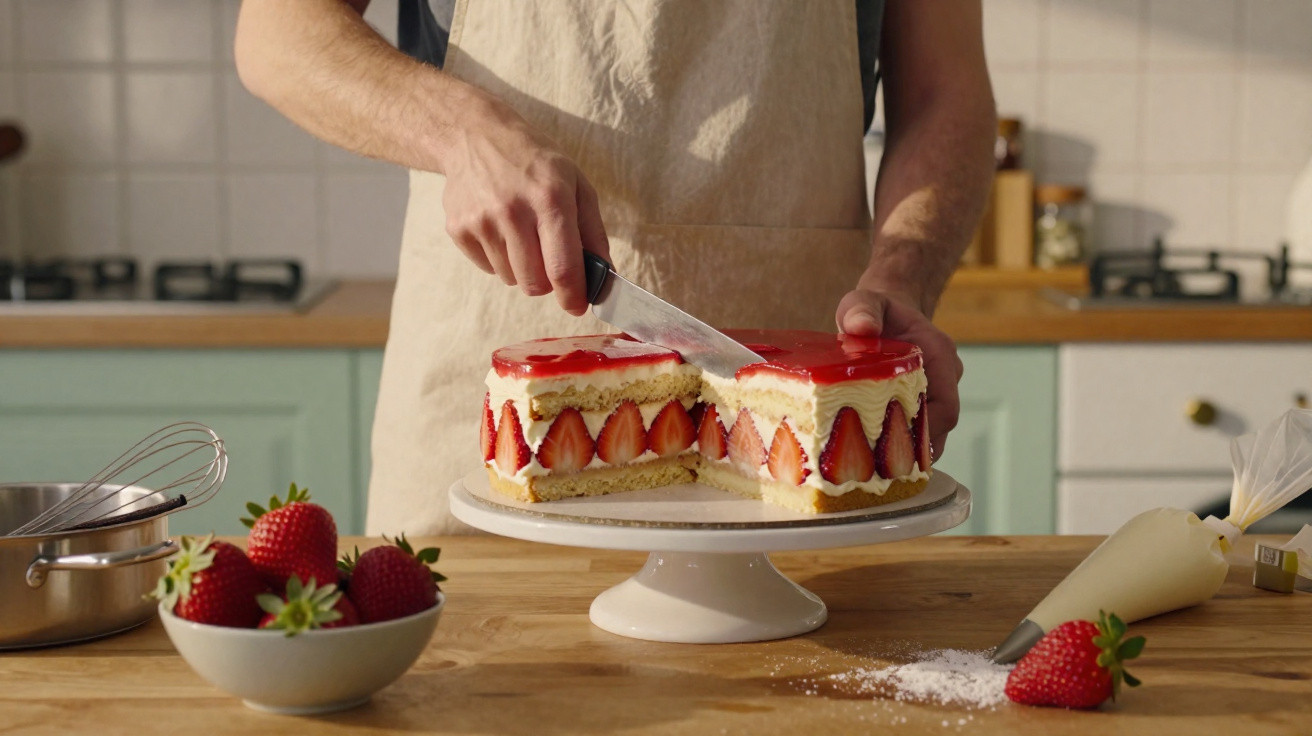
Fresh strawberries, tender sponge and smooth cream: this bakery-style centrepiece may look daunting, but home bakers are quietly learning to make it every weekend.
The traditional French fraisier has travelled from professional pastry kitchens into domestic ovens, helped along by social-media clips and television baking competitions. Beneath its glossy red finish is a carefully ordered process which, when divided into stages, feels more like construction than culinary magic.
Why this classic French cake is trending again
The fraisier is far from new. French pâtisseries have offered it for decades, often as the “serious” birthday cake for adults who consider buttercream cupcakes overly sweet. What is different now is who is baking it and where it is being seen.
Across TikTok and Instagram, home bakers capture close-up footage of its recognisable cross-section: strawberries arranged in a precise ring against a clear strip, pale mousseline cream keeping the layers steady, and a slim golden sponge layer above. That upright pattern works as an instant visual draw. Viewers often share the video before they have even looked up the recipe.
One clean slice of fraisier reveals if the baker controlled texture, timing and temperature from start to finish.
Food retailers have responded to the trend. Supermarkets in the UK, the US and Canada now promote seasonal “strawberry celebration cakes” that visibly take inspiration from the fraisier formula: sponge, vanilla cream, exposed berries and a glossy coating. Even so, many enthusiastic cooks favour making the original version at home and adapting it to their own tastes.
From pâtisserie counter to home kitchen
In commercial pastry kitchens, a fraisier depends on three technical essentials: génoise sponge, crème mousseline and a firm assembly ring. The home-baked approach follows that same principle, simply in a smaller and more streamlined form.
Three pillars of a “wow” fraisier
- A light génoise: whole eggs beaten with sugar before flour is folded through, with no chemical raising agent.
- Crème mousseline: a rich whipped filling made from pastry cream and softened butter, with enough strength to remain upright.
- Precise assembly: halved strawberries arranged around the ring, cream pressed into every space and sponge layers cut to size.
These components are not novel on their own, but together they produce something of an “engineering dessert”. The sponge provides the framework, the cream becomes edible cement, and the strawberries create visible supports around the outside.
Think of a fraisier as a small architectural project: if one layer fails, the whole slice slumps on the plate.
Step-by-step: how home bakers simplify the fraisier
The basic technique remains close to the traditional recipe, although online baking communities have developed shortcuts and safeguards that make it easier to tackle.
1. The pastry cream base
Most bakers begin with standard vanilla pastry cream. Milk is heated with a split vanilla pod, then whisked into egg yolks, sugar and starch. Stirring continuously over a medium heat prevents lumps and transforms the mixture into a thick, glossy cream.
Placing film directly “on contact” with the cream prevents a skin from developing and retains moisture where it should be. Once cold, this mixture becomes the foundation of the mousseline.
2. Whipping a dependable génoise
The sponge seems straightforward yet leaves little room for error. A génoise rises solely through air whipped into its eggs. Underwhip the mixture and the cake remains flat; fold in the flour too forcefully and the trapped air disappears.
Online guidance often focuses on timing: roughly five minutes of whisking the eggs and sugar at high speed, then carefully folding in sifted flour with a spatula. When baked in a tin smaller than the finished cake ring, the sponge can be neatly trimmed and, once cooled, split into two discs.
3. A quick soaking syrup
A basic syrup of heated water and sugar tackles one frequent issue: dry sponge. Generously brushing each génoise disc restores moisture to the crumb and adds flavour, particularly when a spoonful of rum, kirsch or strawberry juice is included.
The heart of the cake: crème mousseline
The cream is where many home versions fail. Mousseline lies somewhere between pastry cream and buttercream. It needs sufficient butter to keep its form, but not so much that it becomes greasy. Managing temperature is central to achieving that balance.
Pastry cream should feel cold but pliable, and butter should press easily under a finger without melting.
When both elements have a matching texture, the mixer takes over: pastry cream returns to the bowl, softened butter is gradually added, and the mixture is whipped until pale and able to leave firm tracks from the whisk. This is the visual sign that the cream will hold inside the ring rather than slide away.
Mousseline versus lighter options
| Type of cream | Components | Texture | Best use |
|---|---|---|---|
| Crème mousseline | Pastry cream + butter | Dense, smooth, holds sharp edges | Tall cakes, neat slices, strong structure |
| Diplomat cream | Pastry cream + whipped cream | Lighter, airy, less stable | Trifles, verrines, lower cakes |
Some home bakers opt for diplomat cream because it feels lighter in the mouth, but many return to mousseline when they want a “wow” slice that stays tall on the plate.
Assembly: where aesthetics meet physics
Most of a fraisier’s visual impact comes from the side. For that reason, how the strawberries are cut and arranged matters just as much as how they taste.
Building the strawberry wall
Once a 20 cm pastry ring is lined with acetate or an equivalent strip, bakers position the first sponge disc inside and brush it with half the syrup. The detailed arrangement then begins: halved strawberries are placed cut-side firmly against the lining to create a close-fitting ring.
Even a small space will be visible in the finished cross-section, so bakers commonly spend time selecting similarly sized fruit and adjusting each piece. The remaining chopped strawberries are scattered through the middle and covered in cream.
A well-packed ring of berries does more than look pretty; it helps lock the structure in place.
Layering cream and sponge
Crème mousseline is first worked into the spaces between the strawberries, before being spread across the full surface. The sequence is important: unfilled gaps around the sides can cause the cream to leak or the cake to lose its shape when the ring is removed.
The second syrup-soaked sponge disc closes the cake. Light pressure forces cream upwards against the inside wall, creating the tidy, level edge seen later. A final fine layer of cream is smoothed over the top before the cake is chilled.
The glossy top and the social media moment
Many modern versions use a straightforward strawberry jam glaze to finish the cake. Briefly warmed in a microwave and strained, the loosened jam flows easily over the cold surface and settles into a glossy coating. Some bakers choose icing sugar instead, while others arrange freshly sliced strawberries in a relaxed design.
Recipe cards rarely dwell on the final stage, but it dominates phone screens: the first slice. A sharp knife, briefly warmed under hot water and dried, cuts cleanly through the chilled cake. Filming that side-on moment has become a mini-genre in online food content.
Why the fraisier suits today’s home-baking culture
Its appearance is not its only appeal. The cake fits modern cooking habits: it makes use of seasonal fruit, rewards preparation and feels celebratory without relying on expensive ingredients. Flour, milk, eggs, butter, sugar and fresh strawberries are affordable for most home baking budgets, especially when berries are plentiful.
It also supports the gradual development of skills. A baker familiar with brownies can progress to whipping a génoise. Someone who regularly makes simple custard can advance to pastry cream and mousseline. These same techniques can then be used for other classic desserts, including charlottes, entremets and fruit tarts with stable fillings.
Practical tips, risks and smart variations
Pastry instructors and experienced bloggers regularly offer troubleshooting guidance, as several things can still interfere with achieving that clean slice.
- Risk of collapse: putting the cake together while the cream remains warm, or serving it before it has chilled for at least four hours, causes layers to sag.
- Fruit bleed: very soft or overripe strawberries release juice into the cream, staining it and compromising its structure.
- Rubbery sponge: baking the génoise for too long or leaving out the soaking syrup results in a dry base that clashes sharply with the soft filling.
- Temperature shock: keeping the cake towards the back of a very cold fridge can make the butter in the mousseline excessively firm, reducing its pleasant texture.
There is also plenty of scope for creativity. Some bakers replace part of the pastry cream milk with strawberry purée, or flavour the syrup with basil or elderflower. Others make individual mini-fraisiers in metal rings for picnics or buffets, neatly matching the current preference for single-serve desserts.
For those learning pastry, the fraisier works as a compact masterclass. It teaches custard-making, sponge technique, syrup balance, gravity-conscious assembly and cold-setting timing. The same principles can even be applied to savoury layered dishes: vegetable terrines and stacked sandwiches rely on similarly structural thinking, just without the sugar. Provided each layer adds flavour and the “cement” holds, the finished slice will always prompt a quiet “wow” when it reaches the plate.

















Comments
No comments yet. Be the first to comment!
Leave a Comment