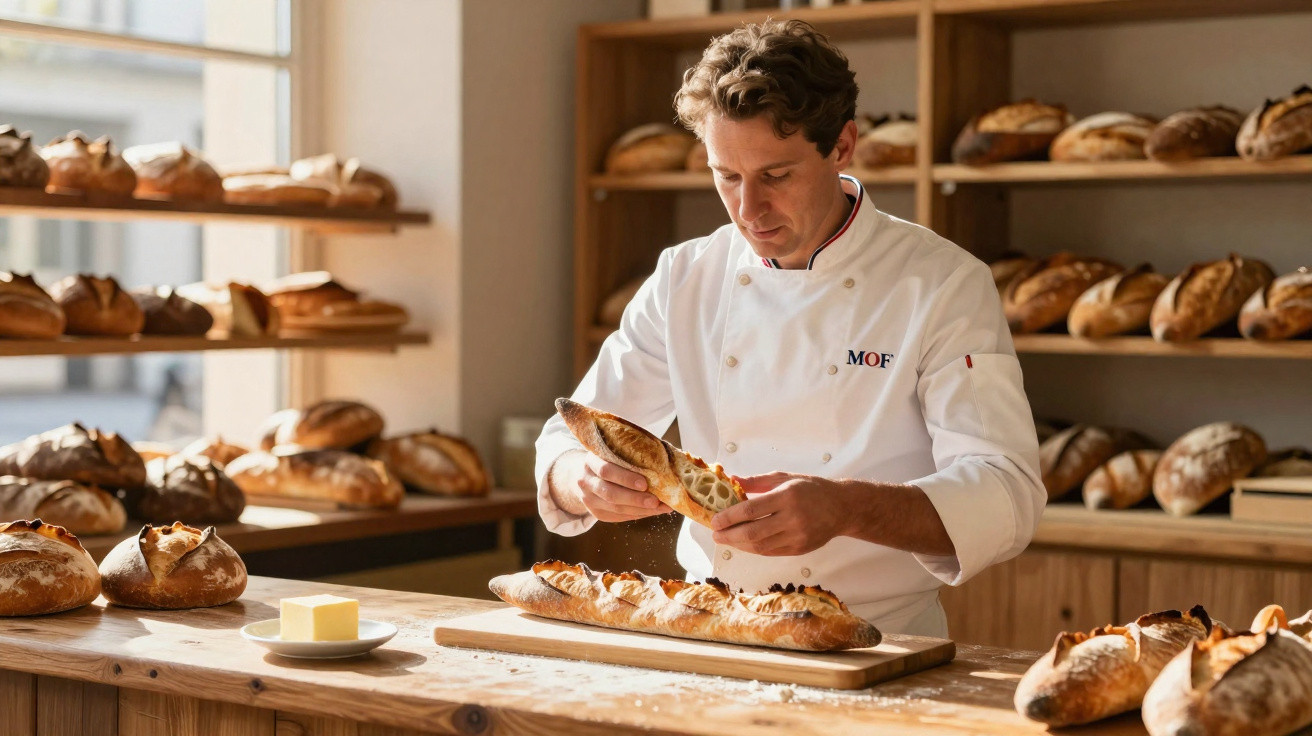
The temptation is physical, almost primal: tear off the end, bite into it in the street, scatter crumbs over your coat and hear that sharp crack ring out in the air. In Paris, the gesture is so familiar that it seems like a national reflex. Yet in a small neighbourhood bakery, a Meilleur Ouvrier de France rolls his eyes whenever he sees it.
That morning, standing in front of his oven, he sets a baguette on the rack and shakes his head. “People have no idea what they’re doing to the bread”, he says as he puts away his peel. He is not talking about snobbery or manners, but texture, flavour and even digestion. His rule is clear-cut, as decisive as a blade slicing through raw dough. And his warning catches plenty of people off guard.
“Never eat a fresh baguette this way”
In his tiny Paris bakery, the MOF baker – dressed in a white jacket with a tricolour collar and flour-dusted hands – notices a customer walking out with a baguette still giving off steam. The door shuts, the bell chimes, and he nearly winces. “He’s going to eat it straight away,” he murmurs, half amused, half resigned. To him, the error is unmistakable: the worst way to eat a baguette is straight out of the oven, piping hot, torn apart in the street.
Warm bread can seem irresistible. Its aroma is more intense, the crust crackles and the crumb feels as soft as a cloud. Your brain tells you that this is the height of enjoyment. From a baker’s perspective, however, it is precisely the opposite. The crumb is still “working” inside: moisture continues to move, starches are setting and aromas are settling. Eating it too early undoes what he has spent 20 hours of fermentation creating. The crust goes soft too quickly, the centre becomes dense and steam masks its more delicate flavours.
He describes it with the calm of someone who has watched thousands of loaves meet their end too soon. With a traditional French baguette, he advises waiting roughly 20 to 30 minutes after it comes from the oven. It is not a matter of hours, only a brief period in which the bread can complete its journey. This is when the crust becomes truly crisp rather than rubbery, while the crumb opens up to become light but springy. There is a technical explanation as well: eating bread while it is scorching can sit heavily in the stomach because the starches have not fully stabilised. What seems like freshness is, for the most part, humidity.
The right way to enjoy a baguette (according to a MOF)
So what does he suggest in place of that instinctive, slightly wild bite in the street? He puts a baguette on the cooling rack and taps its base. It gives a hollow sound, like a gentle knock at a door. His first rule is to let the bread “breathe”. At home, this means removing it from its paper bag and leaving it briefly on a wooden board or clean cloth. No plastic and no wrapping: just air and time quietly doing their work.
Once the baguette is warm rather than hot, he recommends cutting it with a sharp serrated knife instead of pulling it apart with your hands. The slices should be neat, without compressing the crumb. He even mentions the angle of the knife and warns against sawing at it as though it were a log. After slicing, try a piece plain before adding butter, cheese or ham. Give your palate the chance to pick up the crumb’s subtle acidity, the toasted notes of the crust and the slight bitterness of the flour. It may sound almost ceremonial, but the process is straightforward: wait, cut, taste.
People regularly rush this part, particularly at breakfast or aperitif time. The same mistakes recur: eating it too hot, keeping it in the wrong place or reheating it poorly. The MOF baker is not judgemental; he laughs and shrugs. “We’re all in a hurry, we all do it,” he concedes. Let’s be honest: hardly anyone really follows this routine every day. That is exactly what makes his advice feel so practical. He speaks as someone who knows that you will sometimes tear off the heel in the street regardless, yet still wants you to understand how good a baguette can be when you take your time.
“Real bread is alive for a couple of hours after it leaves the oven,” he says. “If you attack it too soon, you kill what makes it interesting.”
To keep it simple, he boils the advice down to a handful of habits that do not feel like homework:
- Wait 20–30 minutes before eating a fresh baguette.
- Let it rest outside the bag on a board or cloth.
- Always cut it with a sharp serrated knife; never press down on it.
- Eat the first bite plain before adding toppings.
- For later, store it in cloth or paper, never plastic.
So, how should we eat baguettes now?
His warning about the “wrong way” to eat a baguette is not intended as a moral lecture. Instead, it raises a small question: how much have we forgotten about proper bread? In a world of industrial loaves and supermarket shelves, allowing bread to rest can sound almost unusual. Yet this short pause alters everything. It transforms a throwaway action into a small ritual. Nothing elaborate: only you, a board, a knife and a piece of crust that genuinely crackles.
What comes through when listening to a MOF baker is not snobbery but obsession. He speaks about fermentation in the way some people speak about music. Time, temperature and humidity all fine-tune flavours that you taste for three seconds before forgetting them. His “never eat it this way” rule is not so much a reprimand as a reminder: there is more to this than you realise. Suddenly, the baguette you absent-mindedly pick up on your way home becomes a small piece of craftsmanship, made by hands you will probably never meet.
Perhaps that is why this advice performs so well on social feeds and Google Discover. It is both simple and faintly radical. You may have assumed that the perfect moment is when the baguette is too hot to hold. A master baker says: actually, wait a little, and it improves. That contrast stays with you. It could change what you do tomorrow morning as you leave the bakery, your fingers lightly burning through a paper bag that is still warm. You may stop for a moment and think: not in the street. Not this time.
| Key point | Detail | Benefit for the reader |
|---|---|---|
| Do not eat the baguette piping hot | Wait 20–30 minutes to allow the crumb to stabilise | Richer flavour, lighter texture and easier digestion |
| Let the bread breathe | Take the baguette out of its bag and place it on a board or tea towel | A crispier crust, with less condensation and rubberiness |
| Adopt simple habits | Use a serrated knife, have the first bite plain and avoid storing it in plastic | Enjoy a good baguette fully without changing your entire routine |

















Comments
No comments yet. Be the first to comment!
Leave a Comment