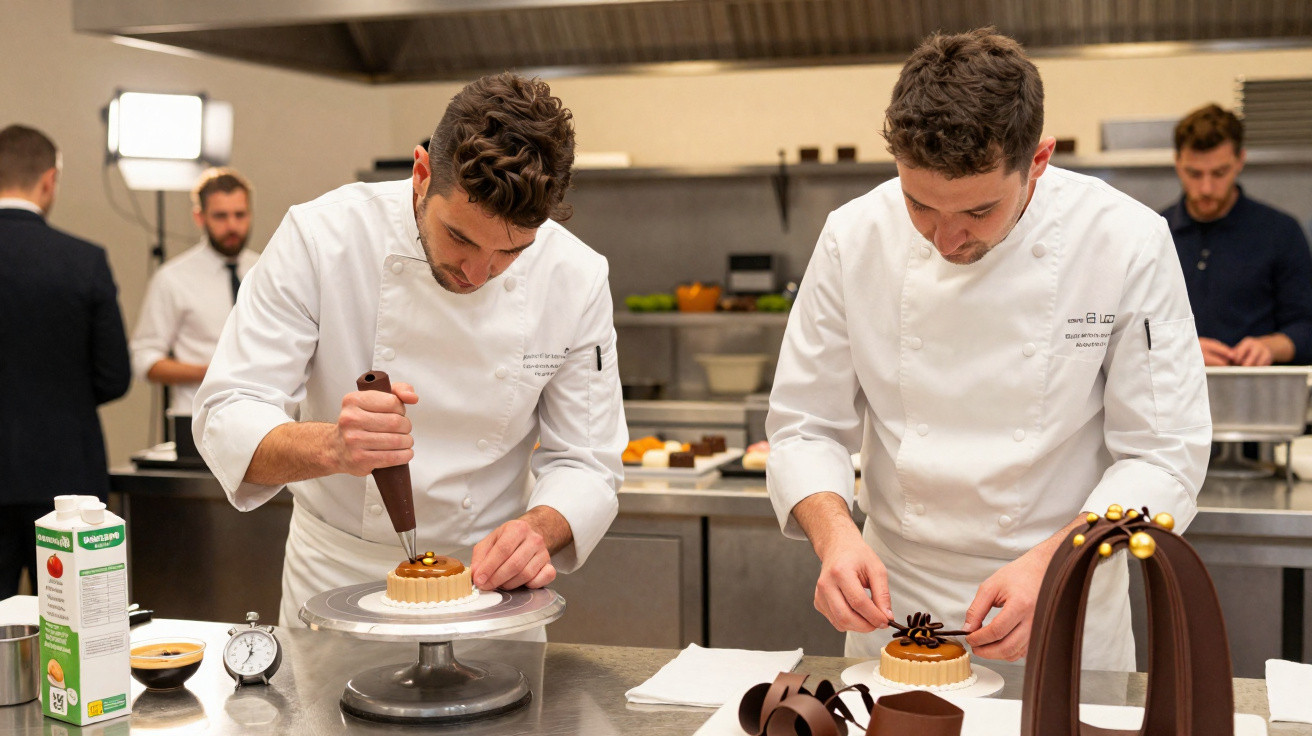
Well away from Parisian limelight and Instagram-ready boutiques, Mathis and Samuel Anstett have secured a junior world title that many established chefs can only hope to attain, making an elite jury take a second look at the names on its score sheets.
The French twin brothers who stole the show in Rimini
Mathis and Samuel Anstett were raised in Zimmersheim, an Alsatian village better known for its traditional bakes than for avant-garde pastry contests. They picked up the same fundamentals in the family kitchen, attended the same professional schools and challenged one another through the same demanding hours in pastry laboratories.
That shared background came to fruition at the Sigep 2026 junior pastry world championship in Rimini. Competing against 18 teams from around the world, the French brothers took the junior world champions title, impressing experienced judges with their composure and command under pressure.
Two brothers from a village near Mulhouse have just topped a field of 18 international teams and been crowned junior pastry world champions in Rimini.
Professionals regard the competition as one of the most exacting events on the global pastry calendar. Rather than a television programme with suspense created in the edit, it is a stopwatch-led endurance test conducted before a seasoned jury and dozens of competing teams.
Ten hours, four challenges and zero margin for error
The Rimini format is unforgiving. Teams receive ten hours, with no extra minute, to complete a rigorous set of assignments and present every item in immaculate condition. Mathis and Samuel's brief called for four distinctly different creations:
- a vegan coffee cake
- a French-inspired street food dessert
- a sourdough-based breakfast product
- an artistic chocolate showpiece standing 1.20 metres tall
Each component faced detailed assessment for flavour, temperature, construction, hygiene, organisation and appearance. The judges also monitor how teams work and clean, manage chocolate during sensitive stages, and respond when problems arise.
The competition blends technical precision with creativity: one misjudged glaze or one unstable chocolate element can send hours of work crashing to the floor.
The French brothers faced strong opposition from teams representing South Korea and China, which went on to complete the podium. A number of judges noted the exceptionally narrow gap between the leading entries: a neater chocolate feather or better-balanced acidity in a cream can alter the medal positions.
A secret weapon: twin timing and unspoken teamwork
Being twins may appear, on paper, to be a pleasant detail. In a pressurised kitchen, however, it offers a tactical benefit. The Anstett brothers operate almost as one person. While one tempers chocolate, the other readies the moulds; a single look can prompt a timing adjustment or a mid-service switch of duties.
Their palates are similarly aligned, making decisions about sweetness, bitterness and texture easier. Rather than discussing every minor judgement, they reach agreement swiftly and avoid losing time in debate. Such intuitive communication is unusual among competition teams, whose chefs may have known each other for only a few weeks before an event.
The brothers also arrived with a defined system: detailed planning, written timetables, contingency recipes and a strict allocation of responsibilities. This framework helped them remain composed as time ran short and tiredness began to build.
Where other teams were still finding their rhythm, the twins followed a rehearsed plan and focused on refinement rather than survival.
From TV show contestants to recognised professionals
French audiences may recognise the Anstett brothers from the M6 programme “Le Meilleur Pâtissier: Les Professionnels”. They stood out on screen through closely coordinated teamwork and polished contemporary desserts, and many observers in the sector identified them as talents to follow.
Their world title now validates those first impressions. More than a trophy to display, it represents a pivotal moment, moving them from promising television personalities to credible contenders on the international circuit. Leading hotels, restaurants and luxury boutiques are likely to seek them out.
A boost for Alsatian pastry traditions
Alsace has a distinctive dessert culture, encompassing kugelhopf, Christmas bredele, generous tarts and rustic cakes. The Anstett brothers remain rooted in that tradition while taking it in a more international and technical direction through vegan methods, accurate sugar work and structural chocolate creations.
For local professionals, their success signals that the region can nurture a new generation of pastry chefs ready to combine childhood flavours with global influences and contemporary dietary trends.
| Element | Traditional Alsace | Twins’ championship approach |
|---|---|---|
| Signature flavours | Butter, cream, nuts, dried fruits | Coffee, cocoa, lighter creams, controlled sugar |
| Techniques | Family recipes, simple proofing, rustic finishes | Vegan pastry, precise fermentation, chocolate artistry |
| Presentation | Large sharing cakes, home-style look | Fine individual pieces, graphic and sculptural lines |
What makes a vegan coffee cake championship-worthy?
The vegan coffee cake was among the brief's most technically demanding elements. In a competition setting, “vegan” involves far more than substituting margarine for butter and almond milk for cow's milk. Its texture, lift and flavour balance must equal or exceed those of conventional versions.
In top-level pastry laboratories, chefs use:
- plant-based fats that reproduce butter's melting behaviour
- alternative proteins (like soy or pea isolates) to give creams structure
- natural setting agents, including pectins or agar-agar
- carefully selected coffees with distinctive aromatic profiles
The difficulty is to produce identical creaminess and stability without eggs or dairy. In a coffee dessert, bitterness must also be managed: sugar, a touch of vanilla or a nut-based element may soften more severe notes.
Behind the chocolate showpiece: engineering in sugar form
The 1.20-metre chocolate showpiece is the point at which the contest approaches culinary engineering. Chocolate is temperamental: when it is too warm, it droops; when it is too cold, it fractures. Large constructions require internal reinforcement, carefully controlled tempering and a firm grasp of weight distribution.
A world-class chocolate sculpture is as much about physics as it is about flavour.
Competitors spend months drawing concepts, testing connections and rehearsing assembly. Within the ten-hour competition period, an error in tempering or construction can result in a disastrous collapse. Teams generally move components around the laboratory as carefully as glassware, with one chef steadying the base while the other directs each movement.
What this means for young aspiring pastry chefs
For culinary school students, the result in Rimini provides a practical benchmark. Two chefs in their early twenties, from beyond France's largest cities, reached the summit of an exceptionally demanding contest through preparation and consistency, rather than showmanship.
Those considering a career in pastry can take several lessons from their journey:
- sound foundations (knife skills, doughs, creams) are more important than elaborate decoration
- competition work demands endurance and emotional discipline
- compatibility within a team directly affects outcomes
- regional heritage can be a creative strength rather than a constraint
How a world title can reshape a career
A junior world championship win seldom brings immediate fame, yet it can transform a CV. Recruiters at luxury hotels, Michelin-starred restaurants and international resorts examine competition achievements closely, treating them as evidence of resilience and discipline.
Mathis and Samuel must now weigh several paths: remaining in France to strengthen their Alsatian roots, going abroad to gain fresh influences, or entering teaching and consultancy despite their young age. Every option involves compromises involving earnings, creative independence and work-life balance.
For pastry enthusiasts, their triumph suggests what may soon appear in shop displays: additional plant-based desserts that remain indulgent, more sophisticated sourdough breakfast pastries, and chocolate installations closer to contemporary sculpture than traditional showpieces.
The Rimini jury may still be replaying those ten hours, searching for the precise point at which the French twins moved ahead. For the Anstett brothers, though, the meaningful work starts now, back in the laboratory, where the next recipe, test and early-morning bake will determine how far this unexpected title takes them.

















Comments
No comments yet. Be the first to comment!
Leave a Comment