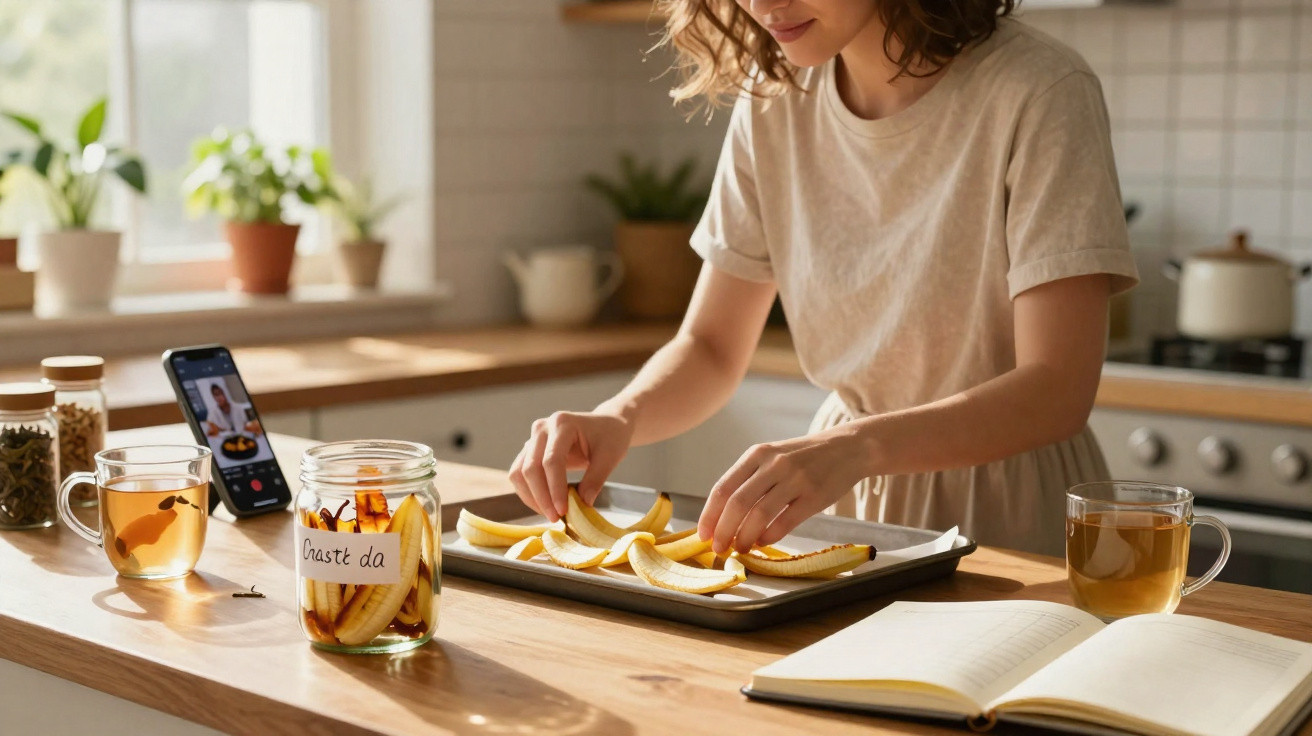
The tray slides out of the oven with a gentle crackle and, at first glance, you might take it for roasted potatoes.
Slender golden strips curl slightly at their edges, carrying a faintly sweet, smoky scent. They are banana peels. A year ago, saying that might have sounded like a poor joke; now, it feels like an ordinary Tuesday afternoon on TikTok.
On the worktop sits a bowl of real bananas – bare, pale and almost bashful without their skins. Yet it is the peels that have taken centre stage. The claim is ambitious: a zero-waste snack, a superfood, perhaps even a miracle remedy for drooping, yellowing houseplants.
But when you give it a go, something rather strange becomes clear.
Baking banana peels tackles a problem that almost nobody discusses.
Baked banana peels do not solve the problem you expect
The trend suggests that baked banana peels will “change your life” because you will never discard them again. Viral videos sweep over trays of crisp strips while dramatic voiceovers murmur about potassium and sustainable living. It appears to be food-waste salvation, packaged in comforting TikTok style.
In most kitchens, though, the reality is more modest and, oddly, more truthful. You make them once because you are curious. Perhaps you repeat it. The flavour turns out to be… all right. Neither unpleasant nor remarkable: somewhere between a chewy vegetable skin and a slightly bitter oven crisp. Then you are left asking the question that follows every online craze.
What was this genuinely meant to solve for me?
A food scientist I spoke to rolled her eyes so hard I could hear it down the phone. “Nutritionally, you can eat them,” she said. “Yes, there’s fibre, some antioxidants, trace minerals. But throwing away a peel isn’t the nutritional catastrophe people imagine.” The banana itself already provides plenty of potassium, as do perfectly everyday foods such as potatoes and beans.
If this is neither a health revolution nor a realistic way to eradicate your food waste overnight, baked banana peels begin to represent something different. They become a symbol: a way to feel that you are making a better choice, one tray at a time, in a world where waste and guilt mount up faster than the recycling bin can cope.
The overlooked issue they quietly confront is not a lack of fibre or the volume of landfill. It is that persistent feeling, as you scrape plates into the bin, that you ought to live differently but are unsure how to start.
Where banana peels really work: small rituals that shift behaviour
The true value of baking banana peels lies in a tiny, unglamorous change: you begin to view “waste” as an ingredient. When you first wash and cut up those peels, your brain registers the awkwardness of it. Something you always binned is now sitting on a chopping board. It is a slightly clumsy, tangible reminder that habits are not laws of nature.
You heat the oven, add a little oil and perhaps season with smoked paprika, salt and a light sprinkle of sugar. The strips are arranged flat and side by side. It is a small, almost ridiculous ritual that takes five minutes. Still, the next time you cook, you look at things differently: carrot tops, stale bread, broccoli stalks. A fresh question emerges: could this become something?
On a grey Tuesday in Leeds, I watched a young couple try the trend for the first time. They had read that baked banana peels could stand in for bacon in a vegan BLT. “We’ve been doomscrolling climate news all week,” one of them admitted, shrugging. “This just felt… doable.”
Their peels emerged with uneven crispness, with some edges close to burnt. There was laughter, some disappointment and then further testing. More marinade next time. Lower heat. They ate their sandwiches regardless, but their conversation was not about recipes. Instead, they discussed manageable changes they might genuinely maintain: freezing leftovers, bringing lunch to work and trying a vegetable box delivery.
Nothing grand. Simply two people shifting their default settings a little to the left.
In statistical terms, baking banana peels will not resolve the food-waste crisis. The UK throws away around 4.7 million tonnes of edible food each year. Even if everyone in Britain cooked every peel, bananas make up only a tiny fraction of discarded food. Behavioural researchers, however, have a name for acts like this: a “gateway behaviour”. It is one small, low-risk trial that can make more ambitious changes feel possible later.
For the climate or nutrition, banana peels are a rounding error. Psychologically, however, they create a crack in the wall of “that’s just how I cook”. That is the issue they truly address: the conviction that your habits cannot change and that your actions do not matter.
How to bake banana peels so they help you, rather than merely your feed
If you choose to bake banana peels, approach it not as a life hack but as a small experiment in your own kitchen. Wash the peels under cool water and scrub them gently; they have travelled a long way and been handled frequently. Cut away the dry stem ends, then use a small knife or scissors to slice the peels into thin strips.
Mix them in a bowl with a teaspoon of oil, a pinch of salt and a smoky or bold flavouring: smoked paprika, soy sauce, garlic powder or even a dash of maple syrup. Lay the strips in one layer on a lined baking tray, leaving space between them so they do not steam. Bake at roughly 180°C for 12–18 minutes, turning them once, until their edges deepen in colour and they move from rubbery to lightly crisp.
Use them as you would a garnish rather than making them the centrepiece – slipped into a sandwich, scattered over rice or crumbled across a salad. Consider them a snack for training your brain.
People do not often say it openly, but many of these “eco recipes” quietly disappear after their first attempt. Let’s be honest: nobody really does this every day. That is absolutely fine. The aim is not to become somebody who faithfully bakes every peel like clockwork. It is to let this unusual trick prompt you to see your kitchen in a new way.
Trying it once and never repeating it does not mean you have failed. You have still spent 20 minutes paying attention. You have still practised a different line of thought: “What else could I use?”
The most common errors are baking them for too long – they quickly become bitter and tough – and failing to season them enough, because plain peel tastes exactly like plain peel. Be gentle with yourself if the first tray is a bit wonky. Food trends can carry a quiet shame, as though failing to adore every hack makes you lazy or uncaring. It does not. You are experimenting in a space that already involves plenty of pressure, particularly for the person who usually cooks.
“The real win,” says one home cook I interviewed, “wasn’t the peel. It was the moment my teenage son asked if we could save the broccoli stalks for stir-fry instead of binning them. The banana thing was just the icebreaker.”
That is the emotional thread running through this: it is not only about peels, but also about permission to experiment, be imperfect and change gradually.
- Choose organic bananas where possible, or at the very least wash the peels thoroughly.
- Do not feel that you must eat every peel; composting is still a positive outcome.
- Begin with one tray on one occasion. See it as an experiment, not a new identity.
The subtle ripple effect of one unusual trend
At face value, baking banana peels is almost absurdly minor: one tray, in one oven, in one flat. Nobody writes policy papers about it. Yet when you speak to people who have tried it, the flavour is not what stays with them. They remember the moment when they looked at something they had always discarded and thought, “Hang on. Maybe not.”
On an overcrowded planet, these small mental reversals count. Not because one individual act saves the world, but because it weakens the story that nothing you do can make any difference. Once that story loosens, even slightly, other decisions become more straightforward: planning one extra meal each week, using what is already in the fridge, choosing the “ugly” vegetables or sharing surplus food rather than letting it wilt.
On a difficult day, baking banana peels is simply an eccentric recipe. On a better day, it is practice for a different relationship with your bin, your budget and your sense of agency. On a very good day, it sparks a conversation – something you tell a friend that makes them inspect their kitchen scraps twice before reaching for the pedal bin.
We all recognise the weighty feeling of scraping a plate into the rubbish and hearing good food land softly on plastic. Trends like this do not remove that feeling. They offer you another response to it: a new instinct, a small story to tell yourself: today, I tried something unusual instead of doing nothing.
Perhaps that is the real value of banana peels – not as a superfood or miracle mulch, but as a harmless, slightly silly excuse to practise changing your mind. Once you have done it with a peel, doing it with everything else becomes just a little easier.
| Key point | Detail | Why it matters to the reader |
|---|---|---|
| Baked peels do not fix “nutrition gaps” | They provide some fibre and antioxidants, but your usual diet is likely to cover these already | Takes away the pressure to follow the trend purely for health reasons |
| The genuine benefit is behavioural | They can act as a gateway to challenging food-waste habits | Helps you turn one experiment into larger, realistic changes |
| See it as a ritual, not a rule | Trying it once can still reshape how you view “waste” | Keeps the trend accessible, low-guilt and genuinely enjoyable |

















Comments
No comments yet. Be the first to comment!
Leave a Comment