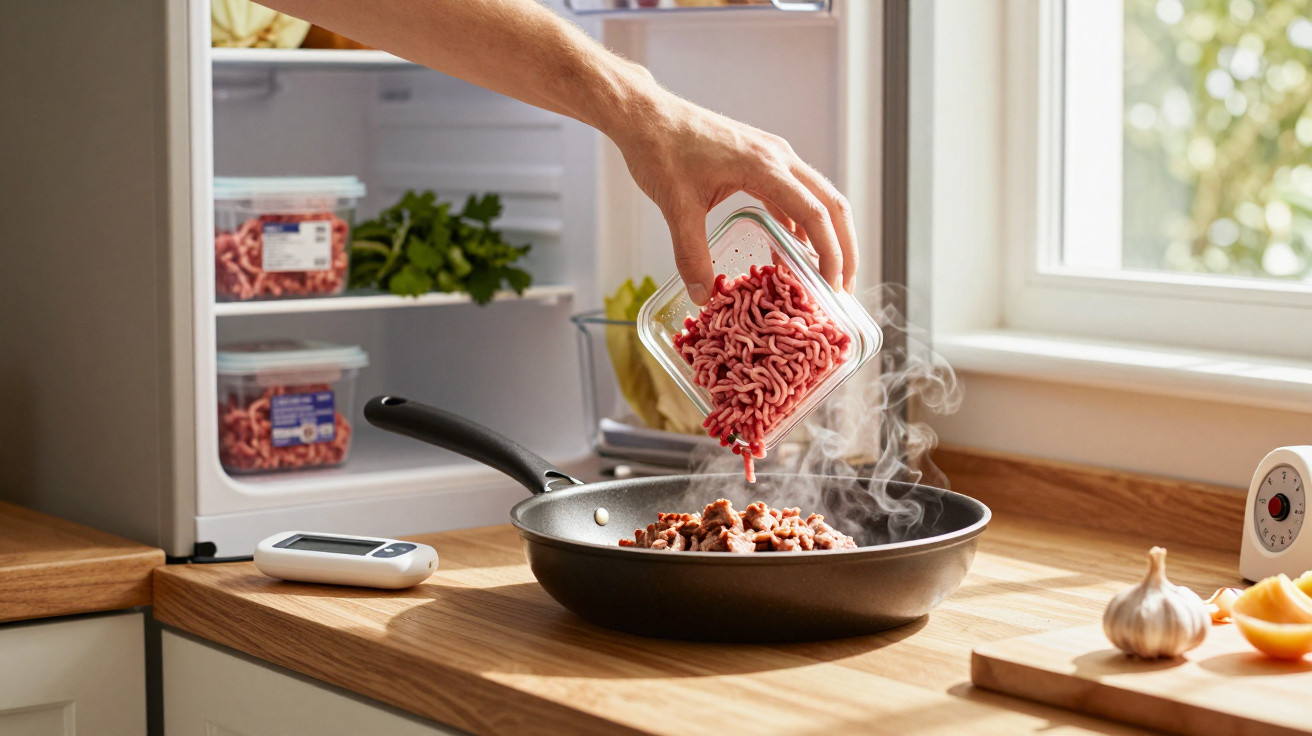
Dinner is nearly ready, the children are hungry, and that pack of minced meat has been sitting quietly in the fridge for two days. You look at it, hesitate, and tell yourself that it “still looks fine”. We have all faced that moment of wanting a quick answer while juggling pans, along with the nagging worry of wasting food that may still be edible. Yet looks do not tell the whole story with minced meat. Its texture, the way it is prepared and its large surface area exposed to air make it far more perishable than a whole steak. Forgetting the date or cooking it too quickly can be enough to turn a family meal into an unpleasant evening. Being careful does not take away from the enjoyment of cooking; it simply means knowing the right checks to make.
Minced meat in the fridge: the storage time is shorter than you might think
Raw minced meat should generally be kept in the fridge for no longer than one to two days, provided the appliance is set to 4 °C or below. In practical terms, it needs to go straight into the coldest part of the fridge, usually on the shelf above the vegetable drawer, rather than in the door, where temperatures fluctuate every time it is opened. The use-by date printed on the pack remains your most important guide. Minced meat bought from a butcher requires even closer attention: ideally, cook it that day or within 24 hours.
Minced meat does not behave like a whole cut of beef. During mincing, bacteria originally found on the surface can become distributed throughout the mixture. A study by ANSES points out that raw foods of animal origin are especially vulnerable when the cold chain is broken. Even 20 minutes in a hot car after shopping starts to matter. That is what makes the risk deceptive: meat can retain an acceptable colour while becoming unsafe to eat.
A strong smell, grey colouring or a sticky texture should clearly raise concerns, but the lack of these warning signs never confirms that the meat is safe. Some bacteria that cause food poisoning do not necessarily alter a product’s smell or taste. Realistically, few people check their fridge temperature every day. Still, a small thermometer placed on a shelf can prevent plenty of uncertainty. If minced meat is not going to be cooked soon, freezing it is the most reassuring option.
Simple steps to prevent unpleasant surprises with minced meat
Once you are home from the shops, put minced meat away without delay. Start with chilled items before unpacking cupboard groceries or household products, even if that may seem a little obsessive. Leave it in its sealed packaging, placing it on a plate or inside a container so that any leaking juices cannot drip onto vegetables, cheese or leftover lunch. If the pack has already been opened, transfer the meat to a clean covered container and cook it within 24 hours.
A common mistake is leaving meat to defrost on the worktop “just for an hour”. It is an understandable shortcut when you get home late, particularly on evenings when ordering a pizza begins to sound appealing. It is safer to defrost it slowly in the fridge, in a dish, or to use the microwave’s defrost setting if it will be cooked immediately. Defrosted minced meat must not be refrozen while raw, unless it has been cooked first.
Cooking must heat the middle of the meat, rather than merely browning the outside. For children, pregnant women, older people and anyone who is vulnerable, serving minced meat pink is not a harmless treat: it calls for extra caution.
“Properly cooked minced meat should no longer have any red or pink areas in the centre, and its juices should run clear.”
- Aim for a core temperature of around 71 °C when using a cooking thermometer.
- Cook minced beef burgers, meatballs and fillings all the way through, turning them where needed.
- Do not taste a raw mixture, even to check its seasoning.
- Wash your hands, knife and chopping board after handling raw meat.
Why thoroughly cooking minced meat really matters
Heat is the crucial step because it destroys most harmful bacteria once the centre of the food reaches a high enough temperature for long enough. With a whole steak, germs are mainly confined to the exterior and are directly exposed to the heat of the pan. In minced meat, however, they may be present throughout the food, including at the centre of a rounded meatball or thick burger. This is why a well-seared crust is not always enough. The middle must be cooked.
This guidance is intended in particular to prevent infections associated with bacteria such as Escherichia coli, Salmonella and Listeria monocytogenes. The effects can range from unpleasant gastroenteritis to more serious complications in vulnerable people. That does not mean being afraid of every minced beef burger. Instead, it is about making a few simple habits almost automatic: keep it cold, keep things clean and cook it thoroughly. A properly heated pan and a few extra minutes can ensure the meal remains enjoyable rather than becoming a memory nobody wants.
You can also plan meals more effectively around this requirement. Buy minced meat on the day you intend to cook it, or freeze it as soon as you buy it in small, flat portions that are easy to defrost. Write the date on the bag, even if it seems unnecessary at the time. Cooked portions can usually be kept in the fridge for two to three days, in an airtight container that has been cooled quickly. These are small routines rather than military discipline, and they make busy evenings easier to manage.
A kitchen habit that protects without making life harder
Minced meat is one of those everyday foods we assume we understand because we have cooked it for years. It finds its way into lasagne, tacos, Sunday meatballs or an improvised cottage pie that rescues the end of the week. Nevertheless, its perishability calls for a slightly different approach: check the date, maintain the cold chain and do not compromise on undercooking. You should never taste-test a doubt. Make the simple choice instead: cook it straight away or throw it away.
There is something reassuring about this habit too. It requires neither complicated equipment nor a chef’s expertise, only a few seconds of attention when putting away shopping and starting to cook. Many households have their own rule, passed down by a parent or grandparent: “you do not leave minced meat waiting”. There is nothing old-fashioned about it. It is a reminder that family cooking often depends on invisible details, the ones that allow everyone to have another helping without a second thought.
| Key point | Detail | Benefit for the reader |
|---|---|---|
| Chilled storage | Keep raw minced meat for a maximum of one to two days at 4 °C or below, in line with the use-by date. | Reduces the risk associated with bacterial growth. |
| Freeze promptly | Freeze the meat as soon as it is bought if it will not be prepared quickly. | Prevents waste without taking unnecessary risks. |
| Cook through | A temperature of around 71 °C and no pink meat are useful indicators. | Makes minced beef burgers and meatballs safer for the whole family. |

















Comments
No comments yet. Be the first to comment!
Leave a Comment