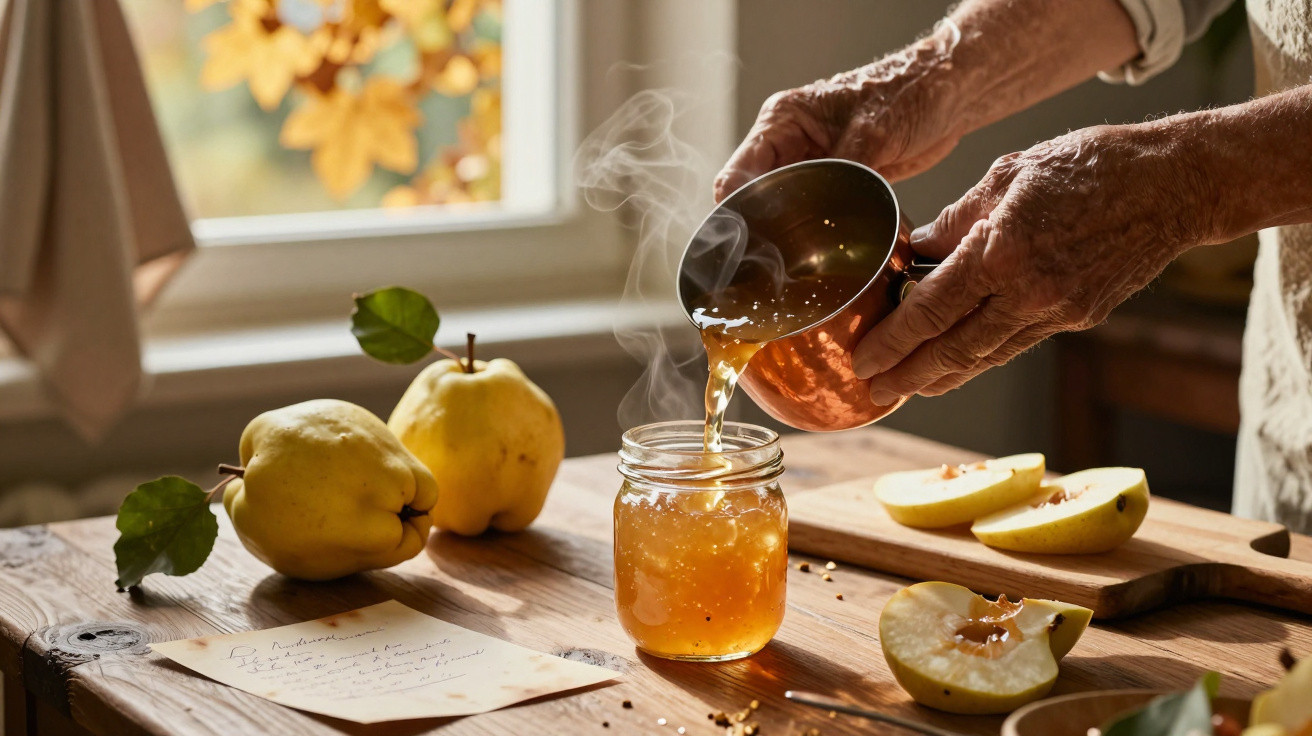
At the market, quinces can easily go unnoticed beside polished apples and pears ready to eat. They sit there with slightly rough yellow skins, a fine down and a surprising scent reminiscent of an old cupboard. Then comes the Sunday when you arrive home with three kilos in a bag, not entirely sure what to do with them, simply because they have stirred a memory of family cooking. In many homes, quince jelly was never a show-stopping recipe: it was an autumn ritual, with a saucepan gently singing and jars lined up on a tea towel. At the first cold-weather breakfast, one slice of toast is enough to bring it all back. That is where the treasure lies.
Quince: the unpromising fruit with an incomparable fragrance
We all know the hesitation when a fruit looks too difficult to choose. Quince is almost never eaten raw: its flesh is hard, astringent and sometimes genuinely unappealing, while its appearance is not always particularly tempting. Yet, when gently heated, it takes on an entirely different character, filling the kitchen with a floral aroma somewhere between ripe apple, honey and rose.
In country gardens, quince trees were often planted beside the vegetable patch or at the back of a yard. One neighbour recalled helping her grandmother, as a child, to rub quinces with an old tea towel before cooking them, removing their delicate greyish down. Six large fruits could sometimes yield four or five small jars of jelly, enough to make the memory last until the final cold days.
This old-fashioned recipe follows a straightforward principle: quince naturally contains plenty of pectin, the substance that enables the juice to set as jelly. The seeds and skins make a major contribution, which is why traditional recipes do not insist on peeling everything with meticulous care. What appeared rustic was actually very clever. In this saucepan, almost nothing truly goes to waste.
Grandmother’s method: from fruit to golden jars
To make quince jelly that recalls childhood, start by selecting fruit that is deeply yellow, firm and highly fragrant, even if it has a few superficial brown marks. Rub it well, cut it into quarters without removing the skins or seeds, then cover it with water in a large stockpot. After 45 minutes to one hour of gentle simmering, the pieces should crush easily beneath a spoon.
The crucial stage comes next: let the juice drip slowly through muslin, a clean cloth or a jelly bag placed over a bowl. Do not squeeze the pulp, however endless the wait may seem, as this can make the juice cloudy. To be honest, nobody really does this every day, but it is a wonderful task for a rainy October afternoon.
Measure the resulting juice, then allow roughly 700 to 800 grams of sugar per litre, according to the fruit’s acidity and your own taste. Cook it rapidly in a wide preserving pan, skim if required, and test the set on a chilled plate: a drop that firms up slightly shows that the jelly is ready.
“Jelly does not require strength; it requires time,” a grandmother would often say while watching the steam gather on the windows.
- Use jars that have been thoroughly washed and sterilised with boiling water.
- Pour in the jelly while still piping hot, stopping a few millimetres below the rim.
- Seal straight away and turn the jars upside down for five minutes.
The details that matter when serving quince jelly
A successful quince jelly does not have to be perfectly transparent, like sweets in a shop window. Its shade may range from pale yellow to rosy amber, depending on the ripeness of the fruit and the cooking time. What matters most is its yielding texture: it should quiver slightly in the jar before melting slowly over warm toast.
The most common mistake is trying to hurry the process, either by pressing the juice or by boiling it until it turns overly firm. It happens to everyone: you look away for two minutes to answer the telephone and, suddenly, the jelly thickens. If it sets too firmly, it is still delicious stirred into yoghurt, spread over pancakes or tucked into the centre of an apple cake.
Homemade quince jelly also deserves a place beyond breakfast. Its gently sharp sweetness pairs particularly well with sheep’s cheese, mature Comté or a slice of foie gras at festive meals. Kept somewhere cool and dark, it will last for several months, sometimes longer; once opened, the fridge is its best home.
A jar of jelly gives autumn a different flavour
Making quince jelly is not simply a way to fill a cupboard with jars. It means embracing a slow recipe at a time that encourages us to simplify, buy and rush everything. The fragrance rising from the stockpot is deeply reassuring: it signals the changing season, the return of the first scarves, and the fact that a kitchen can still be a place where traditions are passed on.
You can recreate a grandmother’s gesture without owning her copper preserving pan or cool cellar. A large pot, a few saved jars and quinces picked from a neighbour’s tree are often enough. The traditional recipe does not need to be rigid: some people add lemon zest, while others use a vanilla pod, but the fruit always has the final word.
There is also a very simple pleasure in giving someone a jar. A handwritten label, a date and perhaps the name of the garden where the fruit was picked make for a modest-looking gift, yet one filled with time and care. And if a child asks why the jelly shines so brightly in the light, there is still a lovely story left to tell.
| Essential point | Detail | Added value for the reader |
|---|---|---|
| Selecting the right quinces | Yellow, firm and fragrant fruit, even when slightly marked | Produces a more aromatic jelly without waste |
| Keeping skins and seeds | They naturally release pectin during cooking | Helps the jelly set well without additives |
| Straining without squeezing | Allow the juice to run slowly through a clean cloth | Preserves a clear, glossy and delicate jelly |

















Comments
No comments yet. Be the first to comment!
Leave a Comment