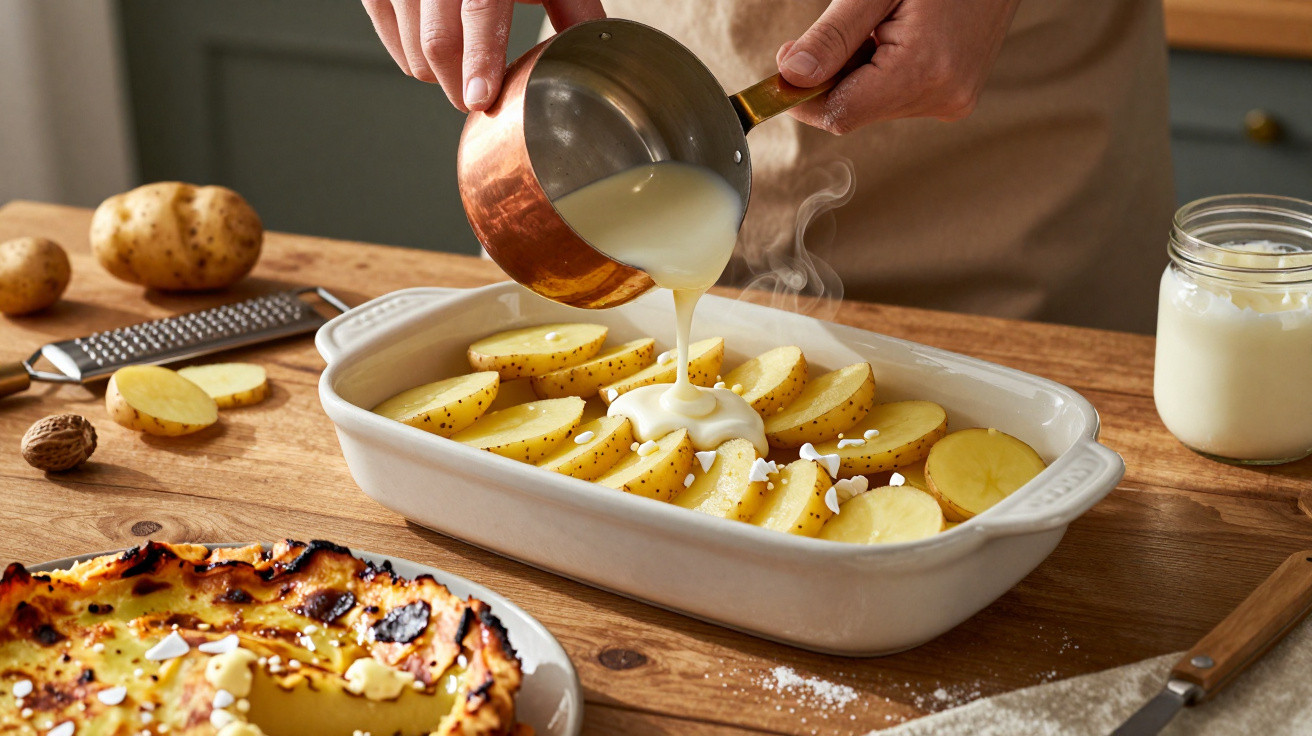
The dish reaches the table in its large brown baking dish, its edges still bubbling, and someone immediately asks: “Which cheese did you use?” It is a question that comes up at almost every family meal. Yet a traditional gratin dauphinois contains not a trace of it. Its golden top comes from milk, cream and slow cooking, not from a handful of Emmental lurking at the back of the fridge. The real challenge lies elsewhere: choosing the potatoes, slicing them to the right thickness, and avoiding one seemingly harmless step that can turn a meltingly soft gratin into grainy mash. We all know the moment when the dish looks flawless before serving, then collapses with the first spoonful. Gratin dauphinois deserves better.
Authentic gratin dauphinois is not hidden beneath cheese
In Dauphiné kitchens, this gratin is recognised first by its aroma: garlic rubbed around the dish, warmed milk, double cream and potatoes gently slow-cooked until tender. No grated Gruyère, no Comté, not even a thin layer added “just to brown it”. This is a widespread habit and it can make a delicious dish, but it is no longer the traditional recipe. The surface should take on colour naturally, almost discreetly, forming a creamy film that splits beneath the spoon. It may be less dramatic than a cheese crust, but it is far more delicate.
A Dauphiné grandmother would often tell her grandchildren, while keeping an eye on the oven, that a gratin should not crunch like a pizza. It should wobble slightly when removed, with slices that hold together without any resistance. For six people, allow roughly 1.2 kg of potatoes, 40 cl of double cream, 40 cl of whole milk, one garlic clove, a little butter, salt, pepper and a pinch of nutmeg. Nothing else. That simplicity is also why every detail matters so much.
Cheese was long added as reassurance, to disguise a slightly dry gratin or to achieve quicker browning. The issue is that it brings fat, salt and a dominant flavour that masks the potato’s gentle sweetness. A proper gratin dauphinois depends on a natural emulsion: the starch released during cooking gradually binds the milk and cream. With the right quantities, the sauce becomes silky without any added flour or cornflour. The gratin must stay creamy, not dense.
Traditional gratin dauphinois: the techniques that make all the difference
Start by selecting a firm or waxy potato variety: Charlotte, Amandine, Nicola, Monalisa and Agata all work very well. Peel them immediately before cooking, then slice them evenly to two or three millimetres thick, ideally with a mandoline. Rub a terracotta or ceramic dish generously with the halved garlic clove, butter it, and arrange the slices in loose layers. Season lightly with salt and pepper between the layers, without overdoing it: the cream will already intensify the flavours.
Pour in the combined milk and cream until it comes level with, or just below, the potatoes. A pinch of nutmeg is enough; it should be detectable rather than take over the kitchen. Bake at 150–160 °C for one hour and 15 minutes to one hour and 30 minutes, depending on the depth of the dish. Let us be honest: hardly anyone truly makes it this way every day, especially on a Tuesday evening between loads of washing. But for a Sunday lunch, this gentle cooking makes all the difference. The gratin can rest for ten minutes after leaving the oven before serving, which will only help it hold its shape more neatly.
The most common mistake is choosing a potato that is too starchy, intended for mash or chips. A very dry Bintje, an especially floury heritage variety, or potatoes that are too old will absorb the liquid and break down, producing a sandy, sometimes almost grainy texture. Do not rinse the slices once they have been cut, as their starch helps bind the cream.
“In a gratin dauphinois, the potato must neither drink up all the sauce nor disappear into it.”
- Choose firm-fleshed potatoes.
- Cut thin, even slices.
- Keep the starch on the slices by not washing them.
- Favour slow cooking without harsh heat.
The mistake that makes potatoes floury
Sometimes, one poorly chosen bag of potatoes is enough to spoil a carefully prepared dish. Floury varieties are excellent for homemade mash, gnocchi or beautifully light chips because they break apart easily. In a gratin, however, this behaviour becomes a flaw: the slices fall apart, the sauce thickens too quickly, and the result leaves a slightly dry, almost powdery feel in the mouth. The trap is all the more common because packaging rarely makes the texture clear. A potato labelled “for roasting” is not necessarily right for dauphinois.
Temperature is another source of trouble. An oven that is too hot colours the top rapidly while the centre struggles to cook evenly. The thermostat is then raised, the cooking time extended, and the slices ultimately lose all their structure. It is better to accept gentle colouring and test with the blade of a knife: it should pass through the layers without effort. If the top browns before the dish is ready, simply lay a sheet of aluminium foil over it without sealing it tightly. Patience is the recipe’s least expensive ingredient.
Gratin dauphinois also reflects a particular approach to home cooking: few ingredients, but no room for guesswork. Some people add a little more cream, while others favour equal parts milk and cream, and every household keeps its own balance. What remains unchanged is the pursuit of that soft, coating, almost satin-like texture. A successful gratin does not try to impress with unnecessary extras. It can accompany roast meat, a lightly bitter salad, or stand alone in the evening with a slice of ham and the memory of a meal that was allowed to take its time.
| Essential point | Detail | Benefit for the reader |
|---|---|---|
| No cheese | The colour develops naturally from the milk, cream and butter. | Rediscover the gentle, authentic flavour of gratin dauphinois. |
| The right variety | Charlotte, Amandine or Monalisa retain their shape well. | Avoid floury slices that fall apart. |
| Slow cooking | Around 1 hour 15 minutes at 160 °C, depending on the depth of the dish. | Achieve a tender centre and naturally thickened sauce. |

















Comments
No comments yet. Be the first to comment!
Leave a Comment