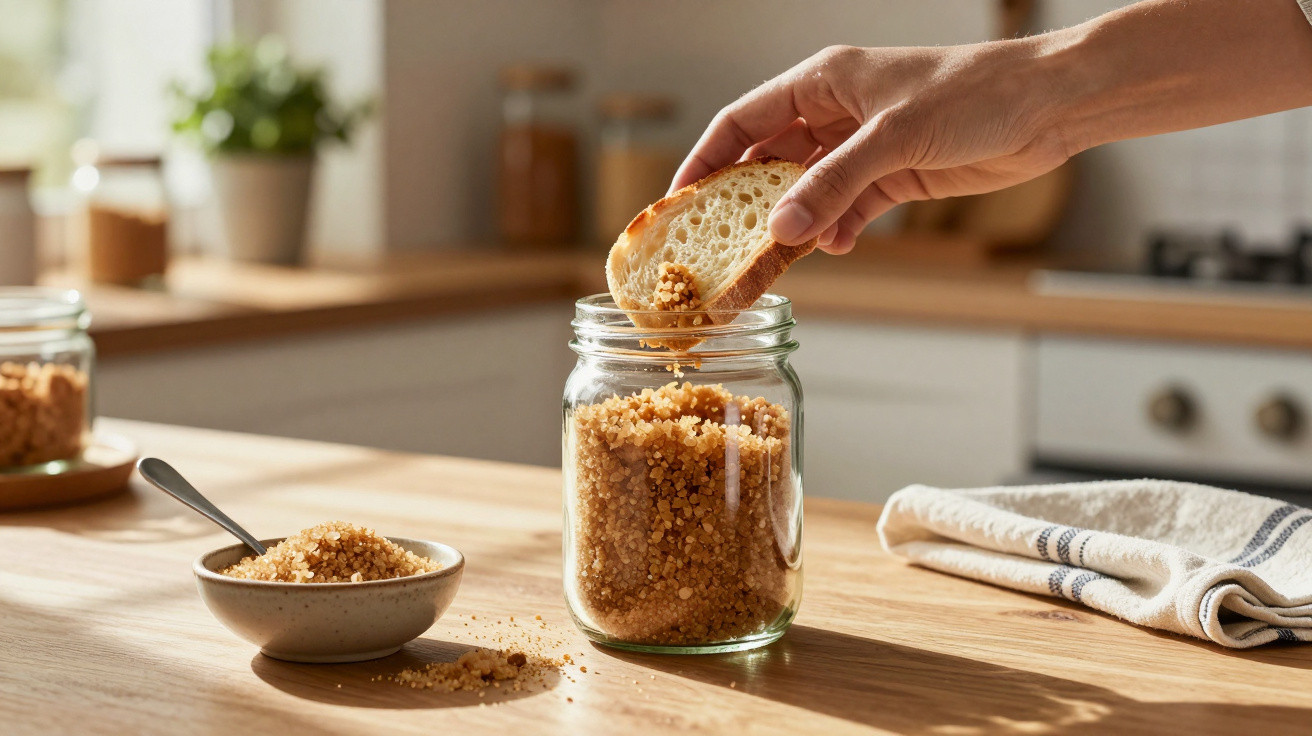
The coffee is ready, the cake is cooling on its rack and, just as you go to sprinkle in a spoonful of brown sugar, the spoon bounces off a lump as hard as stone. We all know this minor kitchen irritation: it strikes on a Sunday morning or just before guests arrive, when there are twenty minutes left and no more. The packet looked properly sealed, tucked away at the back of the cupboard, far from damp. Yet brown sugar has a mind of its own: once it loses its moisture, it clumps together and becomes almost impossible to measure. There is no need to reach for a hammer or abandon the recipe. A simple slice of bread can restore its softness with almost no effort. It may sound surprising, but it works.
Why does brown sugar become so hard in the cupboard?
Brown sugar is not simply white sugar with added colouring. Its crystals are generally coated in molasses, the brown, fragrant, slightly moist ingredient that gives it its caramel flavour. When the surrounding air is too dry, or a lid lets in a little air, this moisture slowly evaporates. The grains then stick to one another until they form a solid mass. It is not particularly glamorous, but it is entirely normal. The block may look beyond saving even though its aroma is often still intact.
In a centrally heated kitchen during winter, this can happen quickly. A container opened several times a week, left beside a radiator or forgotten in a poorly closed cupboard can sometimes turn 500 grams of brown sugar into a pebble within days. One reader recently said she had to bang her bag against the worktop while making cookies with her children: the sugar did not give way, but the bag did. The result was grains everywhere. The kitchen sometimes has a sense of comedy at exactly the wrong moment.
The idea is straightforward: brown sugar needs to regain enough moisture to keep its crystals loose and soft. It does not need to get wet - far from it; a small exchange of water in a sealed container is enough. This is where the slice of bread comes in. It naturally contains moisture, which it gradually releases into the air trapped alongside the sugar. Over several hours, the hardened lump loosens. There is no magic involved, just a little piece of everyday physics that can prevent plenty of swearing.
The slice of bread: the simple trick that saves brown sugar
Put the hardened brown sugar into an airtight container, without trying to break it into crumbs first. Lay a slice of fresh white bread or sliced white bread on top, seal the container carefully and leave it for between twelve and twenty-four hours. If the lump is exceptionally dry, wait up to forty-eight hours, checking its condition along the way. The bread should not be soaked, nor should it sit in a damp container. One ordinary fresh slice is more than enough.
The following morning, or the next evening after work, test the sugar with a fork. It should break apart more easily before becoming crumbly again under your fingers or in a spoon. To be honest, nobody really thinks to do this every day. This trick is mainly useful when the recipe is planned for tomorrow, rather than within the next five minutes. If you are in a rush, a very brief spell in the microwave can help, but bread produces a more even result and avoids heating the sugar too aggressively.
The key precaution concerns the bread itself: once it has done its job, remove and discard it. If left too long in a sealed container, it can dry out, develop an odd smell or encourage mould, even if sugar is not especially welcoming to microbes. A slice of bread is a temporary aid, not a storage accessory.
“The right approach is to give the sugar just enough moisture, then protect it from the air again.”
- Choose an airtight container: a rubber-sealed jar or a box with a clip-on lid reduces everyday air exchange.
- Use fresh bread: a stale slice adds moisture less effectively and may leave behind a stronger smell.
- Avoid flavoured bread: seeded, garlic, walnut bread or flavoured brioche have no place near sugar.
- Do not add water directly: a few drops can create sticky patches that are difficult to rescue.
- Remove the bread after use: as soon as the sugar is soft again, the container should be dry and clean once more.
- Break up pieces gently: after resting, a fork, sturdy spoon or your fingers will do the job.
Simple habits to stop it happening every month
Once the sugar has softened, the wisest option is to transfer it to a clean, dry and genuinely airtight container. The original bag, folded over and held with a clip, rarely provides enough protection for long, especially when the kitchen experiences major temperature changes. Some people place a piece of terracotta designed specifically for brown sugar in the container, having moistened it according to the manufacturer’s instructions. It is handy but not essential: a good lid already makes a significant difference. The ideal cupboard remains cool, dry and away from the oven.
There are other emergency options, such as a wedge of apple or a marshmallow placed in the container. They can release moisture too, but they also bring their own smells and require the same care as bread. Apple, in particular, should never remain with the sugar for long. Plain bread is still the most familiar, least expensive and often most reassuring choice. There is no need for another kitchen gadget to solve a problem our grandmothers already knew well.
This small cupboard mishap reveals something rather encouraging: many everyday frustrations require neither a miracle product nor an impulse purchase. A slice of bread left on the table can rescue a recipe, reduce waste and restore confidence before starting a crumble topping or homemade caramel. You can also pass the tip on, whether to a child discovering baking or a neighbour complaining about sugar that has turned to concrete. These modest solutions are often the most useful because they appear exactly when they are needed.
| Key point | Detail | Benefit for the reader |
|---|---|---|
| Cause of the lump | Brown sugar loses the moisture in its molasses, causing the crystals to clump together. | Understanding the process prevents you from throwing away sugar that is still perfectly usable. |
| The bread trick | A slice of fresh bread in an airtight container gently rehydrates the sugar within 12 to 24 hours. | An affordable, accessible solution requiring no complicated handling. |
| Proper storage | Remove the bread after use, then keep the sugar in a dry, airtight container. | The sugar stays soft for longer, and future recipes start without an unpleasant surprise. |

















Comments
No comments yet. Be the first to comment!
Leave a Comment