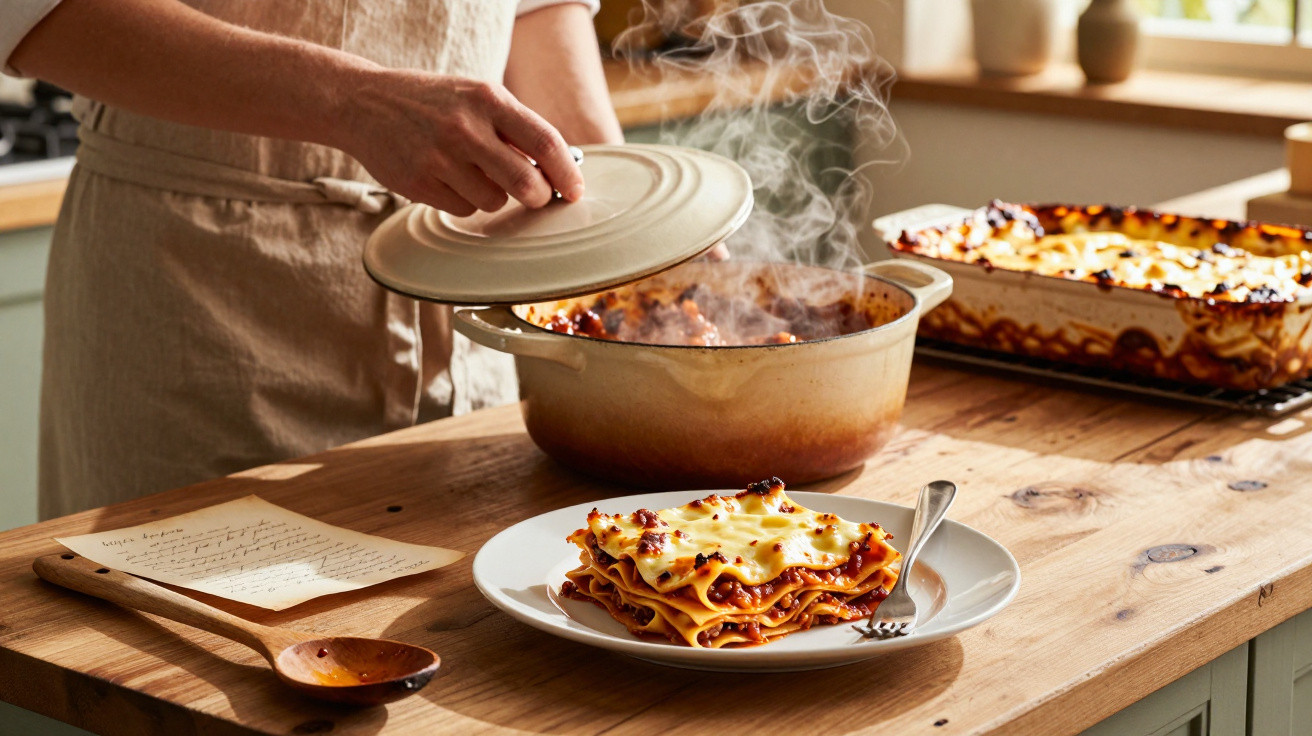
On a rainy Sunday, the kitchen quickly fills with aromas that make you forget the time: onion softening gently, grated carrot, wine crackling at the bottom of the casserole. We all know that moment when we meant only to make dinner, then find ourselves guarding a sauce as though it were a family heirloom. Bolognese lasagne is not a hurried dish. It calls for a little attention, a few patient movements and that curious faith inspired by a pan simmering quietly. In Bologna, ragù is serious business, but you do not need an Italian nonna in your kitchen to come close to it. You simply need to honour the time. And not cut corners on the basics.
Bolognese ragù starts well before the minced meat
For many people, the vegetables are the first surprise when making proper homemade lasagne. The soffritto - finely diced onion, carrot and celery - gives ragù its understated depth: you may not notice it with the first mouthful, but its absence is sorely felt. In a large casserole, soften the vegetables over a low heat with a little olive oil and a knob of butter. They should not brown too quickly. They should almost melt away.
In many Emilia-Romagna kitchens, the quantities are kept restrained: around 100 grams of carrot, 100 grams of celery and one onion for 500 grams of meat. It may seem like an ordinary foundation, yet it changes the sauce entirely. A cook from Bologna will often say that a successful ragù should not taste of any one ingredient. It should taste rounded and comforting, like a conversation that carries on around the table.
Once the vegetables are soft, add the meat, ideally a mixture of beef and pork. The beef gives the sauce structure, while pork brings a slightly fatty tenderness that stops it becoming dry after several hours of cooking. Brown it without rushing, breaking up the pieces with a wooden spoon. The meat should sizzle, not boil. If the casserole is too small or overfilled, the meat will release its water and lose the rich brown colour that already signals a good ragù.
The secret of lasagne: let the sauce tell its story
When the meat has browned properly, pour in a little dry white wine. It need not be an expensive bottle, but it should be a wine you would happily drink. Allow it to reduce almost completely, then stir in tomato purée and chopped tomatoes, without turning the casserole into a red soup. Traditional Bolognese ragù is meatier than it is tomato-led. Add a little stock, cover the pan halfway and leave it to simmer very gently for at least two hours.
Let us be honest: nobody really does this every day. Simmering for two hours requires some planning, the occasional stir and the restraint not to turn up the heat. Yet this is exactly where the dish becomes memorable. A slowly cooked sauce thickens by itself, its flavours meld and the meat develops an almost confit-like texture. Time is an ingredient no supermarket sells.
Towards the end of cooking, add a dash of whole milk if the sauce seems too sharp or acidic. This Italian habit often comes as a surprise, although it lends a very delicate softness. Taste only at this point, as the salt becomes more concentrated during reduction. Then assemble the lasagne with pasta sheets, ragù, a loose béchamel and freshly grated Parmesan.
“A good sauce should not impress in the first minute: it should make you want to return to it with a piece of bread.”
- Allow 500 g of meat for a family dish serving six.
- Simmer the ragù for 2 h to 3 h over a very low heat.
- Use a béchamel that is fluid enough for the pasta to cook without drying out.
- Let the lasagne stand for 15 minutes before serving.
The most common mistake is piling up overly thick layers, as if generosity could be measured in centimetres. Lasagne becomes more elegant when every layer remains distinct: a thin spread of ragù, a veil of béchamel, Parmesan, then pasta. Also avoid using large quantities of mozzarella. It is very popular outside Italy, but less true to the classic Bolognese version. It adds moisture and can weigh down the dish, whereas Parmesan delivers a cleaner flavour.
At the table, lasagne reveals what the recipe does not always say
Taking a dish of lasagne from the oven is always a small domestic occasion. The golden crust cracks beneath the spoon, the sauce still bubbles around the edges, and suddenly everyone is hungry - even the person who claimed ten minutes earlier that they would have “just a small portion”. This dish is less about culinary performance than the care shown to others. It is usually made for several people, and rarely for oneself alone.
The recipe can become your own, too: choose meat from the local butcher, buy fresh pasta at the market or make it on an evening when you have time. Simply keep the spirit of ragù in mind: few ingredients, slow cooking and no dramatic techniques. Flavour comes from patience, not an avalanche of herbs or spices. A little nutmeg in the béchamel is more than enough to give the dish its signature.
Leftovers have a magic of their own. Reheated the next day, lasagne can seem even better, because the layers have settled and the ragù has continued its quiet work. Serve it with a bitter salad, a few rocket leaves or radicchio, and a light glass of Lambrusco if the occasion suits. The aim is not to recreate Bologna down to the last detail; it is to find at home that generous slowness which transforms an ordinary meal.
| Essential point | Detail | Added value for the reader |
|---|---|---|
| The soffritto | Onion, carrot and celery slowly cooked before the meat | A deeper, naturally balanced sauce |
| The simmering | Two to three hours over a low heat, adding only a little liquid at a time | A melting texture and concentrated ragù without heaviness |
| The assembly | Thin layers of pasta, ragù, fluid béchamel and Parmesan | Soft lasagne, clean slices and a well-browned topping |

















Comments
No comments yet. Be the first to comment!
Leave a Comment