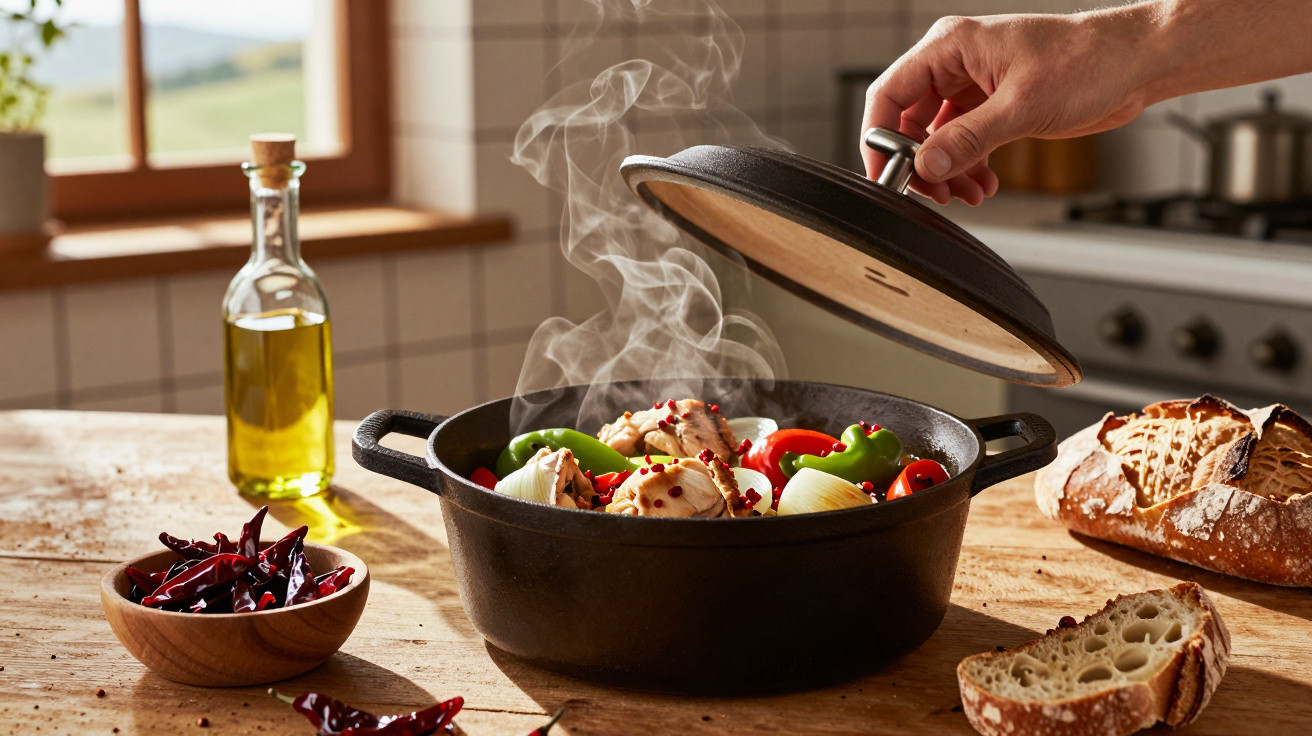
On a Sunday at lunchtime, the casserole begins to sing long before the guests arrive. In the kitchen, red and green peppers slowly release their juices, the onion turns translucent, and the scent of warm tomatoes instantly brings back meals where everyone had time to linger. Basque chicken may not look like a difficult dish at first glance, yet it needs that little extra care which turns an everyday dinner into a proper occasion around the table. We all know the moment when you lift the lid merely to check, only to think that it already smells like a holiday. Its Espelette pepper is not there to set your mouth on fire: it lifts every other flavour. At that point, the casserole does all the talking.
Basque chicken: a matter of patience rather than technique
The real appeal of Basque chicken begins with the vegetables rather than the meat. In a large casserole, the sliced peppers need sufficient time to soften until they are almost confit, while still keeping some of their colour; that melting texture gives the dish its warm, generous character.
In many Basque Country households, everyone has their own small twist: a little Bayonne ham, an extra touch of garlic, or freshly skinned tomatoes while the garden is still producing. For four to six people, you will usually need one jointed chicken, three peppers, two onions, four ripe tomatoes and one level teaspoon of Espelette pepper.
Piperade-the blend of tomatoes, peppers, onions and pepper-is not simply a sauce placed beneath the chicken. It must take in the cooking juices from the meat, absorb some of its fat, then reduce gently until glossy and thick. This is food that should not be hurried, even on days when everything else is a rush.
Traditional Basque chicken with melting peppers and Espelette pepper
First, brown the chicken pieces in a drizzle of olive oil, skin-side down, until they take on an attractive hazelnut colour. Remove them before they are cooked through, then sauté the sliced onions and strips of pepper in the same casserole; they will benefit from every bit of flavour left by the meat.
Add the garlic, chopped tomatoes, one bay leaf and a pinch of thyme, then simmer gently for around twenty minutes before returning the chicken to the pan. Let us be honest: nobody really skins tomatoes one by one every day, so good-quality tinned chopped tomatoes can rescue a meal without betraying the spirit of the dish.
Add the Espelette pepper sparingly, preferably towards the end, to retain its mildly fruity aroma and delicate warmth. It is not a replacement for black pepper: it provides a signature flavour, almost like a touch of brightness in the sauce.
“A good Basque chicken should have just enough heat to make you want another spoonful of sauce.”
- The right choice: opt for chicken legs or thighs, which remain juicier than breast meat.
- Do not salt too early if you are using Bayonne ham, as it is naturally already quite salty.
- Leave the casserole off the heat for ten minutes: the flavours settle and the sauce thickens.
- Serve it with plain rice, steamed potatoes or a slice of country bread.
The small touches that make a casserole memorable
The first mistake is trying to rush the peppers. If they remain crisp, the dish lacks roundness and the tomato tastes more acidic; cook them slowly, stirring now and then, until they are silky. A total cooking time of forty-five minutes is by no means excessive for a family casserole.
The choice of pepper matters too. PDO Espelette pepper guarantees a specific origin from the ten authorised communes in the Basque Country, but a small amount is more than enough: begin with half a teaspoon, then add another pinch when tasting. The pepper should complement, never overpower.
This dish copes extremely well with being left, and it is often even better the next day, once the chicken has had time to soak up the piperade. Make a little extra if possible: gently reheated with rice, or even tucked into a rustic sandwich, it retains the generosity that makes improvised meals feel forgotten.
| Essential point | Detail | Benefit for the reader |
|---|---|---|
| Melting peppers | Long, gentle cooking with the onions | A mellow, generous piperade with no bitterness |
| Properly browned chicken | Colour the pieces before simmering them | Cooking juices that naturally enrich the sauce |
| Espelette pepper | Added sparingly towards the end of cooking | Fragrant warmth without masking the tomatoes or peppers |
There is something reassuring about Basque chicken quietly simmering: it requires neither elaborate presentation nor hard-to-find ingredients, only a casserole, honest produce and a little time to spare. Depending on the season, the recipe can be adjusted with fleshier tomatoes, a yellow pepper to mellow the whole dish, or a few strips of ham to season the sauce with character. The debate over the “real” version will probably continue around dinner tables, and so much the better: recipes that matter always have several stories. Use a light hand with the pepper, allow the peppers to become tender, then share the dish without fuss-perhaps that is the gesture most faithful to the Basque spirit. Sometimes, a casserole set in the middle of the table is enough to bring everyone together.

















Comments
No comments yet. Be the first to comment!
Leave a Comment