On a rainy Saturday lunchtime, drops cling to the windows while the kitchen already smells of warming butter. The first galette is rarely flawless: one edge stays a little too pale, the batter catches in the middle, or the egg yolk looks ready to run before it reaches the table. By the second attempt, though, the movement is steadier, and buckwheat reveals its bold, faintly toasted flavour, silencing everyone gathered around the pan. We all know that moment when an uncomplicated dish unexpectedly becomes a small occasion. The complete galette is one of them. Its secret is not necessarily what you might expect.
Authentic buckwheat batter contains no shortcuts
In a Breton crêperie, a galette arrives thin and pliant at its centre, gently crisp around the edges, yet sturdy enough to hold cheese, ham and egg. That result begins with remarkably simple batter: buckwheat flour, water and salt, with an egg sometimes included according to family custom. The traditional recipe needs neither milk nor sugar, nor oil in the mixing bowl. Buckwheat has a character of its own, both rustic and delicate. Above all, it requires a little time.
For eight to ten galettes, use 330 grams of buckwheat flour, 75 cl of cold water and 8 grams of coarse grey salt. Gradually pour the water into the flour, whisking vigorously until the batter is pourable and resembles thin cream. Some Breton households add an egg to make pan cooking easier; it is not a scandal, simply a different school of thought. The real recipe is often the one that has survived in a butter-stained notebook.
Resting makes a real difference, even if it is not a miracle on its own. An hour in the fridge lets the flour hydrate and gives the batter more body, while leaving it overnight develops a deeper, almost nutty taste. Let us be honest: hardly anyone truly does that every day. When dinner is decided at 7.15 pm, even a 30-minute rest can rescue the meal. Stir gently before cooking, as buckwheat quickly settles at the bottom of the bowl.
The pan matters as much as the recipe
A billig, the large round hotplate used in crêperies, remains the dream for many galette enthusiasts. At home, a good cast-iron pan or a 28 to 32 cm non-stick crêpe pan will still produce excellent results, provided it is heated for long enough. The surface needs to be very hot before the first ladleful, but not smoking like a chimney fire. A light film of salted butter, wiped over with kitchen paper, is enough. Too much fat makes the batter slide rather than sear.
The most common mistake is pouring in too much batter because you are worried about spoiling the galette. The result is a thick, soft crêpe that is hard to fold and cannot turn crisp at the corners. Use a small ladle, then swiftly tilt the pan in a circular motion to spread the batter; on a billig, a wooden rozell does this with almost hypnotic elegance. Do not worry if the first two galettes are temperamental: they are often needed to adjust both the heat and your technique.
The ideal complete filling does not try to impress with ten ingredients. It relies on a clear trio: good-quality cooked ham, grated Emmental or Comté, and a fresh egg, finished with a knob of butter.
“A good galette should taste of buckwheat before it tastes of its filling,” a crêpe maker often says when asked for their secret.
To maintain that pleasing balance, have everything ready beside the pan:
- Plain ham, lightly salted and without overpowering smoky flavourings;
- finely grated cheese, so that it melts before the galette dries out;
- an egg at room temperature, for more even cooking;
- a little salted butter for golden edges;
- freshly ground black pepper, added just before serving.
Folding a complete galette into a proper meal
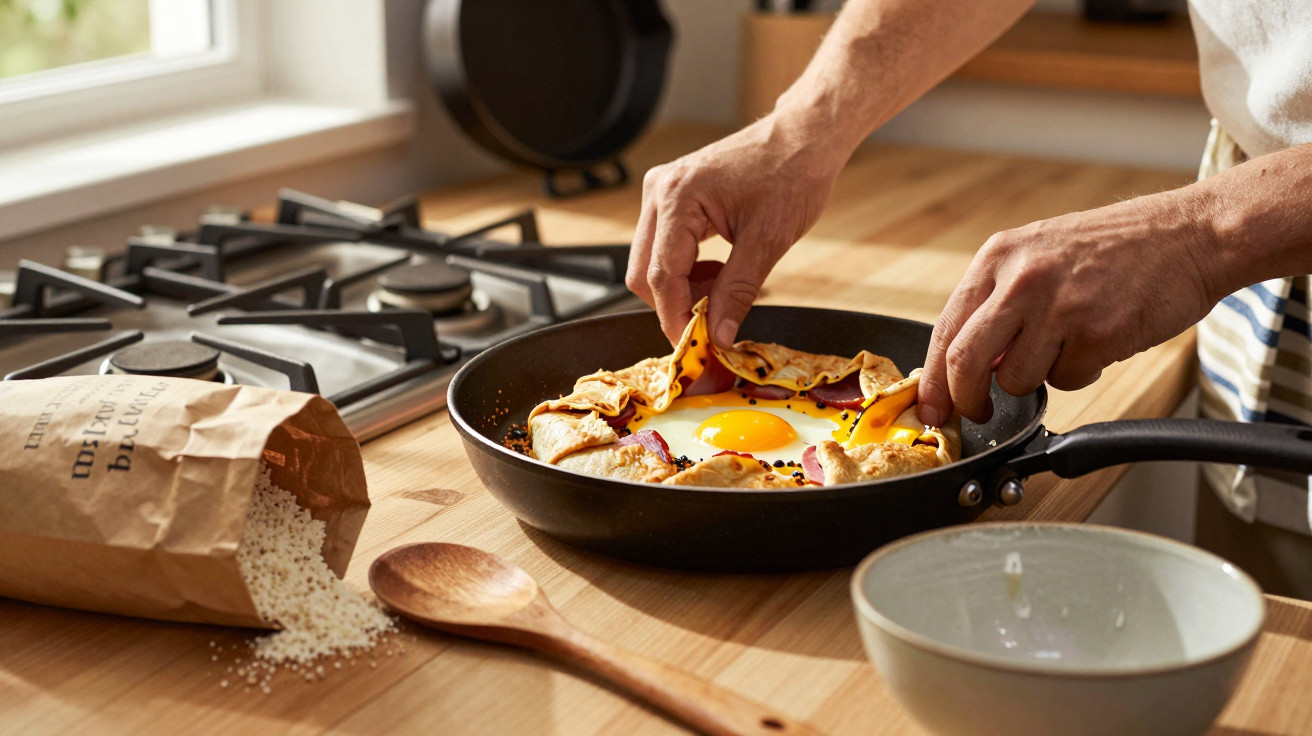
As soon as the galette has been turned, place the cheese in the middle, followed by the ham, leaving the corners clear. Crack the egg into the centre and turn the heat down slightly: the white should set gently while the yolk stays glossy and almost trembling. Fold in all four sides to make a square, without fully enclosing the yolk. This detail matters greatly, because the yolk becomes an instant sauce when the first mouthful is cut with the tip of a knife.
At the table, a complete galette is almost a meal in itself, although a sharp green salad dressed with mustard vinaigrette provides freshness and prevents it from feeling too rich. Those most devoted to tradition serve it with a bowl of dry cider, while children sometimes ask for a well-chilled cloudy apple juice. There is no galette police in a family kitchen. The real pleasure lies in hearing the edge crackle beneath the fork and watching everyone adapt their buckwheat square to their own habits.
Making Breton buckwheat galettes means accepting a small measure of unpredictability: batter that is slightly thinner depending on the flour, an egg that cooks faster than expected, or a pan that seems in a different mood from one evening to the next. This is not cooking that rewards perfection; it rewards attention. Try the plain recipe first, then note what you enjoy: extra crispness, less salt, a stronger cheese, or ham chosen from the butcher. The finest galettes often end up saying something about the person who makes them.
| Essential point | Detail | Benefit for the reader |
|---|---|---|
| Authentic batter | Buckwheat flour, cold water and salt, with resting recommended | A clearer flavour and a pliable galette without heaviness |
| High-heat cooking | A thoroughly preheated pan and a thin layer of salted butter | Crisp edges and less risk of the batter sticking |
| Balanced complete galette | Ham, melting cheese, runny egg and square folding | A simple, generous meal true to the spirit of Breton crêperies |

















Comments
No comments yet. Be the first to comment!
Leave a Comment