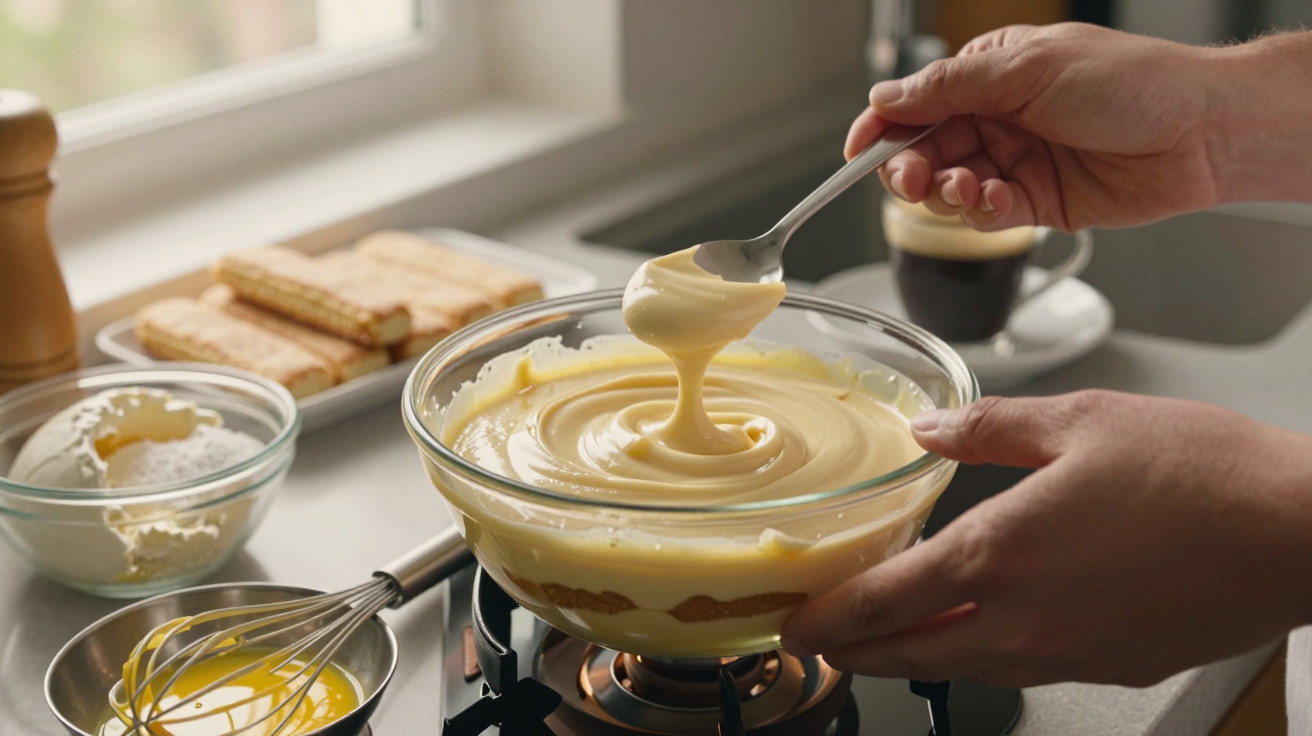
The perfect tiramisù relies on a stable, silky cream that is light enough to flow through the biscuit layers without turning runny. The safest Italian technique starts by whisking egg yolks and sugar over a bain-marie; mascarpone is added only once the base is airy, thick and ready to take on fat without losing its structure.
Why should mascarpone not be added straight to sugar?
Mascarpone is delicate and high in fat. If it is combined directly with sugar without a properly whipped base, it can become heavy, grainy or overly soft, particularly when overwhisked.
Whisking the yolks over a bain-marie produces a zabaione-like base. Gentle, controlled heat melts the sugar, gives the cream more body and lowers the risk of an unstable filling that collapses when the tiramisù is sliced.
What does a bain-marie do to egg yolks?
In a bain-marie, the yolks warm gradually as they are whisked with sugar. This action works air into the mixture, thickens it and gives it a glossier finish, without cooking the yolks into lumps.
- It dissolves the sugar more effectively, preventing crystals in the cream.
- It gives the yolks volume before the mascarpone is added.
- It forms a steadier base to support the layers.
- It produces a silky rather than liquid filling.
How do you fold in mascarpone without splitting the cream?
The mascarpone should be cold but pliable. Add it only after the yolk mixture has been removed from the bain-marie and allowed to lose its excess heat. If the base is too hot, the fat may soften beyond the right point, leaving the tiramisù loose.
Use a spatula or a whisk on a low speed. The aim is to combine the ingredients, not whisk them forcefully. Stop once the mascarpone has disappeared into the mixture and the cream is smooth; further mixing can break the emulsion.
What is the step-by-step method for tiramisù with stable cream?
Before assembling, prepare and cool the coffee, set aside the savoiardi biscuits and choose a deep serving dish. The cream needs to be ready before the biscuits are dipped, as they take up coffee quickly.
- Whisk 4 egg yolks with 100 g of sugar in a heatproof bowl.
- Place it over a bain-marie, ensuring the bowl does not touch the water, then whisk until pale and thickened.
- Remove from the heat and leave the base until lukewarm, almost cold.
- Gently fold in 500 g of mascarpone a little at a time.
- Briefly dip the biscuits in cold coffee, without soaking them through.
- Layer the biscuits and cream, finishing with a layer of cream.
- Refrigerate for at least 6 hours before dusting with cocoa.
The secret of tiramisù lies in the order and resting time
Tiramisù becomes firmer when its cream begins with thoroughly whisked yolks, dissolved sugar and carefully incorporated mascarpone. This order creates a structure that holds the moist biscuits while remaining light on the spoon.
Chilling completes the process: the coffee spreads evenly, the cream develops body and the layers stay neat when sliced. With a bain-marie, properly handled mascarpone and enough chilling time, the tiramisù reaches the table with the texture of Italian patisserie - creamy without running and intense without being heavy.

















Comments
No comments yet. Be the first to comment!
Leave a Comment