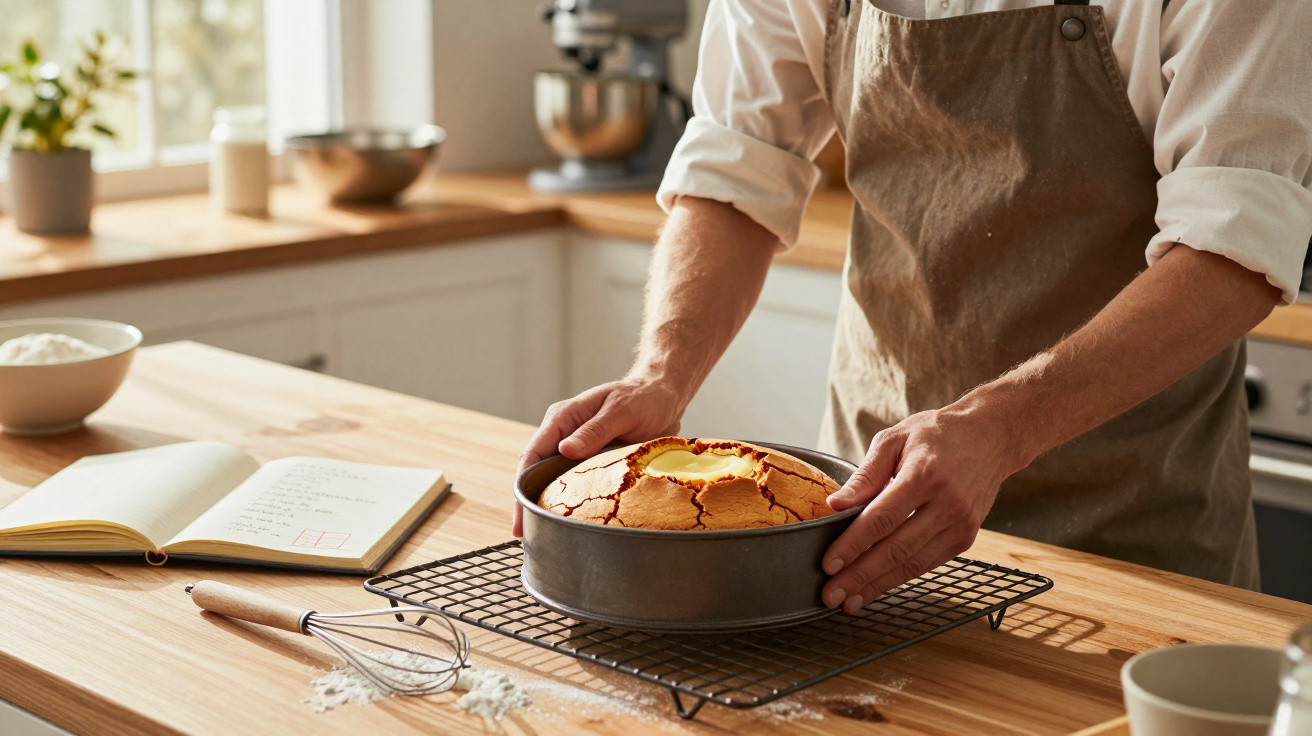
The cake rises behind the oven glass, the kitchen fills with the aroma of warm butter, and you can already picture slices served alongside a coffee. Then comes the crushing moment: scarcely placed on the worktop, the lovely dome sinks in the middle, as though it has lost heart. We all know that quiet disappointment when a cake collapses, particularly when guests are due in an hour or a child is eagerly awaiting their birthday. The good news is that this mishap is not a mystery. Oven temperature, overbeaten eggs and opening the door too soon can all weaken the crumb with just a few small mistakes. They are also far easier to put right than you might think. The key is often decided before the cake even goes into the oven.
Why your cake collapses straight after baking
A cake that sinks has not necessarily been badly made: it has often risen too quickly, before its structure has had time to set. Baking powder, whipped egg whites and air beaten into butter create bubbles which, under heat, lift the batter upwards. If the middle remains moist and delicate, all that impressive height drops away as soon as the temperature falls. The tell-tale signs are a golden, sometimes even beautiful crust, paired with a heavy or slightly sticky centre. The oven can make it seem as though the job is done, when the crucial baking is still happening in the middle of the tin.
The familiar example is a pound cake rushed together on a Sunday afternoon. You enthusiastically whisk the eggs and sugar, add a generous pinch of baking powder “just to be safe”, then watch the cake climb to the rim of the tin. Ten minutes after it comes out, there is a crater. One level teaspoon of baking powder is usually around 4 to 5 grams: in a family recipe, doubling that amount does not double the softness. Instead, it makes the batter rise too abruptly before allowing it to collapse. Height can never take the place of stability.
Oven temperature is equally crucial. An oven set too high browns the top quickly and forms an early crust, while the inside struggles to bake through. On the other hand, heat that is too low lengthens the baking time and dries the edges without giving the batter enough lift. Many domestic ovens display 180 °C when their actual temperature is 165 °C or 195 °C, especially after years of use. An oven thermometer is inexpensive and saves frustrating guesswork. A cake needs steady heat, rather than a dramatic blast of it.
Simple steps to prevent a hollow centre in your cake
Start by following the ingredient order, even when the recipe seems straightforward. Cold eggs added to softened butter can make the mixture split; flour incorporated too soon makes it dense; baking powder left at the bottom of the bowl works unevenly. Take the eggs, milk and butter out about 30 minutes before baking, then weigh everything rather than making up quantities as you go. Once the flour has been added, mix only until no white streaks remain. The batter should be smooth and even, not whipped like Chantilly cream.
The most tempting mistake is opening the oven door. You want to check, smell and admire the rise forming on top: it is only human. Yet during the first twenty minutes of a standard cake’s baking time, a sudden drop in temperature can halt the rise before the crumb has firmed up. Keep the door shut, switch on the oven light if it has one, and use the stated baking time as your first guide. Let us be honest: hardly anyone manages this every day, especially when the recipe comes from an old notebook stained with vanilla. Still, that bit of discipline transforms many batches.
To check whether it is baked through, insert a thin skewer into the centre, away from a chocolate chip or piece of fruit that could give a misleading result. It should emerge clean or with a few crumbs attached, never coated in batter.
“A cake must not merely rise: it needs time to stay standing.”
- Preheat the oven for at least 15 minutes before putting the cake in.
- Use a suitable tin: batter that is too deep will not bake properly in the centre.
- Follow the stated amount of baking powder, without an apparently reassuring “little extra”.
- Leave the cake in its tin for 5 to 10 minutes before turning it out.
A sunken cake can still tell a lovely story
Sometimes a cake sinks despite every precaution: very humid weather, old baking powder, an unpredictable oven or simply a poorly balanced recipe can all muddy the waters. Rather than throwing away this slightly sad dessert, take a look at it. If the centre is baked, a dusting of icing sugar, a light cream or fresh fruit can turn its dip into an indulgent feature. A slightly sunken yoghurt cake even makes an excellent base for strawberries. Home baking is not a shop-window competition, and that is part of what makes it so endearing.
Next time, write down the actual temperature, the type of tin and the baking time that worked in your kitchen. Two kitchens, two ovens and two flour brands can produce different results from the same printed recipe. This notebook of small reference points will eventually become more valuable than a long list of randomly found tips. Some people swear by 170 °C, while others achieve their best soft crumb at 175 °C; the answer often lies in your own oven. Sharing the story of a failed cake may even save someone else’s dessert when they discover that famous crater for themselves.
| Key point | Detail | Benefit for the reader |
|---|---|---|
| Baking the centre | A skewer should come out clean or carrying fine crumbs, with no wet batter. | Prevents a cake that looks attractive on the surface but cannot hold its shape once out of the oven. |
| Stable temperature | Fully preheat the oven and keep its door closed at the start of baking. | Encourages an even rise and a sufficiently firm crumb. |
| Baking powder quantity | Follow the specified amount instead of adding more to gain height. | Reduces excessive rising, which often causes the cake to collapse. |

















Comments
No comments yet. Be the first to comment!
Leave a Comment