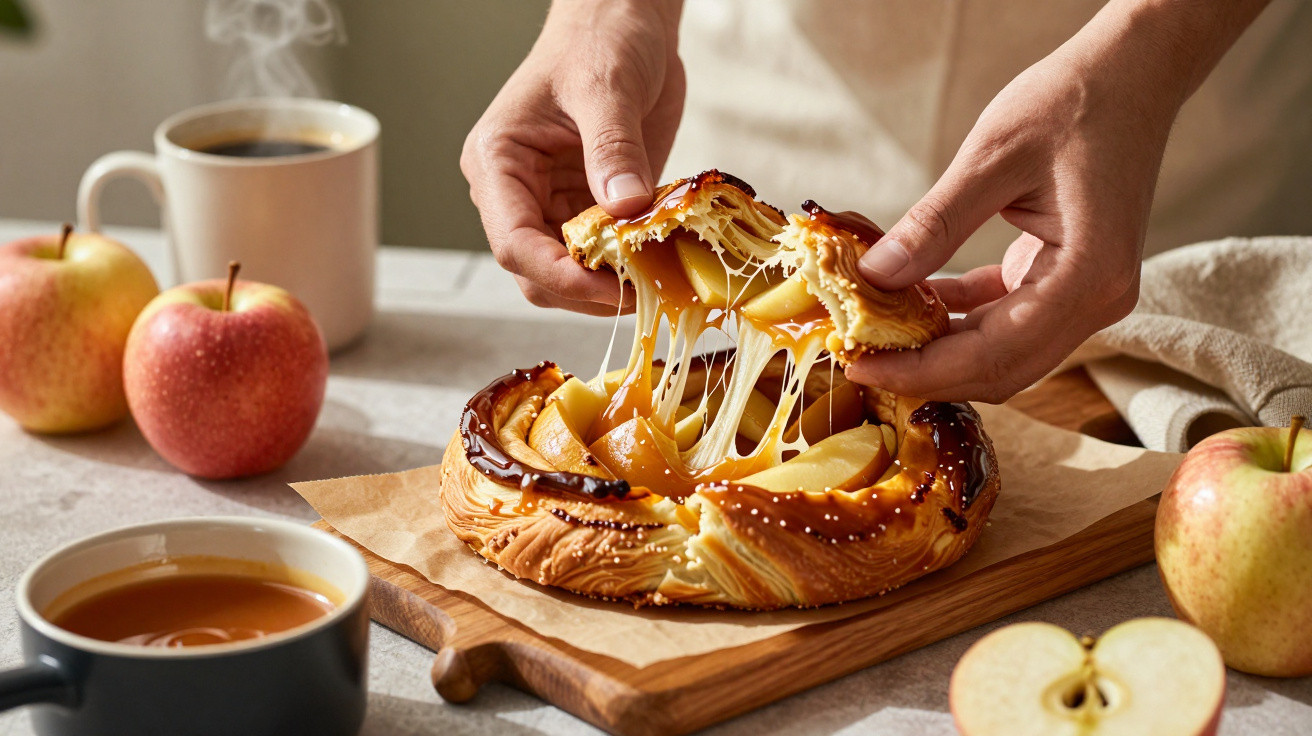
The first bite of a freshly baked apple brioche with caramelised apples makes it immediately clear why recipes like this never go out of fashion. Soft, airy layers of yeasted dough meet gently tart fruit and buttery caramel – a combination that delights children and adults alike, and is ideal for weekends, brunch or an afternoon coffee.
Why everyone loves this apple brioche right now
For many people, brioche is the sort of bakery treat they would rather buy ready-made. Its reputation is simple: delicious, but labour-intensive. This version proves otherwise. Most kitchens already have the ingredients, the method is less difficult than it sounds, and the finished bake looks and tastes as though it came straight from the counter of a quality city bakery.
“A moist yeasted brioche with golden caramelised apples mainly requires time and patience – not a professional baker.”
This pairing comes into its own particularly in spring and autumn, when cosy baking feels especially appealing. The fluffy dough and lightly fruity filling make this brioche suitable for breakfast, as a sweet working-from-home snack or as a dessert served with a scoop of vanilla ice cream.
The foundation: an honest, rich brioche
Ingredients for the yeasted dough
- 300 g wheat flour (Type 550 recommended)
- 3 eggs (medium)
- 150 g softened butter
- 10 g fresh yeast
- 40 g sugar
- 5 g salt
Together, these ingredients create a classic buttery brioche dough: rich in fat, only lightly sweetened and with a delicate crumb. The key point is that the butter should be soft but not melted, so it can be properly worked into the dough.
Ingredients for the caramelised apples
- 3–4 apples, such as Golden Delicious or Boskoop
- 40 g butter
- 50 g light brown sugar
The apple variety has a noticeable effect on the character of the finished bake. Golden Delicious offers gentle sweetness and a firm bite, while Boskoop provides a pronounced sharpness that balances the caramel.
Perfect apple brioche, step by step
Knead the dough until it is truly elastic
Place the yeast, sugar and eggs in a bowl, scatter over the flour and combine everything using your fingers or a mixer until no dry patches remain. Only then add the salt. Next comes the crucial stage: knead vigorously for around 15 minutes, folding the dough repeatedly, until it becomes smooth, glossy and elastic.
“A well-made brioche dough releases itself from the sides of the bowl and stretches easily without tearing straight away.”
Work in the softened butter in several additions. Continue kneading after each addition until it has been fully incorporated. The dough may look greasy at first, but it will gradually turn smooth again. Shape it into a ball, place it in a lightly oiled bowl and cover. Leave it to rise for at least two hours, until its volume has increased significantly.
Caramelise the apples until golden
While the dough is resting, peel and core the apples, then cut them into even wedges or thin slices. Melt the butter in a frying pan, add the apple pieces and sprinkle them with the brown sugar. Cook gently over a medium heat for about eight minutes, turning carefully so they do not break apart.
The apples should be soft in the centre and lightly browned on the outside, while still holding their shape. Varieties that soften too easily quickly turn into compote and can make the dough soggy later. Once cooked, briefly drain the apples on kitchen paper and allow them to cool, so too much syrup does not run into the dough.
Shape it as a roll, plait or wreath
On a floured worktop, gently knock the risen dough back with your fist. Roll it into a rectangle measuring roughly 30 × 20 cm. Spread the apple pieces evenly over the surface, aiming to ensure that every eventual slice contains a good amount of filling.
Roll up the dough tightly from the long side. If you like, slice the roll lengthways once and loosely twist the two strands together to create a kind of filled plait. Alternatively, join the roll into a wreath. Transfer it to a baking tray lined with baking paper, then leave it to rise again for around one hour, until it has visibly expanded.
Bake until the crust and aroma are right
Preheat the oven to 170 °C conventional heat. Bake the brioche on the middle shelf for about 25 minutes, until attractively golden brown and gently domed. If you are unsure, lightly tap the underside: a hollow sound means it is done.
“A few minutes of cooling allow the crumb to set and let the apple flavours come fully into their own.”
Serve it while still warm; this is when the texture is at its most moist and the caramel remains slightly soft.
Bakery tips for even better flavour
Choosing the right apple variety
- Golden Delicious: mild, sweet and stable during cooking; ideal for anyone who prefers less acidity.
- Boskoop: distinctly tart and aromatic, giving the caramel more contrast.
- Not suitable: very floury or exceptionally soft varieties that collapse quickly.
Anyone wishing to experiment can simply combine two varieties – one sweet and one tart. This creates a more complex flavour.
Keep oven temperature and baking time under control
At too high a temperature, the surface browns while the centre is still doughy. 170 °C is a useful guide. If your oven runs particularly hot, use a baking thermometer and check after 20 minutes: if the crust already looks very dark, covering the brioche with a piece of aluminium foil can help.
How to make the dough truly fluffy
Patience is particularly important for an airy texture. The dough needs time to develop both flavour and volume. A warm, but not hot, place at around 24 °C is ideal. Shortening the proving time or leaving the dough near a powerful radiator risks a coarse crumb or a yeasty taste.
Serving, pairing and storing
How apple brioche tastes best
Most people enjoy it plain, still slightly warm and simply sliced. It pairs especially well with:
- a strong coffee or milky coffee
- a cup of tea, such as black tea or chai
- hot chocolate for children and anyone with a sweet tooth
- a dollop of whipped cream or a spoonful of crème fraîche for extra richness
As a dessert, a serving of vanilla or cinnamon ice cream alongside makes it feel almost like a restaurant pudding – with comparatively little effort.
Keeping brioche delicious for several days
Stored in a tightly sealed tin or beneath a cake dome, the bake will keep at room temperature for two to three days. It dries out more quickly in the fridge. An oven is better than a microwave for reheating: wrap the brioche in aluminium foil and warm it at 160 °C for a few minutes, until soft again.
Common mistakes – and how to avoid them
- Kneading for too little time: The dough remains dense and rises less effectively. Solution: work it for a full 10–15 minutes, until it can be stretched.
- Too much liquid from the apples: The crumb becomes heavy and gummy. Solution: drain the apples thoroughly and do not soak them in syrup.
- Proving or baking at too high a temperature: The outside darkens while the inside stays raw. Solution: use moderate heat and allow a few extra minutes of baking time if needed.
If you are sensitive to yeast, you can extend the first proving time or let the dough mature overnight in the fridge. As well as improving digestibility, this gives a more rounded flavour, similar to that of long-fermented bread.
It is also worth considering variations: a few chopped walnuts or almonds in the filling add crunch, while a pinch of cinnamon or cardamom in the dough brings a wintry note. For a lighter version, reduce the butter quantity slightly and use a splash of milk instead – the texture will be a little less rich, but will remain pleasantly soft.

















Comments
No comments yet. Be the first to comment!
Leave a Comment