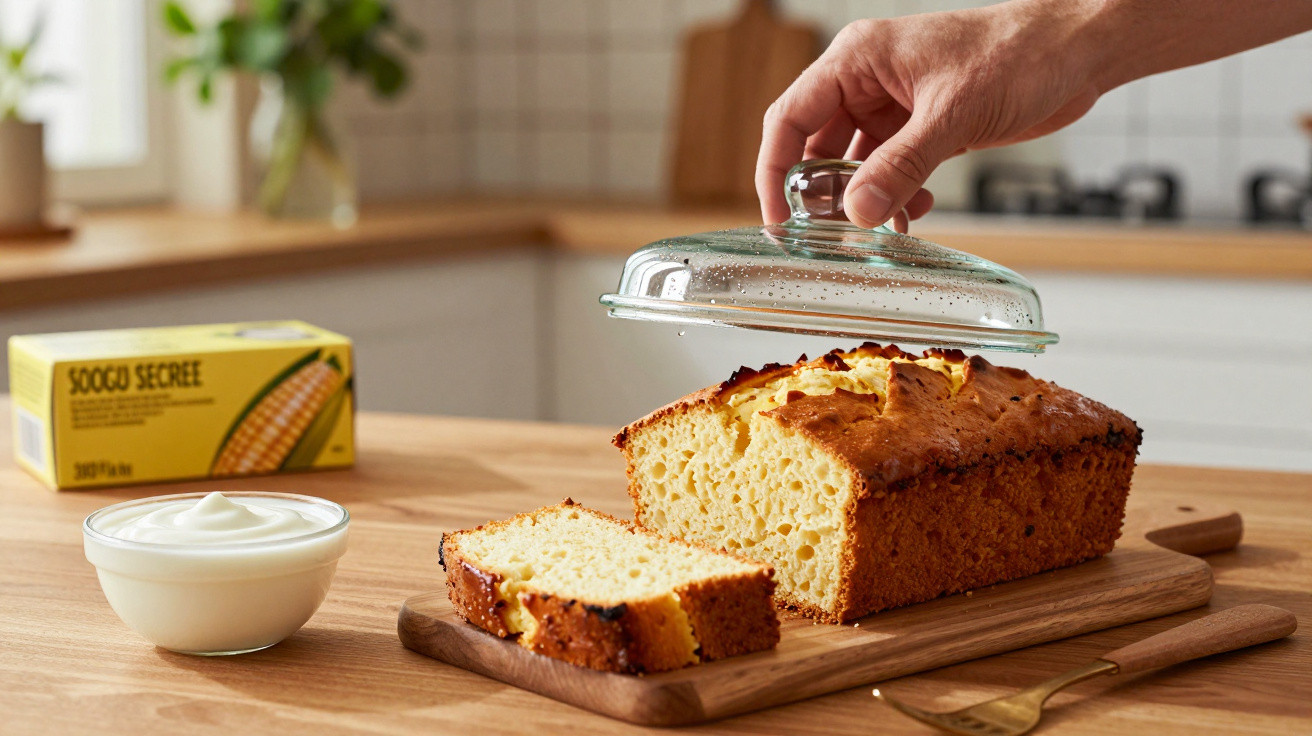
Yoghurt cake is among the easiest and most popular sponge cakes to make. It uses a pot as a measuring tool, needs only a few ingredients and requires no specialist equipment. Yet the disappointment often comes the following day: cracked on the outside, heavy and dry in the middle. One unassuming packet from the cupboard can prevent precisely this problem – and keep the cake moist for 48 hours.
Why classic yoghurt cake so often turns out dry
The basic recipe sounds wonderfully straightforward: one pot of yoghurt, two pots of sugar, three pots of flour, half a pot of oil, three eggs and a raising agent. This recipe has been passed through many family kitchens unchanged for decades. Nevertheless, the texture surprisingly often shifts from “light” to “stodgy”.
The cause is rarely one single mistake; it is usually several factors combined:
- mixing the batter for too long
- an oven that is too hot or an excessively long baking time
- too much wheat flour, and consequently too much gluten
- leaving the cake exposed to the air, where it dries out
The final point is particularly frustrating in everyday life: you bake it the day before for school, work or a picnic, then every slice seems to need half a cup of tea just to go down.
The turning point comes from one packet in the kitchen cupboard: cornflour, often known as Maizena.
The 50/50 cornflour trick: what really happens in the batter
The key technique is to replace half the wheat flour with maize-based cornflour. The usual three pots of “flour” therefore become:
- 1.5 pots of wheat flour
- 1.5 pots of cornflour (maize)
Put both into a bowl with one packet of baking powder, then sift them thoroughly. Sifting removes any lumps and distributes the raising agent evenly.
Limiting gluten, encouraging lightness
Wheat flour contains gluten. As soon as liquid and a whisk are involved, it starts to form an elastic network. This is ideal for bread, but more delicate when baking cake. If the batter is worked too vigorously, the network tightens and the cake becomes dense and rubbery.
Cornflour is pure starch and contains no gluten. It “dilutes” the gluten network, slows its development and creates a finer crumb. The cake retains a stable structure without becoming tough.
Cornflour cuts through the gluten network like tiny air gaps in a sponge – keeping the cake soft rather than “chewy”.
More moisture, fewer crumbs
Maize starch is particularly effective at binding water. In the batter, it holds on to moisture and releases it gradually after baking. As a result, the centre stays soft even once the surface has cooled slightly and begun to set.
This is exactly why yoghurt cake made with the 50/50 mixture still seems noticeably moister after 48 hours than a version made entirely with flour.
Step-by-step method: making a moist yoghurt cake
For a cake baked in a standard loaf tin or springform tin, the simple pot-measure method is sufficient. One yoghurt pot, usually 125 g, is used as the measure.
Basic ingredients
- 1 pot of natural yoghurt
- 2 pots of sugar
- 1/2 pot of neutral oil, such as sunflower oil
- 3 eggs
- 1.5 pots of wheat flour
- 1.5 pots of cornflour (maize)
- 1 packet of baking powder
- Optional: a pinch of bicarbonate of soda
Method
- Preheat the oven to 180°C, conventional heat.
- Grease the tin and, where possible, dust it lightly with flour or cornflour.
- Whisk the yoghurt and sugar together in a bowl until the mixture looks smooth.
- Incorporate the oil and eggs one at a time, mixing only until everything is combined.
- Mix and sift the flour, cornflour and baking powder, along with the optional bicarbonate of soda, in a second bowl.
- Fold the dry ingredients into the yoghurt mixture in two or three additions – do not whip the batter; stir only briefly and gently.
- Transfer the batter to the prepared tin and level the surface.
- Bake at 180°C for around 30–35 minutes. Test with a skewer: if it comes out dry, remove the cake from the oven immediately.
The biggest mistake is overmixing. Once the dry ingredients are in the batter, it is better to stop too early than too late.
Why this yoghurt cake trick keeps the cake soft for 48 hours
The combination of less active gluten and greater moisture retention has a double effect. While ordinary yoghurt cakes can lose a noticeable amount of moisture within a few hours, cornflour keeps it locked into the centre.
The optional bicarbonate of soda also has an interesting role: it reacts with the yoghurt’s natural acidity and produces tiny bubbles of gas. These support the baking powder as the cake rises and make for a fine, evenly aerated crumb.
Anyone preparing the cake the day before a get-together or family outing benefits especially: the following day, it cuts neatly without tearing and is still noticeably soft inside.
Variations without losing texture: keeping the cake light with extras
It is tempting to add chocolate pieces or nuts, only to find afterwards that the batter has become considerably heavier. The 50/50 mixture leaves more room for additions.
Popular additions that barely weigh down the crumb
- finely grated lemon or orange zest
- liquid vanilla flavouring or vanilla seeds
- small chocolate chips or drops
- a knife-tip of cinnamon or cardamom
If you would like to mix in cocoa, replace part of the flour with cocoa rather than sprinkling in extra powder. Otherwise, the mixture will absorb too much.
Storage: how yoghurt cake genuinely stays moist for longer
Even the best batter technique is of little use if the cake dries out uncovered. A few simple rules make the difference:
- Allow the cake to cool completely before covering it, so condensation does not make the surface soggy.
- Pack it in an airtight container, such as a cake tin or tightly sealed wrap.
- Store it at room temperature rather than in the fridge, as cold temperatures make the crumb firm up faster.
| Version | Texture after 24 h | Texture after 48 h |
|---|---|---|
| Wheat flour only | noticeably drier edge | crumbly in the centre, hard around the edge |
| 50% flour, 50% cornflour | soft and easy to slice | slightly firmer, but still moist |
Why this simple yoghurt cake trick is particularly worthwhile for families
Anyone with children at home knows the issue: a cake rarely lasts only one afternoon. Leftovers go into lunchboxes, travel to school or become a snack at work. This is where the improved staying power of the texture becomes clear.
Instead of crumbly pieces that fall apart in a school bag, the slices remain sturdy while still soft. It is especially useful for day trips and picnics, when nobody wants to carry half a suitcase of drinks simply to wash down dry cake.
A look at kitchen chemistry: the principle to remember
Once you understand the principle, you can apply it to other sponge cakes. Whenever a recipe relies heavily on wheat flour but is meant to have a tender result, substituting some cornflour helps. Muffins, loaf cakes and simple fruit cakes all benefit from a lower gluten content.
A rough rule of thumb is this: the softer and finer the cake should feel, the higher the proportion of starch can be. For sponge cakes, a range of around 30 to 50 percent generally works well. For genoise-style sponge, it is often even higher.
If you enjoy experimenting, start with small adjustments: replace one third of the flour first, then increase this to half later. This makes it possible to fine-tune your preferred texture without having to search for a new recipe every time.

















Comments
No comments yet. Be the first to comment!
Leave a Comment