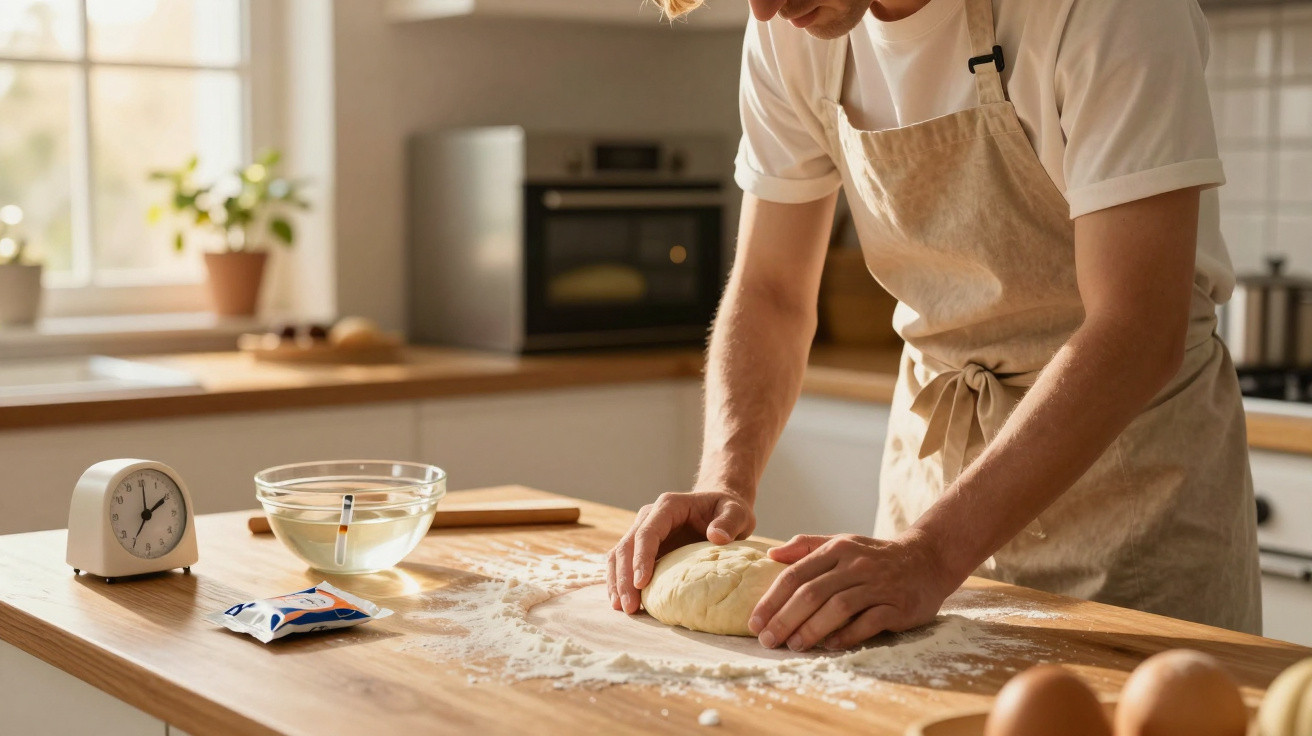
On a Sunday morning, the kitchen fills with the scent of flour, coffee and optimism. You lift the tea towel from the bowl, expecting dough puffed up like a small cloud… only to find a flat, dense mass that feels almost insulting. We all know the moment when homemade bread seems determined not to play along. Yet bread that will not rise does not automatically mean the recipe has failed: it usually points to an overlooked detail, a wrongly judged temperature or a step done a little too quickly. The encouraging part is that these mishaps are highly fixable. Sometimes, all it takes is water that is less hot, a little more patience or yeast stored more carefully. Bread needs time, but it also allows plenty of room for improvisation. It is not quite as mysterious as it seems.
Yeast and water: the two culprits noticed too late
The most common reason for flat bread is often the yeast: a tiny ingredient that nevertheless does all the work. A sachet left for months in a warm cupboard, fresh yeast that has turned slightly grey, or an expired date can be enough to stop fermentation. The dough may be soft, pleasant to knead and beautifully fragrant, but without active yeast it will barely move. Before wasting all your flour, test it by combining it with a little lukewarm water and a pinch of sugar. If foam appears after ten minutes, it is still alive. If nothing happens, it is best to use another sachet.
Overheated water is the other familiar trap. Keen to get the dough started, it is easy to pour in water that feels merely warm on your finger when it is actually close to 50 °C: yeast cannot survive such a harsh bath. At the other extreme, icy water slows its activity so much that you may wrongly assume the recipe is not working. Aim for around 30 to 35 °C, a comfortable temperature similar to water for a baby’s bottle. One amateur baker said she had ruined three batches before discovering that her “warm” tap water was coming out at nearly 45 °C. A thermometer saved her breakfasts.
It is also worth checking how the ingredients are brought together. Salt, essential for flavour and crumb structure, can severely slow yeast when a large amount is placed directly against it. Put the yeast on one side of the flour and the salt on the other, then gradually incorporate the water. This may seem like a tiny precaution, but it prevents many inactive doughs. Yeast is alive, and it responds to its surroundings. Let us be honest: nobody does this every day with laboratory-level precision, but two minutes of care can make all the difference.
Flour, kneading and temperature: what your dough is telling you
Flour with too little protein can prevent bread from gaining height. Gluten creates an elastic network that holds the gases released by yeast; without it, the bubbles escape and the dough spreads rather than rises. For a baguette, loaf or bread rolls, choose T55 or T65 wheat flour, which is often more suitable than some very wholemeal flours. Rye, chestnut and buckwheat flours bring wonderful flavours, but they should be combined with wheat flour if you want a particularly airy crumb. Rustic bread does not have to be heavy.
Kneading also has a subtle but crucial part to play. Dough that has not been worked for long enough lacks structure: it rises a little, then collapses or sinks as soon as it is shaped. When kneading by hand, allow roughly eight to ten minutes of steady movements: stretch, fold and turn it, without attacking it. The dough will become smoother and slightly springy. Conversely, a stand mixer running too fast can warm the dough and weaken its structure. What is the right sign? When you gently stretch a piece, it should create a thin membrane without tearing straight away.
Room temperature accounts for many winter disappointments. Dough left near a cold window may need three hours, or even longer, whereas the same recipe will double in size in an hour and a half in a kitchen at 24 °C. Do not rely on the clock alone: watch its volume.
“Dough does not know the time; it knows the warmth.”
A few straightforward steps can help create a cosy environment:
- put the bowl in a switched-off oven with the light on;
- cover it with a slightly damp cloth or a lid;
- keep it away from draughts and a cold worktop.
The forgotten resting time and the actions that deflate dough
The sixth cause is often the most frustrating, because it happens when everything finally appeared to be going well: insufficient resting time, or overly rough shaping after the first rise. Dough that has not had time to relax resists, tears and loses some of the air it has built up. Once shaped, it still needs to rise before going into the oven. This second rise, sometimes called proofing, gives bread its final volume and a lighter crumb. Wait until it has visibly expanded, but do not let it reach the point where it becomes soft and collapses when touched. Bread is often made in the waiting.
Too much flour on the work surface can create problems too. It is added to prevent sticking, then the dough absorbs this dry flour, becomes firmer and rises less effectively. For handling sticky dough, use slightly damp hands or a small drop of oil instead. Also avoid opening the oven during the first few minutes: the sudden temperature change can disrupt the final rise. Steam, meanwhile, helps the crust remain supple at the beginning. A small dish of hot water placed in the oven is often enough to achieve the dramatic lift you were hoping for.
Flat bread does not mean you are bad at cooking; it means the dough has encountered an obstacle. It may be tired yeast. It may be a cold room, unsuitable flour or the entirely understandable urge to hurry things along. Next time, photograph the dough before and after resting, note the approximate kitchen temperature and observe its texture. Little by little, these details build your instinct. The most rewarding moment remains taking a golden loaf from the oven: perhaps imperfect, but risen, crisp and truly homemade. Which of these small mistakes happens to you most often?
| Key point | Detail | Benefit for the reader |
|---|---|---|
| Active yeast | Test the yeast in water at 30-35 °C with a pinch of sugar | Prevents an entire batch being wasted on an ineffective sachet |
| Right temperature | Leave the dough somewhere warm, covered and free from draughts | Enables a steady rise, even when the kitchen is cold |
| Enough resting time | Allow for the first rise, then the rise after shaping | Produces bread that is taller, lighter and more open-textured |

















Comments
No comments yet. Be the first to comment!
Leave a Comment