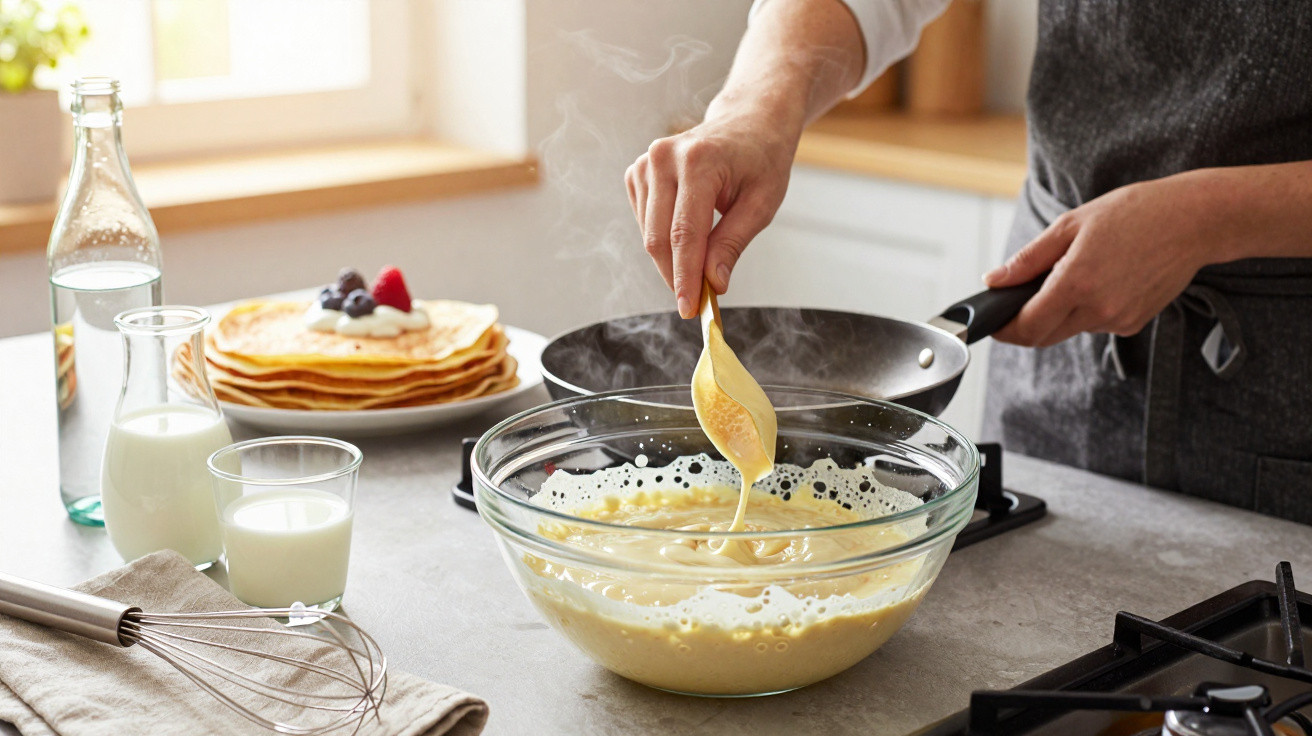
Many people love crêpes or pancakes, yet feel uncomfortably full after just a few. A simple calculation involving the liquid in the batter produces airy, delicate crêpes that feel less heavy – without costly specialist ingredients. The clever idea dates back to rationing periods, suits modern eating habits surprisingly well and costs virtually nothing.
Why traditional crêpes can feel heavy so quickly
Classic crêpe or pancake batter usually combines flour, eggs, a generous amount of milk, some fat and sugar. While this creates flavour and browning, it also means:
- plenty of calories in a small portion
- substantial amounts of fat and protein from the milk
- a relatively dense, compact batter
That density is exactly what can be felt later in the stomach. Add a generous filling of Nutella, jam or cheese and it can soon feel as though you have “eaten a stone”. This is where the straightforward trick helps: it takes some of the heaviness out of the batter without sacrificing volume or enjoyment.
The 50/50 trick: half milk, half water
The basic principle is simple: replace half the milk stated in the recipe with water. Nothing else is required. The batter remains familiar and handles in the pan in the same way; only the balance of liquids changes.
Half milk, half water – the same amount of batter, but a noticeably lighter feeling after eating.
If you would normally use around 500 ml of cow’s milk, instead mix 250 ml of milk with 250 ml of water. Everything else in the recipe stays unchanged: flour, eggs, a pinch of salt, perhaps sugar or vanilla, and a little butter or oil for flavour.
How the nutritional profile changes
Diluting the milk with water significantly reduces the calories contributed by the milk. Experts refer to around 30 per cent fewer calories, fat and protein from this part of the ingredients. This has three benefits:
- less energy per crêpe, despite almost the same size
- a slightly lower lactose content, which can suit many sensitive stomachs
- an overall lighter mouthfeel
The method also benefits the household budget: tap water costs next to nothing, while milk can become expensive quickly in larger families.
Even lighter crêpes: sparkling water for extra air in the batter
For especially fluffy crêpes, use sparkling mineral water rather than still water. The reason for the effect is easy to understand with a little physics.
Carbonation in the batter creates tiny bubbles as it heats – like a natural air cushion inside the crêpe.
The carbon dioxide in sparkling water expands in the hot pan, forming small bubbles that loosen the batter. The resulting crêpes are:
- lighter and more tender
- finished with fine, lace-like edges
- pleasantly flexible and easy to fold
How to use the sparkling-water trick
For everyday cooking, follow this straightforward method:
- Mix the batter as usual using flour, eggs and half the quantity of milk.
- Beat out any lumps thoroughly, or briefly pour the mixture through a sieve.
- Take well-chilled sparkling mineral water from the fridge.
- Stir in the fizzy water only at the very end, so that as many bubbles as possible remain in the batter.
- Pour the batter straight into a very hot, lightly greased pan.
The combination of ice-cold mineral water and a hot pan creates a marked temperature shock. The surface sets quickly, effectively “freezing” the gas bubbles into their airy shape. This keeps the crêpes light without making them tear.
An alternative to sparkling water: bicarbonate of soda and lemon
No sparkling water at home? A small kitchen trick can partly recreate the effect. Combine cold water with a teaspoon of bicarbonate of soda and a few drops of lemon juice. The acid reacts with the bicarbonate, producing tiny gas bubbles that also add some lightness. It barely changes the flavour, but the texture becomes noticeably looser.
Can crêpes be made without any milk?
Technically, crêpe batter also works entirely with water – making it suitable for people avoiding dairy products or those who do not tolerate lactose well. In this version, the eggs and flour provide most of the binding.
100 per cent water in the batter makes crêpes lighter, but removes some of milk’s “rounded” flavour.
If you make dairy-free batter, keep two things in mind:
- Heat the pan thoroughly so the batter begins setting immediately.
- Lightly grease the pan again between each crêpe, as the batter itself contains less fat.
Flavourings can make up for the missing milk element: vanilla, orange blossom, a little rum or finely grated citrus zest all add depth. The filling matters greatly too. Fruity toppings, nut butter or savoury fillings can make the flavour of the batter almost secondary.
How lighter crêpe batter fits into everyday life
Many people who try the 50/50 trick report feeling considerably less bloated – especially on occasions such as Candlemas, birthday buffets or Sunday brunches, when stacks of crêpes are served. You can still enjoy several without ending up drowsy in an armchair for hours.
For families with children, the method has another advantage: the batter goes further. Where one bowl previously made ten crêpes, the same amount of flour can now produce more because the added water increases the overall mixture. It also makes it easier to cater for an unexpected group of visitors.
Healthier fillings that support the lighter approach
The batter is only half the equation. To avoid immediately undoing the lighter effect, it is worth paying some attention to the filling. Consider these options:
- fresh berries with a little yoghurt or Skyr
- low-sugar fruit compotes, such as apple or plum
- savoury versions with spinach, mushrooms or lean ham
- a thin spread of nut butter instead of thick layers of chocolate spread
Anyone unwilling to give up favourites such as chocolate spread can simply use a smaller amount and bulk it out with banana slices. The enjoyment remains, while the calorie balance is still more moderate.
Why water in crêpe batter can feel gentler on digestion
Adding water dilutes the concentration of fat and lactose in every mouthful. For people with sensitive stomachs or mild lactose intolerance, this can make a noticeable difference. The body has less work to do to process each crêpe.
The airy structure created by carbonation also plays a part: loosely baked batters can feel subjectively less heavy than very dense versions. The same principle applies to bread rolls and sponge cakes – the more air they contain, the lighter they seem in both the mouth and the stomach.
A practical basic formula for home
To remember the method, you really need only one rule of thumb. A possible basic batter for a household could look like this:
| Ingredient | Quantity |
|---|---|
| Flour | 250 g |
| Eggs | 3 |
| Milk | 250 ml |
| Water (still or sparkling) | 250 ml |
| Pinch of salt, optional sugar/vanilla | To taste |
If the batter looks too thick, add a little more water a splash at a time. If it becomes too thin, thoroughly stir in a tablespoon of flour to bring it back to the usual consistency.
When the trick is most worthwhile – and what to watch for
The 50/50 mix is particularly useful when lots of crêpes will be eaten: children’s birthday parties, brunch buffets, sports-club events or film nights. Anyone eating only one or two will mainly notice the difference in texture rather than digestion.
With induction hobs or particularly powerful gas cookers, a little sensitivity is helpful. The pan should be very hot, but not smoking so fiercely that the thinner batter burns straight away. One test crêpe will help you find the ideal temperature.
Anyone who uses this approach regularly will soon develop a feel for how the batter should flow from ladle to pan. After that, it matters little whether you have sparkling water, tap water or slightly more milk to hand – the crêpes will stay tender, flexible and, above all, pleasantly light.

















Comments
No comments yet. Be the first to comment!
Leave a Comment