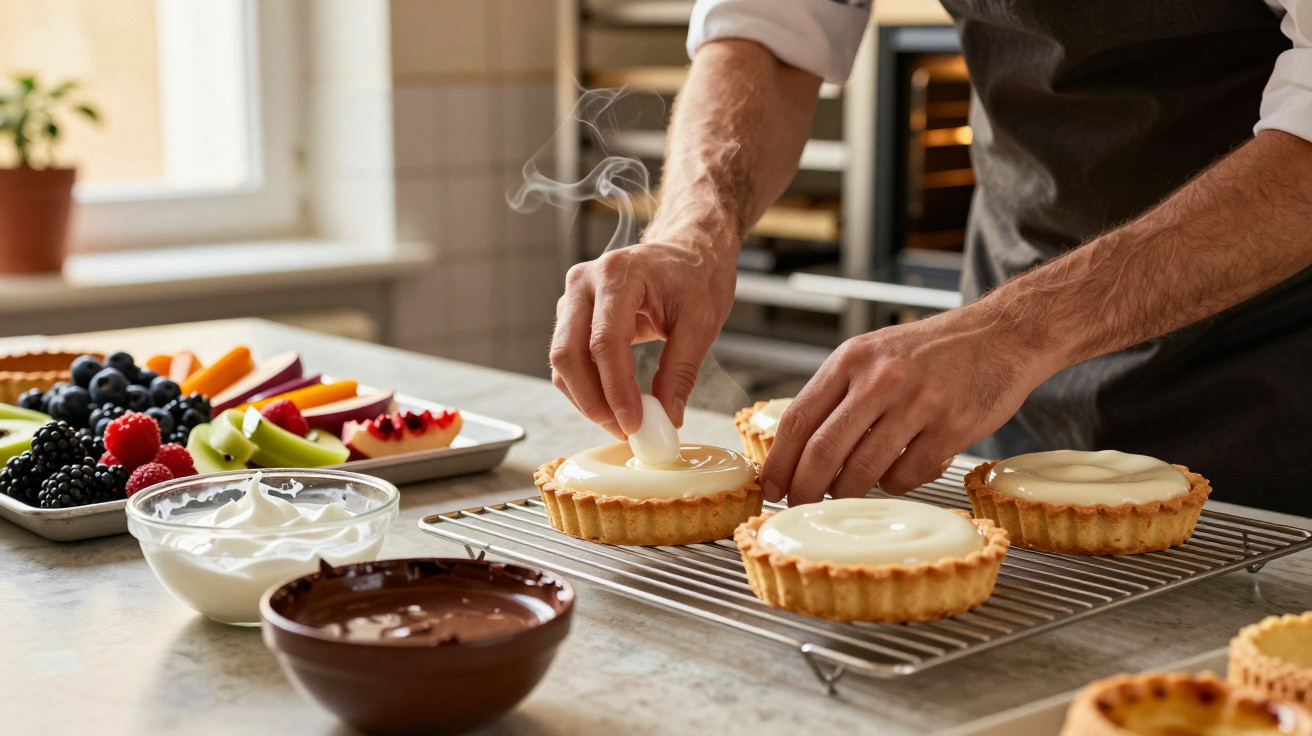
In Austria, a pastry chef has outlined an ultra-quick technique used in shops to keep tart bases flawless, even with very juicy fillings.
In an article published by the Austrian online outlet Salzburger Nachrichten, a professional pastry chef reveals how to make tart pastry stay crisp, even after several hours in the fridge. This “five-minute reflex”, used in the country’s pastry shops, relies on a brief yet crucial stage that home cooks often overlook.
Soggy tarts: a pastry chef’s nightmare
The Austrian pastry chef interviewed by Salzburger Nachrichten starts with a straightforward observation: pastry suffers when fillings contain plenty of water. Fresh fruit, creams, and fillings made with quark or yoghurt can quickly soften a tart base unless it is protected.
In a display case, a tart that is difficult to slice, has a base that breaks apart or turns into a juice-soaked mush cannot remain on sale for long. Professionals in both restaurants and shops have therefore developed ways around this. The expert says everything happens “before the tart is even filled”, when the base comes out of the oven.
The secret lies not only in the pastry recipe, but in what is done during the five minutes after its blind bake.
For customers, the improvement is obvious: the tart remains attractive, cuts neatly and retains a pleasant mouthfeel, contrasting crisp pastry with a melting filling.
The five-minute reflex used by professional pastry shops
Always blind-bake the pastry
The first rule set out by the pastry chef is that a tart base should never be filled raw when a wet filling is planned. He describes the classic blind-baking method, widely used in both Austria and France:
- Line the tin with well-chilled pastry.
- Prick the base lightly to prevent air bubbles.
- Cover with baking parchment, then fill with baking beans, dried beans or rice.
- Bake until the edges are only just golden, without allowing them to colour too deeply.
The well-known five-minute reflex takes place immediately after this blind bake, while the pastry is cooked but still hot.
Form a thin waterproof barrier on the hot base
The core technique described by the professional is to seal the tart base while taking advantage of its residual heat. According to Salzburger Nachrichten, Austrian pastry shops mainly use two complementary options:
- Brush the hot tart base with a little lightly beaten egg white, then return it to the oven for a few minutes to set it.
- Alternatively, for more indulgent tarts, spread a very thin layer of melted chocolate-usually dark or white according to the filling-over the fully cooled base after this stage.
The pastry chef explains that both techniques create a protective film between the pastry and its filling. Dried egg white makes a fine, transparent layer, whereas chocolate forms a more indulgent barrier as it sets, suitable for instance for red-fruit or exotic-fruit tarts.
In practice, the barrier takes less than five minutes to prepare, but completely changes how well the tart holds for hours.
This very short task fits easily into a professional kitchen workflow: while the bases are “drying”, the team can already prepare fillings or other pastry doughs.
Practical details of the anti-soggy technique
Egg white: the unobtrusive choice for classic tarts
The professional interviewed by Salzburger Nachrichten describes egg white as the most versatile option. He recommends:
- Applying only a very thin coat with a brush to the base while it is still hot, without overdoing it.
- Returning it briefly to the oven for just a few minutes, until the surface becomes matt.
- Letting it cool completely before adding a cold filling such as crème pâtissière or whipped cream.
Egg white adds virtually no flavour, yet produces a slightly waterproof layer. The pastry stays crisp beneath cream, ganache or a cooked-fruit mixture.
Chocolate: the secret weapon for fruit tarts in display cases
For tarts especially exposed to moisture-strawberries, raspberries and very juicy yellow fruit-Austrian pastry shops often favour chocolate. The chef quoted by Salzburger Nachrichten specifies that the layer must remain extremely thin, so it does not overpower the flavour of the filling.
Chocolate provides:
- Effective protection for tarts left for several hours in a refrigerated display case.
- An extra crisp element, highly valued by some customers.
- Greater stability when slicing, as the pastry is less likely to break.
This technique is common in shops, yet it remains relatively underused by home bakers, often because they are unaware of it. In Austria, the reflex has become something of a standard, taught in pastry schools and professional workshops.
Other professional tips mentioned by the pastry chef
The expert interviewed notes that the five-minute reflex works even better as part of an overall approach. Salzburger Nachrichten highlights several useful additions:
- Use perforated tart tins or micro-perforated baking sheets, which allow heat and moisture to circulate more effectively.
- Avoid pastry that is overly rich in water by monitoring the quantity of milk or egg yolks.
- Reduce the moisture in fruit: some fruit is lightly drained or patted dry with kitchen paper before arranging it.
- Add the filling shortly before serving for very liquid preparations, such as certain whipped creams.
The protective barrier does not replace good moisture management; it complements it.
By combining these measures, Austrian pastry chefs can offer tarts that keep well for several hours without losing their structure, even in summer.
What this changes for a home baker in France
For a French reader, the benefit of this technique is immediate: it uses everyday ingredients, namely eggs and chocolate, and requires no specialist equipment beyond a reliable oven. French pastry chefs, particularly in high-end shops, use comparable methods, even if they are not always explained to the public.
Blind baking, thoroughly drained fruit and a fine chocolate layer in some pâtisserie strawberry tarts can all be found in France. The method described by Salzburger Nachrichten is therefore an established professional practice, but its emphasis on the “five-minute reflex” helps home bakers make it a regular habit.
| Step | What pastry shops do | What a home baker can do |
|---|---|---|
| Baking the pastry | Controlled blind baking, suitable tins | Blind bake with dried beans in a standard tin |
| Five-minute reflex | Egg white or chocolate depending on the tart | Brush with egg white, then bake for a few minutes |
| Assembling | Filling prepared, fruit drained | Cool the pastry before adding cream; pat fruit dry |
In France, equivalent training in these techniques is available through CAP pâtissier qualifications and hospitality schools, where students learn to manage pastry texture according to fillings and serving times.
Understanding soggy pastry: a very simple process
“Sogginess” refers to the point at which water in the filling migrates into the pastry. Water molecules soften the structure of the pastry, especially when it contains plenty of flour and butter. Without protection, this movement begins as soon as the filling touches the base.
Oven heat initially helps dry the pastry slightly, but once the tart has cooled, the process resumes in the opposite direction: moisture from the top moves down into the base. The thin layer of coagulated egg white or chocolate then acts as a partial “wall”, slowing this movement without stopping it entirely.
The same principle also applies to other preparations: some quiches benefit from being pre-baked with well-sealed pastry, while certain puff pastries are protected in the same way when they hold creams.
An easy technique to try at home
For a home cook, the appeal of the method promoted by Salzburger Nachrichten is its simplicity. It adds very little time, costs nothing and delivers visible results from the first attempt with fruit or cream tarts.
One practical way to test it is to prepare two identical tart bases: one simply blind baked, and the other blind baked, brushed with egg white and briefly returned to the oven. Fill both with the same mixture and, after a few hours in the fridge, the difference in crispness will be clear when tasted.
For anyone who often prepares tarts in advance for a family meal or buffet, this “five-minute reflex” can become automatic. It reduces the risk of broken pastry, makes serving easier and improves guests’ perception of the tart, without changing the usual recipes.

















Comments
No comments yet. Be the first to comment!
Leave a Comment