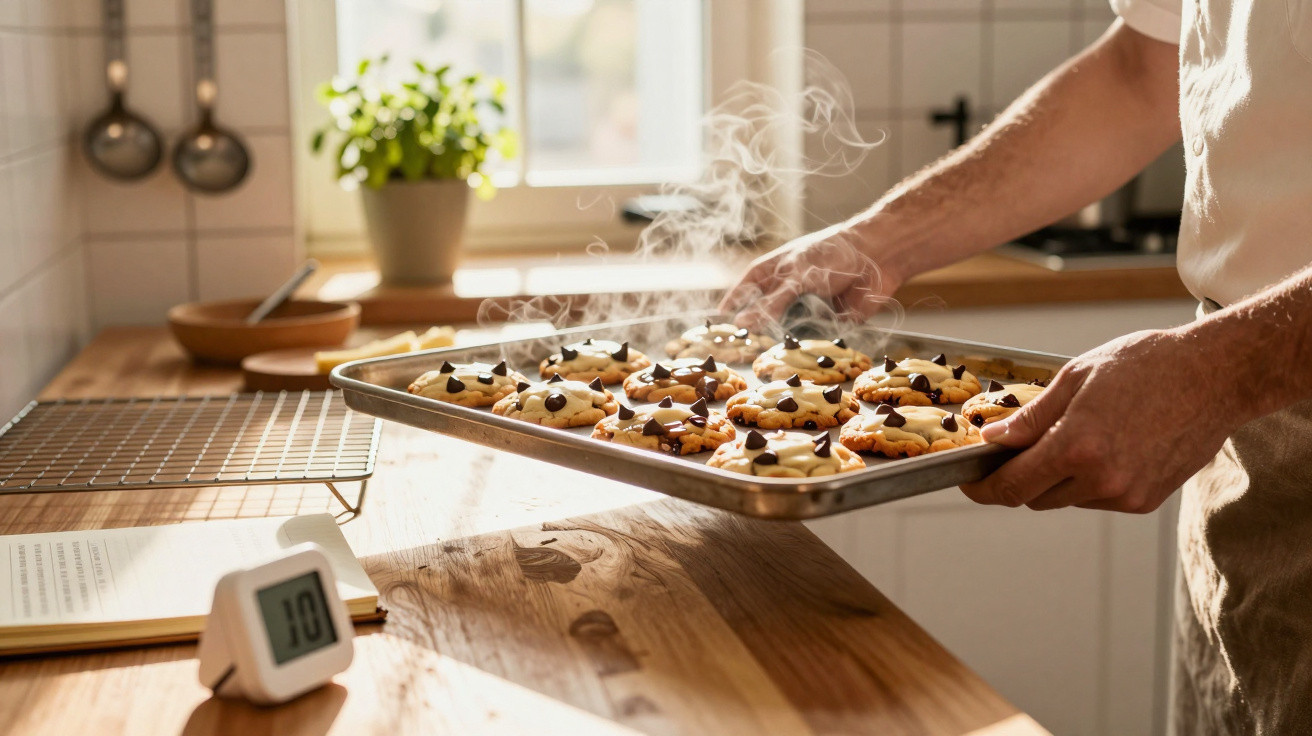
It begins with that small thud against the baking tray. Cookies that appeared flawless in the oven collapse into thin discs with crisp edges as soon as they come out. The kitchen may smell like a bakery, yet when you snap one open, there is no tender middle or pleasing chew – only a dry crack.
You followed the recipe. You bought the “best” chocolate chips. You even chilled the dough… once.
Still, the cookies from that local bakery remain soft for days, nearly fudgy at the centre and edged with the faintest hint of gold. What are they doing so quietly that you are not?
The secret bakers rely on for soft, chewy cookies
Professional bakers rarely advertise it in flashing lights, but they focus intensely on one factor: controlling moisture. It is not simply about the amount of water in the dough; it is also about how gradually that moisture escapes as the cookies bake and cool.
That is the understated method behind the soft, flexible chocolate chip cookies that stay on your mind. They are made to retain water like a sponge, from the point where butter is beaten with sugar through to the tray cooling on the worktop.
Ask three bakers for their “chewy cookie secret” and their answers may sound different, although they lead to the same conclusion. One will insist on additional brown sugar, another on removing the tray exactly two minutes early, and a third on including an extra yolk.
A New York pastry chef told me that she makes test batches with a thermometer inserted in a cookie, monitoring the speed at which its internal temperature rises. “It’s not about raw,” she laughed. “It’s about keeping water trapped. Soft is just water behaving itself.” Every “family recipe” that remains chewy on its second day has a little hidden science behind it.
The straightforward reality is this: soft, chewy cookies aren’t an accident. They come from consciously selecting ingredients and techniques that delay moisture loss.
Brown sugar contains molasses, which is hygroscopic – it draws moisture from the air. An additional egg yolk provides fat and emulsifiers, allowing the dough to retain liquid more effectively. Baking slightly less keeps the centre below the stage at which it completely firms up and dries out.
The largest unseen factor is residual heat. Cookies continue baking once they have left the oven, so the baker who takes them out “too early” is often the one who achieves that ideal bend in the middle.
The one trick: take them out before they appear ready
This is the soft-and-chewy technique experienced bakers depend on without making a fuss: Remove cookies when their edges have just set and turned lightly golden, while their centres remain slightly puffed and look almost underbaked.
Do not wait until they are coloured all over. When you gently move the tray, the cookies should wobble a little, much like soft jelly. Leave them to cool on that hot baking sheet for at least 5–10 minutes.
The tray acts as a discreet second oven. Residual heat completes the bake gently, setting the cookies sufficiently while holding valuable moisture inside.
If you have ever thought, “These were perfect straight from the oven, but rock-hard the next day,” you probably baked them perfectly in the oven before residual heat pushed them into overbaking. That final minute or two is where most home bakers lose the battle for softness.
We have all had that thought: “They still look raw, I’ll give them two more minutes,” only to move abruptly from chewy to crunchy. Bakers who repeat this process all day learn to trust a modest golden edge and disregard a glossy-looking centre. At first it feels wrong, even a little defiant, but after cooling, the cookie’s middle bends when opened rather than snapping.
The explanation is straightforward once it has been highlighted. The starch and egg proteins in cookie dough set at approximately 66°C to 82°C. The hotter they become, the firmer and drier the cookie will be.
Taking the tray out slightly sooner ends the direct intensity of the oven heat. The cookies then complete the process using the milder warmth of the baking sheet. It is like releasing the accelerator and allowing a car to coast to a stop rather than braking sharply.
There is another subtle benefit: as the cookies rest, the chocolate continues melting a little, creating a glossy, gooey pocket at the centre rather than dull, seized chips. That’s why bakery cookies taste “soft baked,” even when they’re not fresh from the oven.
Fine-tuning the soft-and-chewy method at home
To make this method work consistently, treat each cookie as a small store of moisture. Begin with greater moisture potential, then keep it protected.
Use a higher proportion of brown sugar than white sugar: at least 2:1 if you prefer a chewy result. For added richness and softness, mix one extra egg yolk into your usual recipe. Use slightly less flour than the measure suggests, or preferably weigh it so that it is not packed down.
Once the dough has been combined, refrigerate it for 30–60 minutes. Chilled dough spreads more gradually, allowing the exterior to set while the interior stays tender.
Your eyes, rather than the recipe, are responsible for the most frequent mistake. Glossy food photography has taught us to pursue an even deep-golden colour, which suits crisp cookies but destroys chewiness.
There is also the issue of an overcrowded baking tray. When cookies meet during baking, they steam one another, then overbake while you wait for them to “look right.” Use cooled trays, allow space between portions of dough, and turn the pans if your oven has hot spots.
In truth, hardly anyone follows every one of these steps every day. But when you do, the bakery-standard outcome makes those extra five minutes seem worthwhile.
“Home bakers almost always ask me for my secret ingredient,” one hotel pastry chef told me. “I tell them the same thing every time: my secret is that I pull cookies when they still scare me a little.”
- Choose more brown sugar than white sugar to increase moisture and chew.
- Add an extra egg yolk for greater richness and softness.
- Chill the dough so the edges set before the centre can dry out.
- Take cookies out when the edges are set but the centre still appears slightly underdone.
- Let them cool on the hot tray so gentle residual heat can finish the bake.
Why this small timing change transforms soft, chewy cookies
Once you understand how early a tray can be removed while still producing fully set cookies, your approach to baking changes almost without notice. Rather than pursuing colour, you begin assessing texture: the dry outer ring, the soft dome at the centre and the point where the dough loses its raw sheen.
An “all right” recipe can suddenly become your signature bake. You will find that the same timing approach works with various additions, including dark chocolate chunks, chopped nuts and even small pools of caramel. The central rule remains unchanged – preserve moisture, account for residual heat and trust the unsettling moment.
And this is what no one mentions: after you perfect that soft, chewy centre, people stop asking where you purchased your cookies and instead ask when you will bake again. They will compete for the final one in the tin. You will view your oven timer differently, knowing the magic is not a secret ingredient from a professional kitchen, but a five-second choice at your own oven door.
| Key point | Detail | Value for the reader |
|---|---|---|
| Remove cookies early | Take them out when the edges have set and the centres still appear slightly underbaked | Produces soft, chewy centres without raw dough |
| Manage moisture | Use more brown sugar, an extra yolk and chilled dough | Helps cookies remain soft for longer, rather than only when fresh from the oven |
| Use residual heat | Cool on the hot tray for 5–10 minutes | Finishes the bake gently and prevents dry, overdone cookies |

















Comments
No comments yet. Be the first to comment!
Leave a Comment