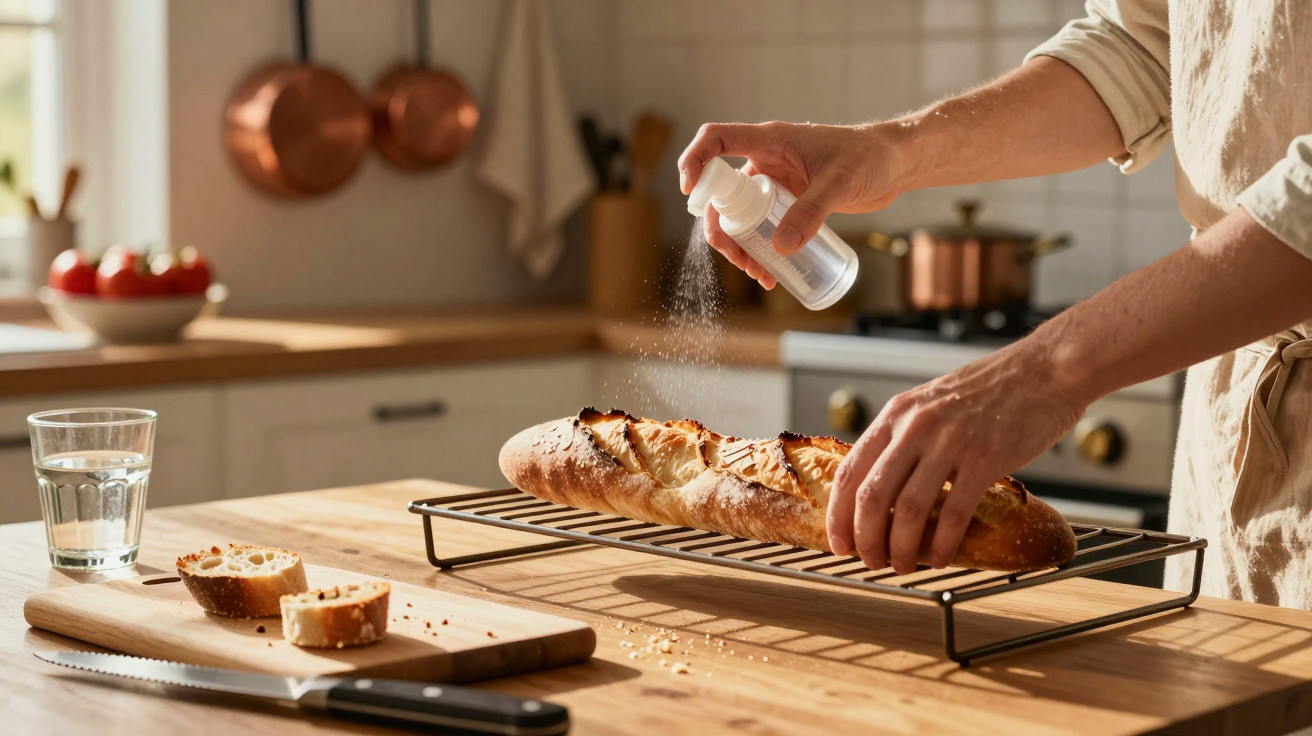
Yesterday’s baguette may be a little sad and rubbery, but it need not go in the bin – or be drowned in soup.
French bakers use a small, almost effortless trick to restore day-old bread. It requires no specialist equipment or complicated recipe: simply use water and heat cleverly so the crust becomes crisp again while the centre stays soft rather than chewy.
Why reheated baguettes often become limp and disappointing
Most of us have chosen the shortcut: 20 seconds in the microwave and a hopeful wait. It seldom produces a pleasing result. The baguette emerges warm, yet its crust becomes leathery while the crumb turns springy and almost sticky.
This happens because of the way water behaves inside the loaf. A baguette holds plenty of moisture within its structure, especially in the crumb. Reheating it incorrectly sends that moisture in the wrong direction. Microwave heat works quickly and unevenly: some water moves into and saturates the crust, while some escapes too rapidly, leaving the crumb firm.
The challenge is simple: warm the crumb, dry the crust, and move moisture just enough – not too much, not too fast.
A household microwave is excellent for reheating leftovers, but bread often becomes a hot sponge without any crunch. Fortunately, professional bakers deal with precisely the same physics and use a straightforward, dependable solution.
The French baker’s secret: water and a fiercely hot oven
In many French bakeries, loaves from the previous day are not automatically discarded. Rather than baking them again from the beginning, bakers know how to “wake” them. The technique seems almost overly simple: add a little water to the crust, then give the bread a brief blast in a very hot oven.
A thin film of water on the crust, followed by a short, intense heat, recreates the contrast between crisp outside and tender inside.
The process works like this: the small amount of moisture on the exterior becomes steam as soon as the baguette enters the hot oven. For a moment, the steam softens the outside layer and lets the crust expand once more. Intense heat then rapidly dries the surface, creating a fine, crisp shell. Meanwhile, the inside heats more gently and some of its moisture redistributes, restoring a pleasantly soft crumb.
How to refresh a baguette at home
A professional deck oven is unnecessary. An ordinary home oven will do the job, provided you follow several precise steps.
- Heat the oven to around 220°C / 425°F, whether fan-assisted or conventional.
- Dampen your hand lightly, or use a spray bottle, then cover the crust with a fine mist of water.
- Put the baguette directly on the oven shelf rather than onto a cold baking tray.
- Warm it for 4 to 6 minutes, according to how dry the bread is.
- Remove it and leave it on a cooling rack for one minute before cutting.
For a quick check, tap the underside of the baguette with your fingertips. It should feel crisp and sound hollow, while the crust should “crackle” as it cools. That noise can often be more useful than watching the clock.
Common mistakes that spoil a good baguette
Although the method is forgiving, certain habits can undermine the result.
- Using the microwave alone: it heats water molecules too quickly, making the crumb rubbery and removing any crunch from the crust.
- Drenching the loaf: a light coating of water is sufficient. If the baguette appears soaked, its crust will remain soft and lacklustre.
- Baking it for too long: after more than 7 minutes in a very hot oven, the crumb begins to dry. Rather than refreshed bread, you will have a brittle stick.
Think of this as a wake-up call for bread, not a full second bake. The aim is refreshment, not transformation.
This technique preserves the baguette’s original qualities: a thin crust, open crumb and delicate aroma. Extending the heating time turns it into something more like a hard breadstick.
Adjusting the method for different “tired” baguettes
Not every leftover loaf is alike. You can adapt the same approach to suit the condition of your bread.
| Type of baguette | Water | Oven time (220°C / 425°F) |
|---|---|---|
| Less than 24 hours old, slightly soft | Very light spray | 3–5 minutes |
| Quite dry, 1–2 days old | A little more moisture over the top and sides | 6–7 minutes |
| Half or quarter baguette | Light spray, chiefly on the cut surface | 2–4 minutes |
| Very powerful oven | Light spray only | Temperature closer to 200°C, watch closely |
If you are short of time, a combined approach can be useful. Give the baguette an extremely brief microwave burst – about 5 to 10 seconds – to warm the middle slightly, then place it in a hot oven for 3 to 4 minutes. This can help when the loaf feels rock-hard, although it needs careful monitoring or the centre may become gummy.
Why this trick reduces food waste – and saves money
Homes across Europe and the US discard substantial quantities of bread every week. Baguettes are especially prone to this: they are perfect for only a few hours before their quality declines quickly. Mastering this simple refreshing method can alter both your shopping habits and meal planning.
One quick reheating habit can turn “yesterday’s bread” into a reliable backup for lunches, cheese boards, and last-minute dinners.
Rather than purchasing fresh baguettes twice daily, many French families quietly depend on this method. A loaf bought the previous evening can still be enjoyed with jam the following morning, or served with soup and salad at lunch. Over a month, this could mean a dozen loaves avoided in the bin and a noticeable reduction in food costs.
Practical occasions when a refreshed baguette saves the day
Imagine a Friday evening: friends arrive unexpectedly, you take cheese and olives from the fridge… then discover a neglected, sad baguette on the worktop. Five minutes in the oven can make that same loaf crackle again, ready for a generous spread of Brie.
Packed lunches offer another example. Many people freeze sliced baguette and quickly reheat it before leaving for work. A short time in a hot oven with a little moisture restores enough freshness to make sandwiches satisfying instead of stale.
- For garlic bread, refresh the baguette first, then add butter and garlic before heating for another two minutes.
- For bruschetta, revive the loaf, cut it while warm, then briefly toast it beneath the grill with olive oil.
- For children’s snacks, reheat it and serve immediately with chocolate spread or peanut butter.
What “staling” really means for bread
Air and dryness are often blamed for stale bread, but the science is more nuanced. Once bread begins cooling after baking, the starch it contains gradually alters its structure. This is known as starch retrogradation, and it makes the crumb firmer and less elastic over time, even when the loaf is wrapped.
Careful reheating can reverse part of this process. The starch softens once again, making the crumb seem fresher. However, the result does not last – the bread will become firm again as it cools – so timing is important. For the best texture, reheat the baguette shortly before you intend to eat it.
When to refresh a baguette, and when to repurpose it
Every reheating technique has its limits. A baguette left uncovered on the worktop for several days may improve slightly, but it will not recreate the condition it had on the morning it left the bakery. At that point, the oven method is less successful and alternative uses become more worthwhile.
Exceptionally dry baguettes work well as homemade breadcrumbs, croutons, French toast or bread-based puddings. Transforming them into another dish still prevents waste and may be more realistic than trying to recreate the precise crunch of a fresh loaf.
Still, for the familiar “day-old and slightly sad” baguette found in so many kitchens, a splash of water and a fiercely hot oven can often restore the aroma and sound of freshly baked bread – with almost no effort and no special equipment whatsoever.

















Comments
No comments yet. Be the first to comment!
Leave a Comment