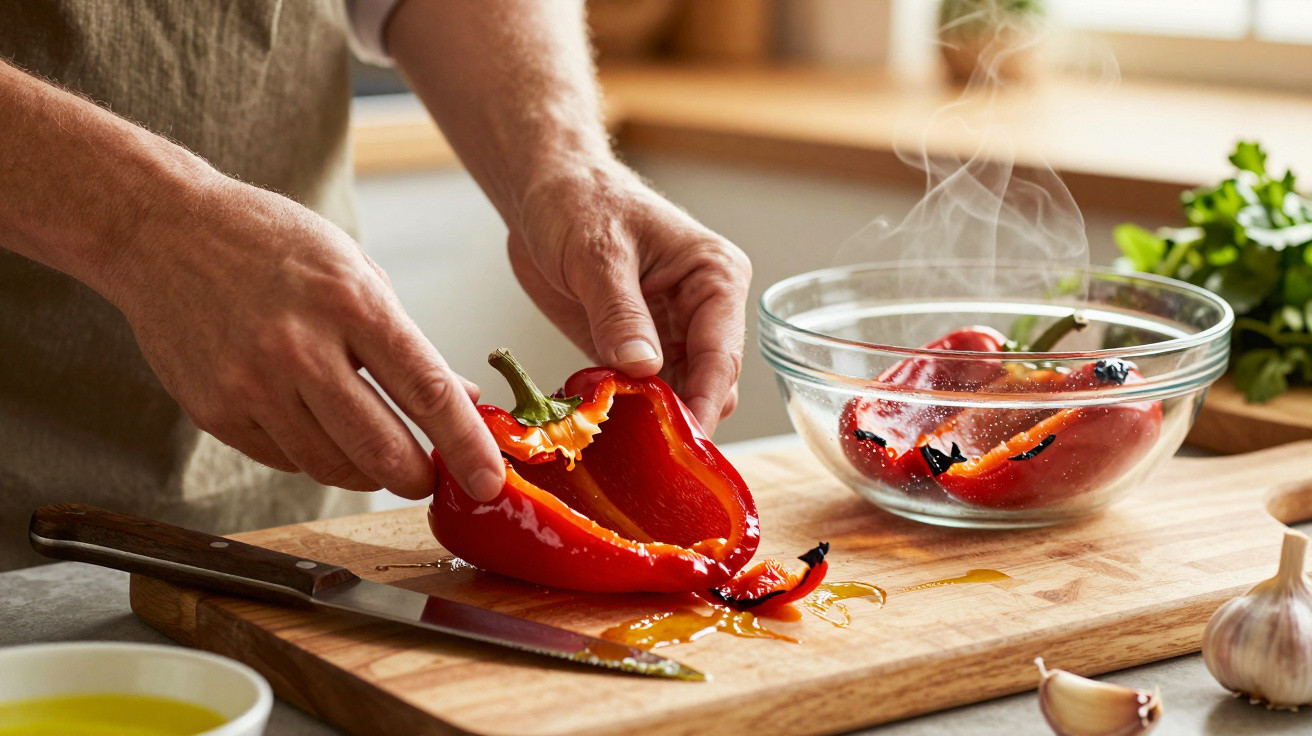
Sometimes, the smell escaping from the oven is enough to bring back memories of summer cooking: bright red peppers, almost black in places, sitting on a baking tray waiting to be opened up. At the table, nearly everyone loves them. Yet once the meal is over, some people already regret having another helping. Their thin but tough skin is often blamed for making this generously flavoured vegetable harder to digest. The useful trick needs neither specialist equipment nor chef-level skill. Above all, it means letting the heat do the work for a few extra minutes. The difference on the plate is striking.
Pepper skin: the small detail that can spoil everything
We all know the crunch of a raw pepper in a salad, with its freshness, juice and slight bitterness. It is enjoyable at the time, but can be less so a few hours later, when the skin seems determined to linger in the stomach. Peppers belong to the nightshade family, alongside tomatoes and aubergines, and their outer layer contains plenty of firm fibre. For sensitive digestive systems, that can be enough to cause a feeling of heaviness.
For 48-year-old Claire, peppers had almost disappeared from the family menu after several summer meals ended in digestive discomfort. Then she tried a recipe for grilled peppers, made the day before for drinks. “Even my husband, who had avoided them for years, went back for more,” she says. The change often comes down to one very straightforward step: after grilling, the skin comes away in large strips and the flesh turns soft, almost melting.
Cooking does not eliminate all of the pepper’s fibre, nor is that the intention. Instead, it mainly softens the skin, concentrates the natural sugars and makes the plant cells easier to chew. The body therefore has less work to do, which may improve comfort for many people. A properly prepared pepper does not have the same character as one thrown raw into a frying pan. It becomes rounder in flavour, more aromatic and almost jammy around the edges.
The covered-bowl trick for peeling peppers without the fuss
The most dependable method begins in the oven, beneath the grill, or directly over a flame if you have the patience. Put whole peppers on a baking tray at roughly 220 °C, turning them as their skin blisters and blackens. They will usually need 20 to 30 minutes, depending on their size and the power of the appliance. Once they are thoroughly blistered, move them into a bowl and immediately cover it with a plate, lid or cling film.
This covered resting stage is what makes the real difference: steam builds up inside the sealed bowl and loosens the skin from the flesh. Leave the peppers for 10 to 15 minutes, without lifting the cover every two minutes, however irresistible the smell may be. To be honest, nobody really does this every day. But when you are planning a large salad, fajitas or ratatouille, this short wait saves you from battling with a knife afterwards.
Then remove the skin with your fingers, holding the peppers over a bowl to collect their fragrant juices. Avoid rinsing them under water: it may seem convenient, but it washes away some of the smoky flavour developed during cooking.
“When the skin comes away almost by itself, the pepper has had enough heat and enough resting time,” sums up a very simple rule often passed on in home kitchens.
To make sure this preparation goes well, keep the following points in mind:
- Choose fleshy peppers, as they are easier to peel than very small ones.
- Blacken them without turning them to ash: the skin should blister on every side.
- Enclose them while still hot to create the essential steam.
- Remove the seeds and white membranes, which can be bitter and poorly tolerated.
- Add olive oil only after peeling the flesh.
A simple roasted pepper preparation that makes you want to cook them again
Once peeled, peppers become an unexpectedly versatile starting point. Slice them into strips, drizzle them with olive oil, add very finely chopped garlic and allow them to cool with a few basil leaves. They can then accompany grilled meat, a slice of bread rubbed with tomato or a pasta dish without demanding much attention. Their juice, often forgotten at the bottom of the bowl, is also worth saving: it lifts a vinaigrette or a quick sauce.
People with greater sensitivity can go a step further by removing the seeds and the white inner parts. They are not harmful, far from it, but their texture and flavour may be unappealing. A pinch of salt, a squeeze of lemon or a few capers are then enough to brighten the grilled flesh. There is no need to drown everything in a heavy sauce: a pepper already has plenty to say when it comes out of the oven.
This approach also makes it possible to cook ahead without giving up freshness. Peeled peppers will keep for two to three days in the fridge in an airtight container, covered with a little oil, and can even be frozen in portions. The next day, their aroma can sometimes seem even better. It is a practical way of turning a vegetable that some people approach with caution into a regular small pleasure, without claiming that every digestive system will react in the same way.
There is still some common sense to apply: if peppers repeatedly cause pain, significant reflux or lasting discomfort, it is better to adjust the portions and discuss it with a healthcare professional. For many food lovers, simply removing the skin is enough to transform the experience, especially when the peppers are ripe, warm and served lukewarm. There is something reassuring, almost family-like, about this technique: a familiar ingredient is given a few minutes of attention and becomes more tender. In a kitchen where everything moves quickly, that resting time beneath a lid feels like an idea worth keeping.
| Key point | Detail | Added value for the reader |
|---|---|---|
| Grill the skin | Cook the peppers until they blister and become lightly blackened. | The skin comes away more easily and the flesh becomes sweeter. |
| Create steam | Seal the hot peppers in a covered bowl for 10 to 15 minutes. | Less effort is needed for peeling, without wasting their flavour. |
| Adapt the finishing touches | Remove the seeds and white membranes, then season simply. | A preparation that is often better tolerated and easy to reuse in several dishes. |

















Comments
No comments yet. Be the first to comment!
Leave a Comment