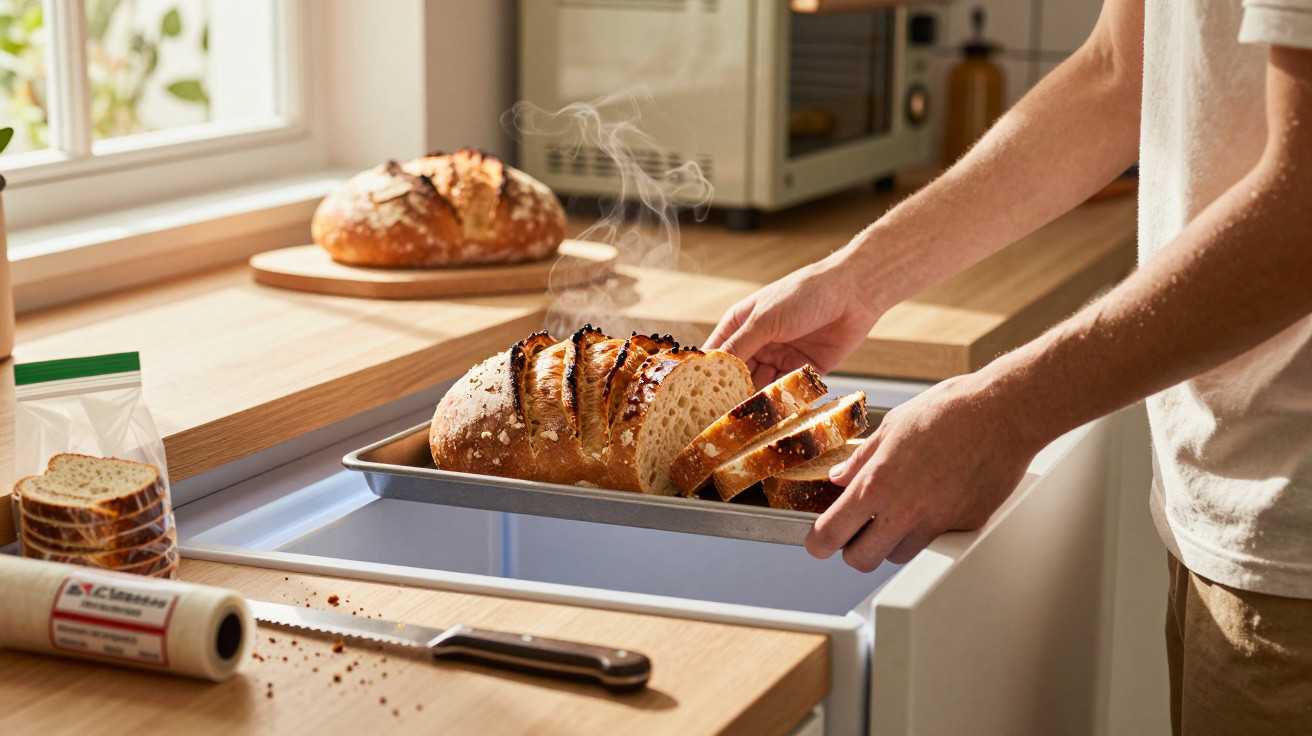
Frozen bread can genuinely help to cut food waste. The crucial factor, however, is timing: when does the bread go into the freezer, and what condition is it in? Get this wrong and you are not freezing in freshness, but bread that has already deteriorated. The consequences become obvious at the latest when it is defrosted and reheated.
Why fresh bread loses quality so quickly
On the surface, there is nothing to worry about: the loaf comes out of the oven with a crisp crust, a wonderful aroma and a soft feel. Yet from that very moment, a process begins inside it that gradually changes its texture for the worse.
In technical terms, this is known as “starch retrogradation”. In simple terms, this is what happens:
- During baking, starch molecules absorb water and “swell”, leaving the crumb soft and springy.
- As the bread cools, the molecules slowly rearrange themselves and become firmer.
- The bread steadily loses elasticity, feels drier and develops a hard crust.
Bread does not become stale only when it turns hard – the ageing process begins immediately after baking.
If bread is frozen only once it seems slightly dry in the evening or its crust has become very hard, that poorer condition is what gets frozen. Defrosting cannot fully reverse it, even when using an oven or toaster.
The best time to freeze bread
The key rule is simple: freeze bread as early as possible, while it is still at its freshest.
How early is early enough?
As a general guide:
- Bread from a bakery should be frozen within a few hours of purchase.
- Freshly baked homemade bread should cool down a little first, then be packed and frozen promptly.
- Do not wait until the crust has noticeably hardened and the centre feels chewy or dry.
Very pale breads with a light, open crumb are particularly sensitive, including:
- baguettes
- ciabatta-style loaves
- traditional white bread rolls
They are more affected by the transition between freezer and defrosting. Their crumb can quickly turn rubbery or fall apart when sliced.
Wholemeal and mixed-grain loaves, with their higher fibre content and denser structure, tend to be more stable. They retain moisture more effectively, often stay moister after freezing and are more forgiving of small mistakes.
Freezing bread properly: whole or sliced?
Both methods work; the difference lies in convenience and in the result after defrosting.
Freezing a whole loaf
Advantages:
- The crumb has better protection and is less likely to dry out.
- Moisture stays inside the loaf for longer.
Disadvantages:
- It takes longer to defrost, usually a full night at room temperature.
- The entire loaf has to be defrosted, even if only part of it is needed.
Freezing pre-sliced bread
Advantages:
- You can take out exactly the amount required.
- Frozen slices can go straight into the toaster, making them ideal for breakfast or snacks.
- There is less risk of the bread becoming damp inside while drying out on the outside.
Disadvantages:
- The cut surfaces are more exposed to air, so poorly packed bread will dry out more.
Anyone who eats only a little bread at a time is best served by pre-sliced portions – provided they are packed truly airtight.
How to pack bread correctly for the freezer
A common misconception is: “Nothing can happen to bread in the freezer.” In fact, it faces not only cold temperatures there, but also dehydration.
For the best result, it is worth taking some care with packing:
- Remove as much air as possible: press the bag down or seal it very tightly with a clip.
- Use thick freezer bags or sturdy containers rather than thin, open bags.
- Make small portions, such as 3–4 slices in each pack, to avoid opening the packaging repeatedly.
- Write down the date: ideally, use the bread within one to two months.
It can theoretically be frozen for longer, but its flavour and texture will decline over time, even if it is well packed.
Defrosting bread and making it crisp again
Simply leaving it at room temperature is often not enough if you want the crust to become crisp again.
Gentle defrosting
If time allows, place the bread, whole or sliced, on a board or wire rack at room temperature. Covering it with a clean tea towel stops the surface from drying out too quickly.
For individual slices from the freezer, the toaster is unbeatable: put them straight in, toast gently and they are ready.
Oven trick for a fresh crust
For whole loaves or larger pieces, the oven gives the best result:
- Let the bread begin to defrost at room temperature until it is no longer rock hard.
- Preheat the oven to around 150–180°C.
- Bake for a few minutes; 5–8 minutes is usually enough.
One small extra step creates an especially crisp finish:
A light mist of water over the surface creates steam in the oven. This makes the crust noticeably crisp again.
Do not expect miracles: stale bread will not become freshly baked bread again. But bread that was frozen well can be “revived” very successfully in this way.
White patches on frozen bread: mould or just freezer burn?
When taking bread out of the freezer, people are sometimes alarmed by pale areas on the crust or cut surfaces. Mould is often the immediate suspicion.
In many cases, though, it is not fungal growth but freezer burn – cold damage caused by dehydration.
How to tell the difference
| Feature | Cold damage / freezer burn | Mould |
|---|---|---|
| Colour | paler, slightly grey-white and dry-looking | greenish, grey, sometimes black or blotchy |
| Surface | dry, smooth or slightly rough, but not “dusty” | usually furry, powdery or with a distinct layer |
| Smell | neutral, with no noticeable odour | musty, unpleasant or mouldy |
Freezer burn occurs when:
- the packaging is not sealed properly,
- a lot of air remains in the bag,
- the freezer is opened frequently and the temperature fluctuates.
Although affected areas are not visually appealing and are often very dry, they are generally not considered spoiled. If necessary, they can simply be cut away.
Why the freezer is not a time machine
A freezer stops bread from ageing, but it does not turn back the clock. If you freeze bread that is already very hard, chewy or almost dry as dust, you will later take out exactly that quality – only cold, then warmed up.
That is why a different everyday routine is worthwhile: rather than freezing leftovers in the evening, decide just after buying the bread which part will be eaten straight away while fresh and which part will be deliberately frozen early.
Practical everyday examples
A well-planned approach can make a major difference in situations such as these:
- One-person households: Slice large loaves completely straight away, freeze them in portions and take out only what is needed.
- Families with changing bread consumption: Keep part of the loaf whole on shopping day and freeze the rest in slices for greater flexibility.
- Home bakers at the weekend: Once homemade bread has cooled, cut it into halves or thirds, eat one portion fresh and freeze the rest early.
Once you get used to putting fresh portions into the freezer intentionally, rather than treating bread as a “leftover”, you save money, avoid disappointing breakfasts and substantially reduce food waste.

















Comments
No comments yet. Be the first to comment!
Leave a Comment