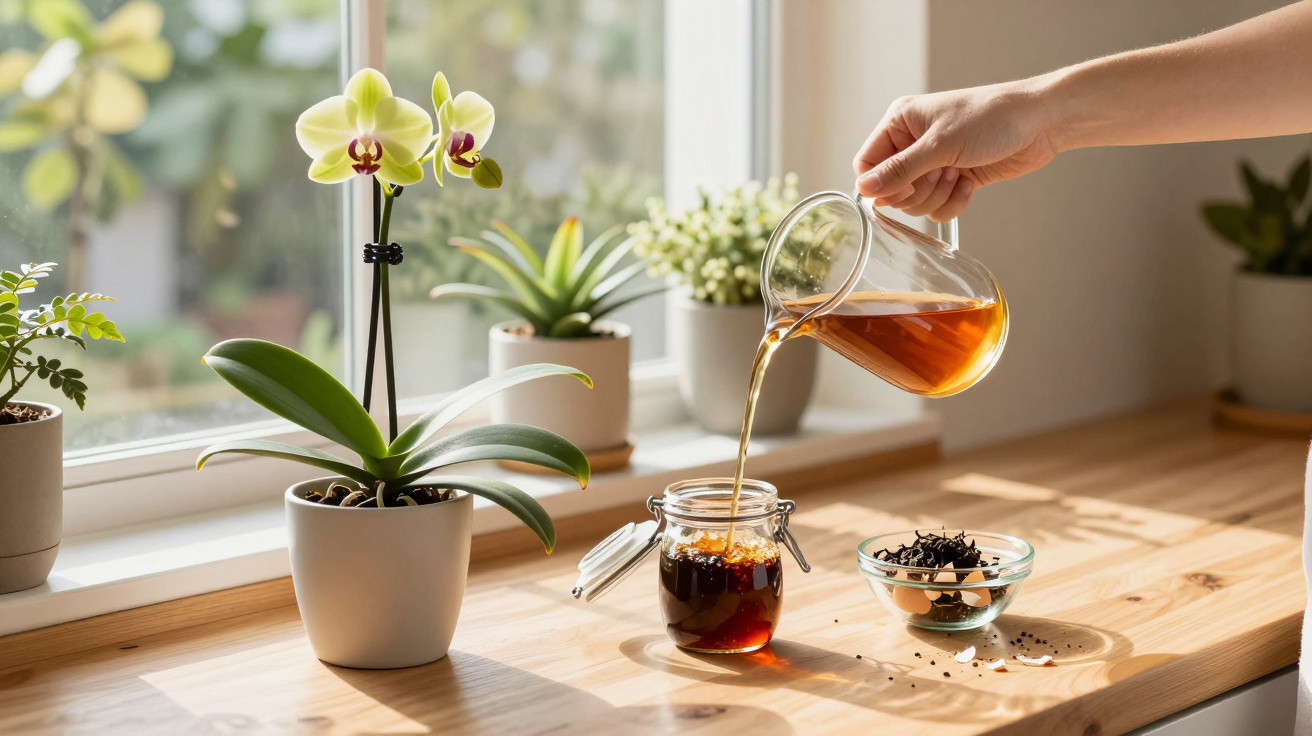
Many orchids end up in a quiet plant exile after their first flowering period – even though a simple kitchen trick can help bring them back to a truly impressive display of blooms.
Anyone who buys a moth orchid usually experiences a small miracle: its flowers shine for weeks, then drop off – and nothing else seems to happen. The leaves remain green and the roots appear healthy, yet new flower spikes fail to emerge. This is where a surprising tip, shared in gardening forums and among hobby gardeners, comes in: one particular ingredient from the baking cupboard is said to encourage plants to regain strength and flower more intensely.
Why so many orchids stall after their first flowering
Orchids, especially Phalaenopsis, are considered sensitive, but they are actually more like creatures of habit. If the light, temperature and watering routine are broadly suitable, they usually survive without difficulty. What many plants lack is not a green thumb, but simply the energy needed for their next flowering phase.
In shops, orchids are grown in high-performance substrates and receive precisely measured professional fertiliser. At home, they often get only tap water and perhaps a little liquid fertiliser now and then. As a result, the plant continues living but does not build up sufficient reserves to produce new flower stems. That is where an ingredient more commonly associated with gingerbread dough than a flowerpot comes into play.
The secret baking ingredient: what molasses does for orchids
The key ingredient is molasses – a dark syrup produced during sugar processing, used in many baking recipes for its rich flavour. For orchids, it can become a nutrient boost.
“Molasses provides potassium, magnesium, trace elements and sugars – a combination that strengthens roots and encourages the development of new flower shoots.”
This is what it contains:
- Potassium promotes sturdy stems and strong flower spikes.
- Magnesium supports chlorophyll production and therefore energy generation in the leaves.
- Trace elements such as iron, copper and manganese help maintain a balanced metabolism.
- Sugar feeds microorganisms in the substrate, which in turn can make the roots more active and better able to absorb nutrients.
The bark in which most orchids grow is home to many beneficial microbes. When they receive a little “food”, they break down organic matter more effectively and release nutrients. The roots benefit in two ways: they become stronger and can take up more water and minerals.
How to use molasses correctly: the simple monthly treatment
The method sounds almost too easy: once a month, give the orchid specially prepared watering water containing molasses. Nothing more is needed. Correct dilution is essential.
Step-by-step guide to molasses watering water
For an ordinary household quantity, even a small measuring spoon is enough:
- Pour around 240 millilitres of lukewarm water into a watering can or spray bottle.
- Add half a teaspoon tip of molasses.
- Shake or stir thoroughly until the molasses is evenly dispersed.
- Pour the solution directly onto the substrate, rather than over the leaves.
- Use only enough to moisten the substrate properly, and do not allow water to remain in the saucer.
If you have several orchids, the ratio is easy to scale up: around one teaspoon of molasses per litre of water is sufficient for several pots.
“Once a month is entirely sufficient – molasses works like an energy boost, not like a daily fertiliser.”
How often is sensible – and where is the limit?
The usual rule for nutrients applies here too: less is often better. Orchids react sensitively to over-fertilising, particularly when growing in coarse bark.
A useful rule of thumb for molasses is:
- Frequency: no more than one watering per month with molasses water.
- In between: water normally with plain water or a very weakly diluted orchid fertiliser.
- Combining fertilisers: molasses does not replace specialist fertiliser; it complements it.
Anyone who reaches for the syrup bottle more often risks allowing too many nutrients to accumulate around the roots. This can lead to burnt root tips, yellow leaves or a sudden halt in growth.
Warning signs: when molasses harms the orchid
Molasses remains a sugar-rich syrup – and sugar attracts not only microorganisms but also unwelcome visitors. Using too much or watering with it too frequently can create problems.
Typical warning signs include:
- small flies or swarms of gnats around the pot
- ants appearing around the plant
- white, cotton-like deposits on the surface of the substrate
- a sweet, fermenting smell coming from the pot
- substrate that feels sticky
If any of these signs appear, the plant needs a kind of “reset”:
- Flush the pot thoroughly with lukewarm water.
- Let all water drain away completely and avoid waterlogging.
- Give only plain water for several weeks.
- Resume fertilising sparingly only once the substrate looks healthy again.
Other kitchen leftovers as gentle orchid fertiliser
Molasses is not the only kitchen ingredient suitable for orchids. A few household leftovers can also provide nutrients when used in a very highly diluted form.
| Kitchen ingredient | Effect | Application advice |
|---|---|---|
| Banana peels | Source of potassium, supports flower formation | Use only as a short cold infusion in water, heavily diluted |
| Eggshells | Calcium, strengthens cell walls | Dry and grind finely, then use in very small amounts |
| Rice water | Traces of starch and minerals | Use only unsalted cooking water and use it quickly |
Molasses has an advantage over these leftovers: it comes ready bottled, keeps for a long time, can be measured accurately and causes fewer odour issues when used sparingly.
How soon can you expect new flowers?
Anyone treating an orchid to molasses water now should not expect overnight miracles. First, the plants build up reserves and strengthen their roots before producing new flower shoots.
A typical sequence with good care is:
- After a few weeks: stronger leaf colour and firmer leaves.
- After one to three months: the first new flower shoots or side shoots on old stems.
- Later: more densely covered flower sprays with blooms that last longer.
“Molasses cannot save a dead plant, but it can give a weakened orchid the crucial boost it needs to grow actively again.”
What matters besides molasses
Syrup alone will not create an explosion of flowers. The standard orchid care rules remain crucial:
- a bright position without intense midday sun
- a temperature difference of a few degrees between day and night
- watering when the substrate is almost dry – not every day
- no waterlogging inside the decorative outer pot
The slight difference between daytime and night-time temperatures in particular acts as a natural signal for new flower shoots. Combined with a nutrient boost from molasses, it offers the best chance of a lush second or third flowering.
Practical examples and risks for beginners
People who water generously are often inclined to be equally generous when fertilising. For orchids, that is a risky combination. Beginners should therefore start with an even weaker dose, around a quarter of a teaspoon per half litre of water, and observe the plant’s reaction over several weeks.
Plants whose roots are still firm and silvery green respond particularly well. They can process the addition effectively. If an orchid is growing in old, already decomposing substrate, it is worth repotting it into fresh bark before using molasses for the first time. This provides a much better environment for the fed microorganisms to show their strengths.
Anyone combining several methods – molasses, a little orchid fertiliser and occasional rice water – should keep a kind of “plant calendar”. Notes on the date, what was given and any visible response help prevent the orchid from being overfed without noticing. That way, the baking ingredient molasses remains what it is intended to be: a small but effective trick that turns the windowsill back into a shelf full of flowers.

















Comments
No comments yet. Be the first to comment!
Leave a Comment