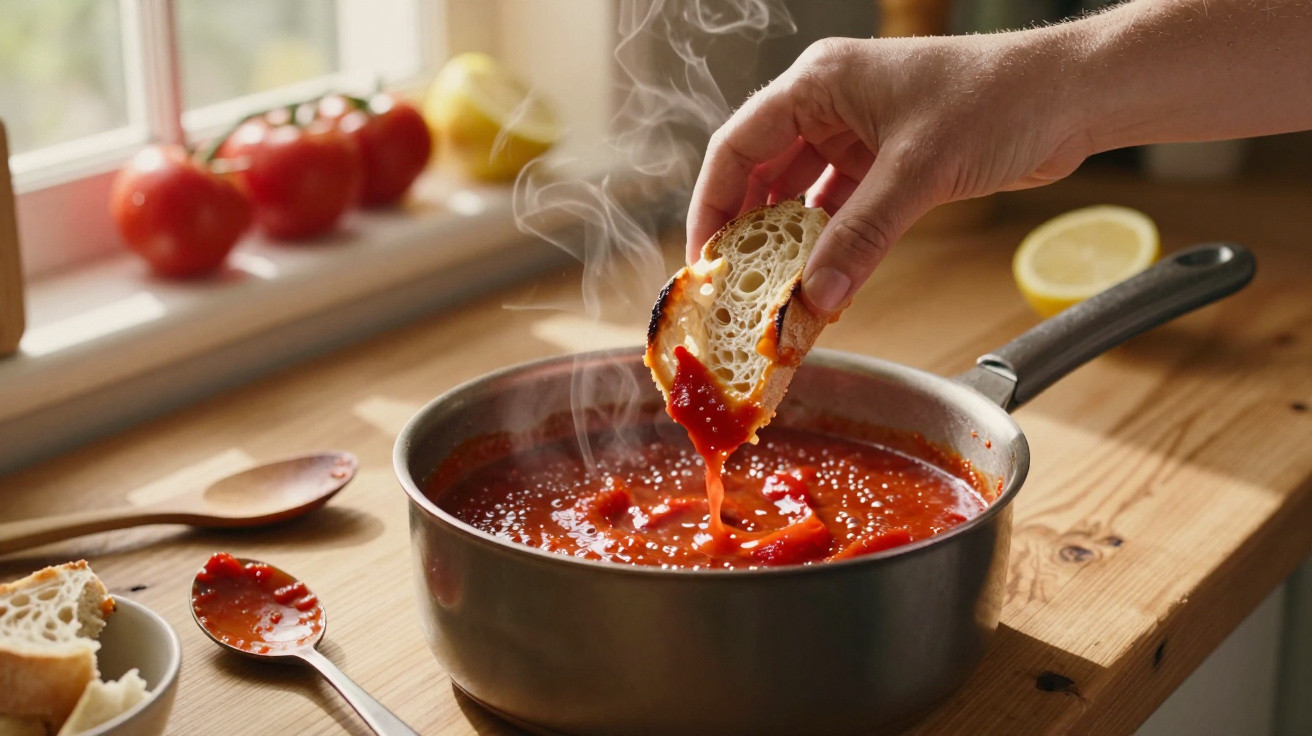
The tomato sauce is bubbling away, the living room smells like the weekend, and someone in the kitchen was certain: “Today it will be perfect.” Then comes the first taste – and just like that, all the romance goes down the sink. Too acidic. That sharp acidity that scratches at the back of your throat and makes your whole face tighten. It is a small moment of kitchen panic, when ordering a pizza instead suddenly seems tempting.
Anyone who cooks regularly knows this exact situation. You have decent ingredients, good intentions and perhaps even a recipe. Yet somehow a splash too much vinegar lands in the pan, or the tomatoes are more forceful than expected. Many people instinctively reach for sugar, while others hurriedly add cream. What not everyone realises is that something entirely ordinary can become the quiet hero in these moments.
A simple piece of bread.
Why a piece of bread can suddenly transform a sauce
It sounds almost like a kitchen myth, the sort of thing a grandmother might mention in passing: “If the sauce is too acidic, just put a piece of bread in it.” There is no scientific lecture or precise gram measurement, merely calm advice. Then there you are, holding half a bread roll and wondering: really? Can bread rescue something that seemed beyond saving only moments ago?
In many kitchens, this move has long been part of the standard repertoire. Some cooks swear by a slice of white bread, while others use a piece of day-old baguette. The idea seems almost too straightforward in a world of elaborate food hacks. Yet this modest trick demonstrates just how sensitively sauces respond when they are treated with care rather than aggressively over-seasoned.
Let us be honest: most of us respond to such moments with frantic action rather than calm.
I first saw this bread trick in a tiny restaurant kitchen in Naples. The chef, a quiet man with soot-blackened hands and flour on his apron, was stirring a richly fragrant pot of tomato sauce. Suddenly, he pulled a face, muttered something rude in Italian and, without hesitation, reached for an old end of bread lying beside the chopping board. He broke off a piece, dropped it into the sauce and simply carried on as if nothing had happened.
I watched the bread gradually soak itself through. The sauce became thicker, rounder and less harsh. When I tasted it later, there was no trace of bread: no noticeable crumbs, no unfamiliar texture. There was simply a sauce that tasted as though someone had gently turned down the volume, rather than changed the entire playlist.
He grinned when he noticed my expression. “The bread eats away the edges,” he said. That sort of down-to-earth kitchen poetry stays with you.
Behind this seemingly magical result lies a straightforward process. Bread is made up of starch, air and, depending on the variety, a little sugar and protein. When you add a piece to an overly acidic sauce, the starch absorbs liquid much like a small flavour sponge. Some of the free acidity is drawn into the crumb along with water and flavour compounds, rather than hitting your taste receptors directly.
At the same time, bread – particularly white bread – brings a mild character of its own: subtle sweetness and lightly toasted notes, depending on how old or toasted it is. It does not completely alter the sauce; instead, it provides a counterbalance. The acidity remains where it belongs, as a fresh and lively element, but loses its sharpest edge.
It is less a magic trick than a small shift in the balance of flavours.
How to use bread deliberately in an overly acidic sauce
The method is easy, but it works best if you approach it as a small ritual. Choose a neutral bread, ideally a pale one: baguette, white bread, ciabatta or a plain bread roll without a heavily toasted crust. Cut off a piece roughly the size of your thumb, or slightly larger, and place it in the gently simmering sauce. No force, no frantic tearing – simply let it slip in, then leave it alone.
Allow the sauce to bubble quietly for a few minutes. Stir occasionally so that nothing catches on the base of the pan. After around five minutes, lift the bread back out. It will be soft, heavy and saturated. Taste the sauce again. If the acidity is still too intense, add a second, slightly smaller piece. Work gradually rather than sinking half a loaf into the pan at once.
The greatest danger is impatience. Many people expect one piece of bread to transform the sauce completely within seconds and, after the first disappointment, immediately throw in two more. The result is an overloaded, cloudy sauce that smells more like institutional soup than carefully concentrated cooking. We know this from other parts of life too: changing too much too quickly often alters more than we intended.
There is another consideration: not every bread is suitable. Strongly seasoned loaves, sourdough with pronounced tang, and wholemeal breads with deep toasted notes all bring flavours of their own that can distort the sauce unnecessarily. One small misstep can turn a slightly over-acidic tomato sauce into a heavy, dull mixture that tastes like bread soup.
Let us be honest: no one measures every breadcrumb in milligrams during everyday cooking. Still, having a basic instinct for “two small pieces one after the other rather than one huge piece all at once” can save a great deal.
“Cooking is often nothing more than damage limitation with steady nerves,” a chef once told me. “Bread in the sauce is exactly that kind of moment: you correct a mistake without rewriting the whole story.”
For situations like these, a short mental checklist can help:
- Choose pale rather than dark bread: neutral, light bread adds mildness rather than creating a muddle of flavours.
- Start small: use it gradually, taste every few minutes and adjust as needed.
- Do not leave it in for too long: once the bread completely breaks down, the texture becomes thick and dull.
- Use it only for liquid sauces: in creamy sauces, bread can quickly make the result heavy and pasty.
- Combine it with other balancing methods: a little fat, a splash of dairy or a touch of sweetness can work alongside bread to create a remarkably balanced result.
When bread, acidity and everyday cooking offer a small lesson
Ultimately, this bread trick is about more than rescuing a plate of pasta. It reveals how much room for adjustment we have in the kitchen before “too much” truly becomes irreversible. Many people give up too soon when a sauce goes wrong, underestimating how adaptable flavour can be when they are willing to pause, take a breath and work with simple ingredients.
At a time when everything is expected to look perfect – recipes, plates and photographs – a quiet, slightly old-fashioned technique like this feels almost reassuring. It is not spectacular, not especially Instagram-worthy and rarely appears on trend lists. Even so, it points to a small truth: many kitchen problems are less dramatic than they seem in the first moment of alarm. Sometimes all it takes is a piece of bread, a spoonful of patience and a willingness to let the sauce surprise you once more.
Anyone who consciously tries this trick once will usually begin seasoning differently too: with curiosity rather than anxiety, and playfulness rather than rigidity. Perhaps that is its hidden benefit: not only does the acidity become gentler, but so does the way we deal with our own small mishaps. The sauce is too acidic? Fine. Put some bread in it – and carry on.
| Key point | Detail | Benefit for the reader |
|---|---|---|
| Bread binds acidity indirectly | The starch in bread absorbs liquid and some of the free acidity | An understanding of why the trick works, rather than blindly following recipes |
| Pale, neutral bread in small pieces | Add pieces of white bread or baguette to the sauce gradually, then remove them | A practical, easy-to-use method for everyday cooking |
| Can be combined with other balancing strategies | Fat, gentle sweetness or dairy can complement the effect of bread | Readers learn to balance sauces deliberately rather than giving up on them |

















Comments
No comments yet. Be the first to comment!
Leave a Comment