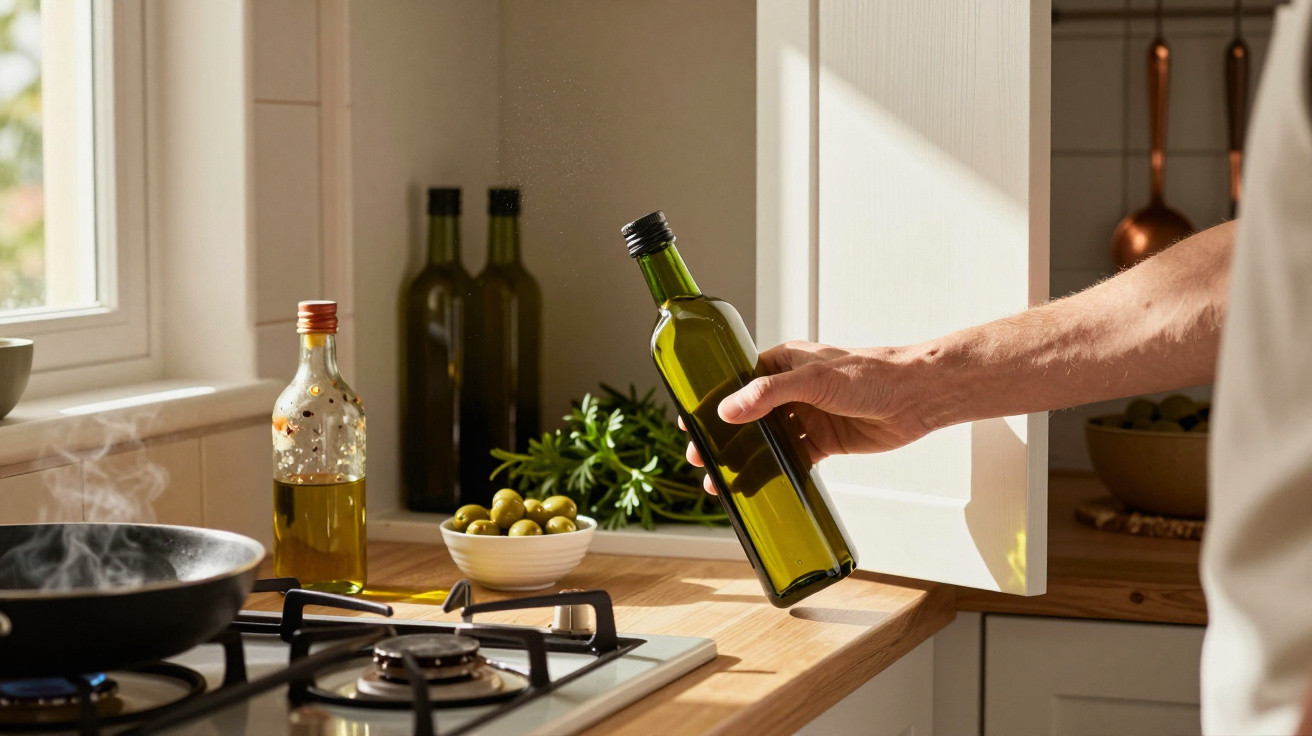
Dinner is simmering, the frying pan is sizzling, and the bottle of olive oil is waiting patiently a few centimetres from the hob. It is a familiar picture in many kitchens: convenient, reassuring and almost instinctive. One hand reaches for the bottle while the other stirs the vegetables, without realising that this small habit can gradually alter the flavour and qualities of an oil that may have cost quite a lot. The heat does not have to be fierce to have an effect. It builds up gently, with every meal cooked and every saucepan releasing steam. The oil says nothing. Until one day it seems less fruity, heavier and almost bland. A simple storage detail can change everything.
Near the hob, olive oil ages far more quickly
We all know those times when the kitchen is working at full pace: the oven is hot, a sauce is reducing and the hobs have been left on a little too long. Placed right beside them, olive oil endures this environment without attracting any attention. Yet it is much better kept at a steady temperature, away from repeated fluctuations. A bottle exposed to cooking heat every evening may gradually lose its green aromas, reminiscent of fresh grass, artichoke or almond. The issue is not the spoonful of oil poured into a hot pan. It is the bottle left there, an unobtrusive neighbour to the heat.
In a kitchen, the temperature near a hob can rise far above that shown by the room thermostat. A bottle stored twenty centimetres from a heat source may therefore go through several spells at around 30 °C, or even higher, over the course of a week. Research into oil storage shows that heat speeds up the oxidation of fats, a process that slowly changes their more delicate components. At home, this rarely results in an obviously unpleasant smell overnight. The change is subtler: an oil that is less expressive, less enjoyable on a salad and less true to the promise made by its label.
Olive oil contains unsaturated fatty acids and natural antioxidant compounds, notably polyphenols. These give it good resilience, though not complete protection. When heat, oxygen and light come together, deterioration progresses more quickly. This is why an attractive clear bottle standing beside the hob in sunlight combines all the warning signs. Olive oil is not a piece of kitchen decoration. It deserves some calm, even when the kitchen itself does not always have any.
The best place to store olive oil is not necessarily the most convenient
The easiest step is to move the bottle into a closed cupboard, away from the oven, dishwasher and hobs. A low cabinet or internal shelf, protected from direct light, is perfectly suitable if the room remains temperate. The ideal is often around 14 to 18 °C, without becoming fixated on a thermometer: in an ordinary home, a cupboard away from heat sources already makes a significant difference. Keep only a small serving bottle close to the worktop, topping it up from the main container when needed.
Many people keep their oil beside the hob simply because it is much quicker. There is nothing foolish about that: when arriving home late, people want effortless movements, not a perfectly choreographed cooking routine. Let us be honest: nobody really manages that every day. The common mistake is instead buying a large, good-quality tin, then leaving it open or poorly resealed within reach of steam for several months. Extra virgin olive oil deserves to be used within the months following opening, depending on its packaging and storage conditions.
The choice of container matters just as much as its location. Dark glass, stainless steel or an opaque metal tin protect oil better than clear glass, particularly if it is left on a bright worktop.
“To remain true to its original flavour, olive oil needs darkness, a mild temperature and a tightly closed cap.”
A few habits are enough to limit the damage:
- close the bottle again immediately after use;
- avoid window sills and areas close to the hobs;
- choose a small format if olive oil is used infrequently;
- check the harvest date when it is stated.
A better-stored bottle also makes for a more flavoursome kitchen
Moving olive oil by thirty centimetres, or simply placing it in a cupboard, may seem insignificant; nevertheless, it changes how the oil ages at home. After a few weeks, you may rediscover that slight pepperiness at the back of the throat or the spicy note that enhanced a tomato so well. Flavour is often the first clue: oil that becomes flat or greasy on the palate may have suffered too much from heat, without necessarily being unfit to eat. It has merely lost the qualities that gave it character.
It is also important to separate storage from use. Yes, olive oil can be used for cooking, roasting or searing, according to the recipe and chosen temperature. Heating it occasionally in a frying pan is entirely different from leaving it permanently in the hottest area of the kitchen. This confusion is common because the two situations appear identical at first glance. They are not. An oil can handle cooking; it does not need to spend its whole life beside the heat.
Your next meal can provide a very practical little test. Look at where your bottle is kept, smell it before using it and taste a drop on a piece of bread. Is its aroma fresh, green and slightly bitter, or does it suggest rancid nuts and cardboard instead? This is not a laboratory investigation, merely a habit that brings us closer to what we eat. In many kitchens, the least spectacular cupboard ultimately becomes the best ally of a good olive oil. This modest attention may also prompt you to reconsider where you keep spices, coffee or dried fruit.
| Key point | Detail | Added value for the reader |
|---|---|---|
| Keep oil away from the hob | Repeated heat accelerates its oxidation | Preserves flavour and aromas for longer |
| Choose a closed cupboard | Darkness and a stable temperature limit deterioration | Prevents good-quality oil from turning bland too quickly |
| Select a suitable container | Dark glass or opaque metal protects against light | Helps you get more from every bottle you buy |

















Comments
No comments yet. Be the first to comment!
Leave a Comment