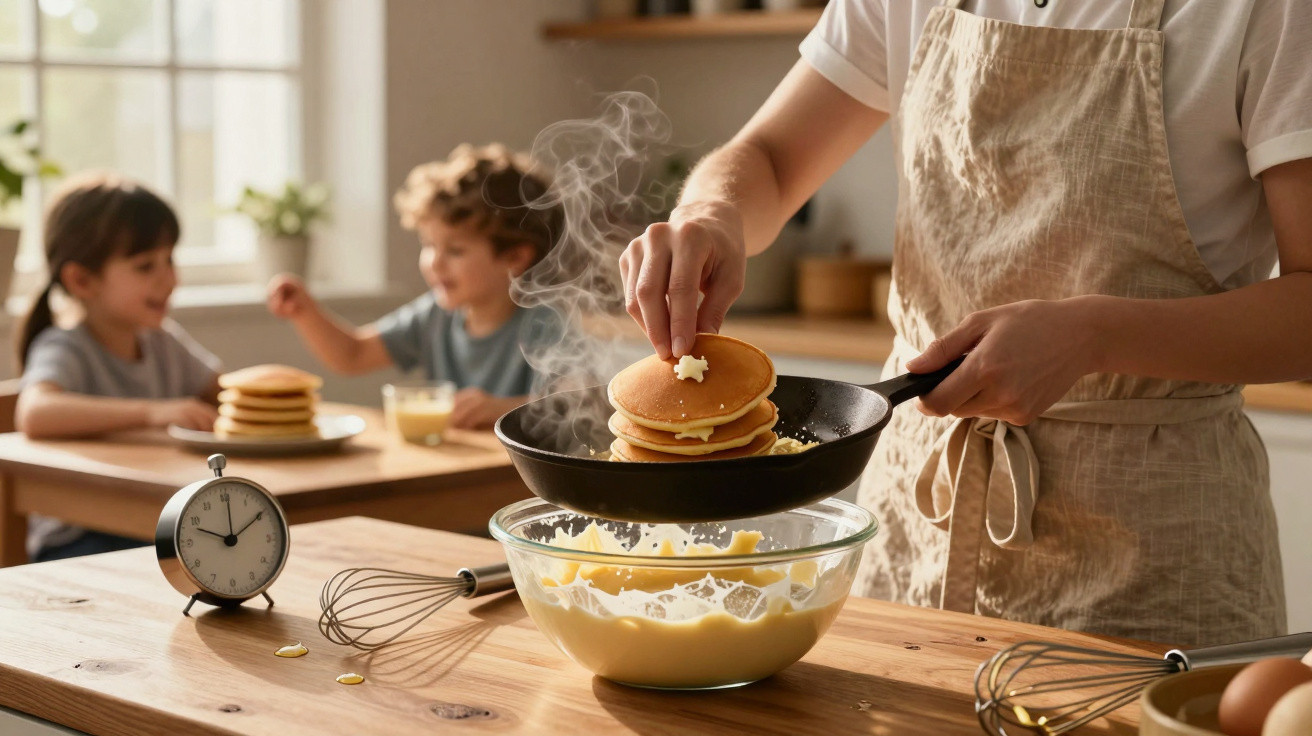
It is 5.40 pm, the kitchen is already filling with the scent of warm butter, and the children are asking almost in unison, “Will they be ready soon?”. On the worktop, the flour has made a small white cloud, the first attempt has stuck to the pan, and the batter looks oddly too runny. We all know that moment when a straightforward pancake evening turns into a test of patience. Cyril Lignac relies on very simple techniques, rather than complicated recipes or impossible-to-find ingredients. His secret is not some magic powder: it is mainly about order, consistency and a little time. A smooth, fragrant, lump-free batter completely changes the mood around the table. And the turning point is often found where you least expect it.
Cyril Lignac’s real secret starts before cooking
When Cyril Lignac makes pancake batter, he does not try to rush at all costs. He starts by gathering the essentials: flour, eggs, milk, a pinch of salt, a little sugar depending on how the pancakes will be served, followed by a subtle fat. On paper, there is nothing remarkable about it. Yet everything happens in the mixing bowl. The flour needs to be shaped into a sufficiently wide well to hold the eggs without letting them run to the edges, then the milk should be added gradually. This patient method prevents those notorious lumps, the ones that resist the spoon and always seem to hide in the final pancake.
The basic ratio frequently found in the chef’s recipes is straightforward: around 250 grams of flour for three eggs and half a litre of milk. This usually makes about a dozen thin pancakes, depending on the pan’s size and how generously the ladle is filled. For a family of four, they can disappear in under twenty minutes, especially when the chocolate spread comes to the table. A spoonful of neutral oil or a little melted butter in the batter helps produce a more supple texture. It is the small details that rescue a big pancake craving.
The cleverest move is to work in the milk in stages, beginning at the centre. First combine the eggs and flour to make a thick, almost compact mixture, then gradually loosen it with the liquid. This process creates a smooth batter without needing to bring out the blender. Let us be honest: nobody really does this every day with a pastry chef’s precision. Even so, spending two extra minutes at the beginning saves ten minutes of fixing things later. A properly prepared batter also holds its shape better while cooking, without becoming heavy or rubbery.
Resting the batter: the stage skipped too often
The advice most associated with Cyril Lignac often comes up in home kitchens: leave the batter to rest. Thirty minutes is already a sound starting point, while an hour makes things even easier. The bowl can stay covered at room temperature if the room is not too warm, or go into the fridge if it needs to wait longer. During this time, the flour absorbs the liquid and the gluten relaxes. The batter becomes more even and easier to spread around the pan. Batter resting beneath a tea towel is not especially glamorous. Nevertheless, it may be the most useful part of the recipe.
A common mistake is to assume that a runny batter has necessarily gone wrong. Once it has rested, it may seem to have thickened or, conversely, look more fluid: both are perfectly normal. Simply stir it gently and add a small splash of milk if it does not spread easily. Do not pour in a large amount at once, or you risk upsetting the balance you have achieved. Many inexperienced cooks also heat the pan too fiercely to save time. The outcome is a pancake browned at the edges, pale in the middle and impossible to turn over. It happens even to the keenest cooks.
For a batter in keeping with the chef’s indulgent style, a flavouring can make all the difference without overwhelming the taste of butter and milk. A touch of vanilla, a little orange blossom water, lemon zest or a spoonful of dark rum is more than enough. The flavour should remain a subtle signature.
“A good pancake batter should flow easily from the ladle, then spread into a thin layer as soon as it meets the pan.”
- Add the milk little by little, never all in one go.
- Allow the batter to rest for at least 30 minutes.
- Grease the pan sparingly between the first pancakes.
- Stir the batter before each fresh ladleful if it has been sitting.
The pan, the butter and the right moment to turn
Even a successful batter can be spoiled by a pan that is not hot enough. The test is easy: a tiny drop of batter should sizzle gently, without burning straight away. Cyril Lignac favours steady cooking over medium-high heat rather than an aggressive flame. Grease the surface using kitchen paper dipped in melted butter or oil. The pan should have only the faintest sheen, not be swimming in fat. An overly greasy pancake absorbs everything, browns poorly and leaves a slightly heavy feeling, even with a light filling.
Do not be discouraged by the first attempt. The first pancake is often imperfect, and it is almost a family tradition: it helps you adjust the temperature, judge the amount of batter and appease the impatient people gathered around the table. Wait until the edges lift away and the surface is no longer glossy before turning it. A thin spatula is helpful, though the more confident cooks toss it with a flick of the wrist. The right moment cannot really be timed: you need to watch for it. After two or three pancakes, the movement becomes surprisingly natural.
The final secret is consistency. Always use the same ladle, tilt the pan immediately and pour the batter in a quick circle without hesitation. If it fails to cover the entire surface, do not add a second ladleful in the middle: that creates uneven thickness. It is better to remember the lesson for the next one. Once cooked, keep each pancake beneath a plate or a clean tea towel to maintain its softness. Stacking them this way stops them drying out while the pile grows. And, let us admit it, there is something deeply reassuring about that pile.
A successful pancake batter is also about sharing
Cyril Lignac’s approach is a reminder of something quite simple: everyday cooking does not have to be perfect to become memorable. Lump-free batter that has rested and is cooked in a well-adjusted pan is enough to bring back memories of holidays, rainy afternoon snacks or noisy Sundays. Children want sugar, some people ask for lemon, and others prefer a savoury version with cheese and ham. The same batter can satisfy all these tastes, provided the sugar is added lightly from the outset. A successful pancake makes no noise, yet it brings everyone together.
There is also freedom to make the recipe your own. Plant-based milk can replace ordinary milk, a little pale beer can add lightness, and buckwheat flour opens the way to savoury fillings. The key is to preserve the rhythm: mix without being rough, leave it to rest and cook without rushing. These are modest, almost everyday actions, but they truly transform the result. The next time the batter seems too thick or the first pancake tears, there will be less panic. Just a small adjustment, a smile, then another ladleful.
| Essential point | Detail | Added value for the reader |
|---|---|---|
| Gradual incorporation | Pour the milk in stages into the centre of the well | Smooth batter without stubborn lumps |
| Resting time | Allow at least 30 minutes before cooking | More supple pancakes that are easier to spread |
| Controlled cooking | Hot pan, little fat and consistent movements | Even browning and a soft texture |

















Comments
No comments yet. Be the first to comment!
Leave a Comment