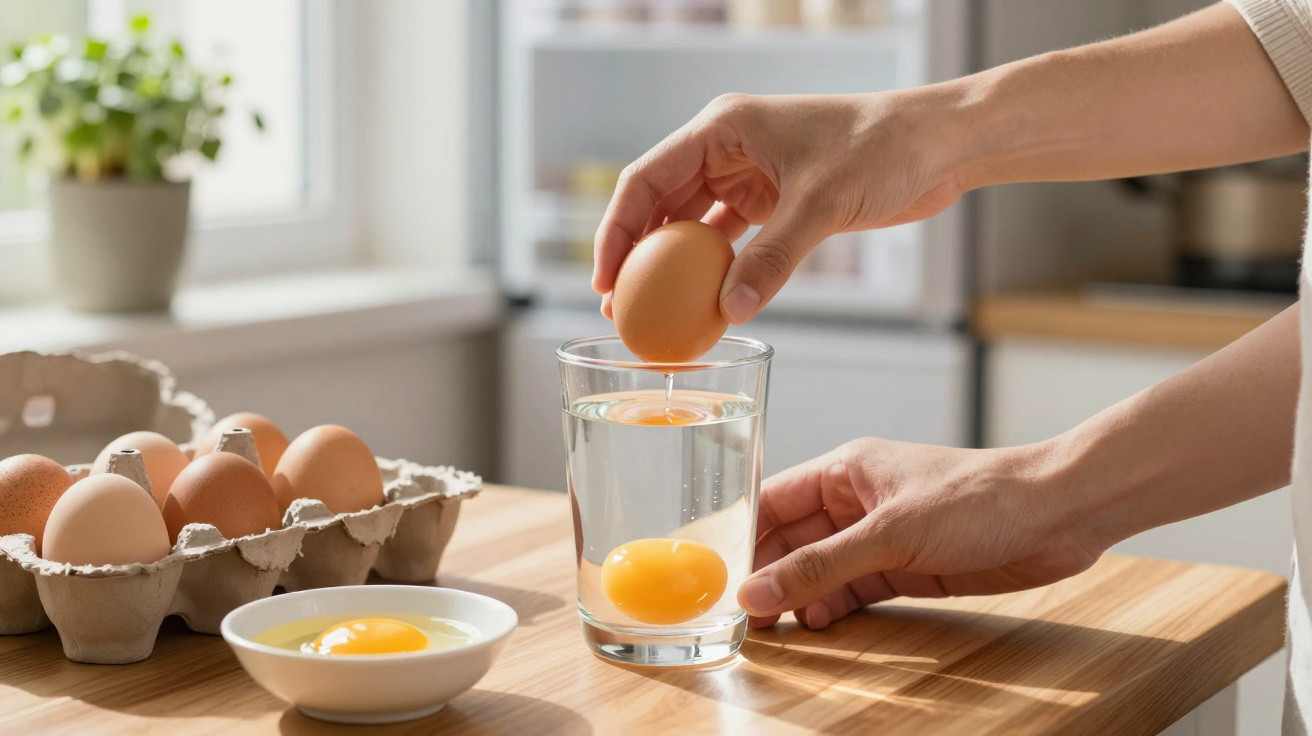
Dinner is nearly ready, the frying pan is already hot, and all that remains is to crack two eggs for a last-minute omelette. Then comes that familiar hesitation: the carton has been sitting at the back of the fridge for some time, its date has passed or is close to passing, and nobody can remember when it was bought. We have all faced this moment, egg in hand, torn between avoiding waste and being cautious. Yet a simple glass of water can offer an initial clue in seconds, without getting a questionable smell on your fingers or sacrificing a recipe. The test is well known, but it is worth understanding properly. Your kitchen may be hiding a floating surprise.
A floating egg is not necessarily beyond use
The method could hardly be simpler: fill a large glass or bowl with cold water, then carefully lower the egg into it. If it lies flat on the bottom, it is usually very fresh; if it stands upright, it has already been around for a few days. If it rises clearly to the surface, its age is displayed like a small flag in the water. The glass of water test is based on a natural process, rather than an old wives’ tale with no basis.
In a family kitchen, a carton forgotten for two weeks can produce surprising results: some eggs will remain obediently on the bottom, while others will point upwards without actually floating. This variation often depends on the laying date, but also on the temperature at which they have been stored. In France, the best-before date is set at 28 days after laying. That is a useful guide, although it does not remove the need for common sense when cooking.
An eggshell is not completely airtight: as time passes, a small amount of water evaporates and air gradually enters the air cell. The larger this air pocket becomes, the lighter the egg is, causing it to stand up and eventually float. Water therefore does not reveal contamination; it mainly indicates how the egg has aged. A floating egg calls for careful checks once cracked, not an automatic and unquestioning verdict.
The right approach: check the egg before cooking
To carry out the test properly, use cold water in a container deep enough for the egg to settle freely. Lower it in gently rather than dropping it: a cracked shell can allow water inside and distort the result. An egg lying flat on the bottom can be used for mayonnaise, soft-boiled eggs or baking. If it stands upright while still touching the bottom, it is better suited to thorough cooking, such as in a cake or a well-baked quiche.
The most common mistake is cracking a floating egg straight into an entire mixture. It is understandable: when making a cake for children or a quick meal, nobody wants to wash another bowl. Let us be honest: hardly anyone does this every day. Even so, cracking each doubtful egg into a small ramekin makes it possible to inspect its appearance and smell it before putting the other ingredients at risk.
A few straightforward signs can help you decide without overreacting. A strong, sulphurous or distinctly unpleasant smell means the egg must be thrown away, whereas a very runny white mainly indicates reduced freshness and does not, by itself, prove that the egg is unsafe to eat.
“The float test is an indicator of age, not a complete food safety check.”
- Egg lying flat on the bottom: very fresh.
- Egg standing on the bottom: older, preferably cook it.
- Egg floating: crack it separately and inspect it.
Storing eggs without turning the fridge into a laboratory
The most effective way to prevent uncertainty is to keep eggs in their original carton, pointed end down, away from odours and knocks. The carton displays the date, shields the shells and prevents mix-ups with a newer purchase. At home, the fridge is often the most practical option, particularly where kitchen temperatures fluctuate considerably. Keep eggs away from the door, which is the area exposed to the greatest temperature changes.
It is best not to wash eggs before storing them. Their shells have a thin natural protective layer, known as the cuticle, which restricts the passage of microbes; water can weaken this barrier. If a shell is dirty, wipe it just before use with clean, dry paper. If it is cracked, do not take chances: use the egg immediately after thorough cooking, or discard it if it gives you even the slightest doubt.
Once an egg has been cracked, its appearance provides details that a glass of water cannot. A rounded yolk and an egg white that holds together usually suggest a recently laid egg; a flattened yolk and a very spread-out white show that it has aged. This may affect the texture of a meringue or poached egg, but less so that of a generous sponge cake. Egg freshness is not solely a safety issue: it also affects the result on the plate.
A simple habit that prevents waste and unpleasant surprises
The glass of water test is reassuring because it gives you a little control over an everyday food that is often left at the back of the fridge until the day it is needed. It does not replace the date on the carton, checking the shell or smelling the egg after cracking it. Above all, it encourages you to pause for two seconds. At a time when food is quickly discarded for fear of making the wrong choice, this small habit can prevent a great deal of unnecessary waste.
People at greater risk, including young children, pregnant women, older people and those with weakened immune systems, should favour very fresh, thoroughly cooked eggs. Raw or lightly cooked dishes - chocolate mousse, homemade mayonnaise, tiramisu and soft-boiled eggs - require extra care. An egg with uncertain origins or storage conditions has no place in a recipe served raw. Caution remains more appetising than an unpleasant evening.
There is also a small, almost homely satisfaction in knowing how to interpret what happens in a glass of water. Floating eggs are not always fit only for the bin, while eggs that sink still require checking: that distinction matters. Telling someone close to you about this test, comparing results from one carton to another or writing the purchase date on the carton can become a surprisingly useful habit. In ordinary kitchens, the best practices are often the simplest.
| Key point | Detail | Benefit for the reader |
|---|---|---|
| Egg on the bottom | It lies flat: its air cell is still small. | A good choice for recipes where freshness matters. |
| Egg standing upright | It has aged, but still touches the bottom of the container. | Best used in a thoroughly cooked recipe. |
| Floating egg | Its air cell is larger; it should be cracked separately. | Prevents an entire preparation being wasted if it smells suspicious. |

















Comments
No comments yet. Be the first to comment!
Leave a Comment