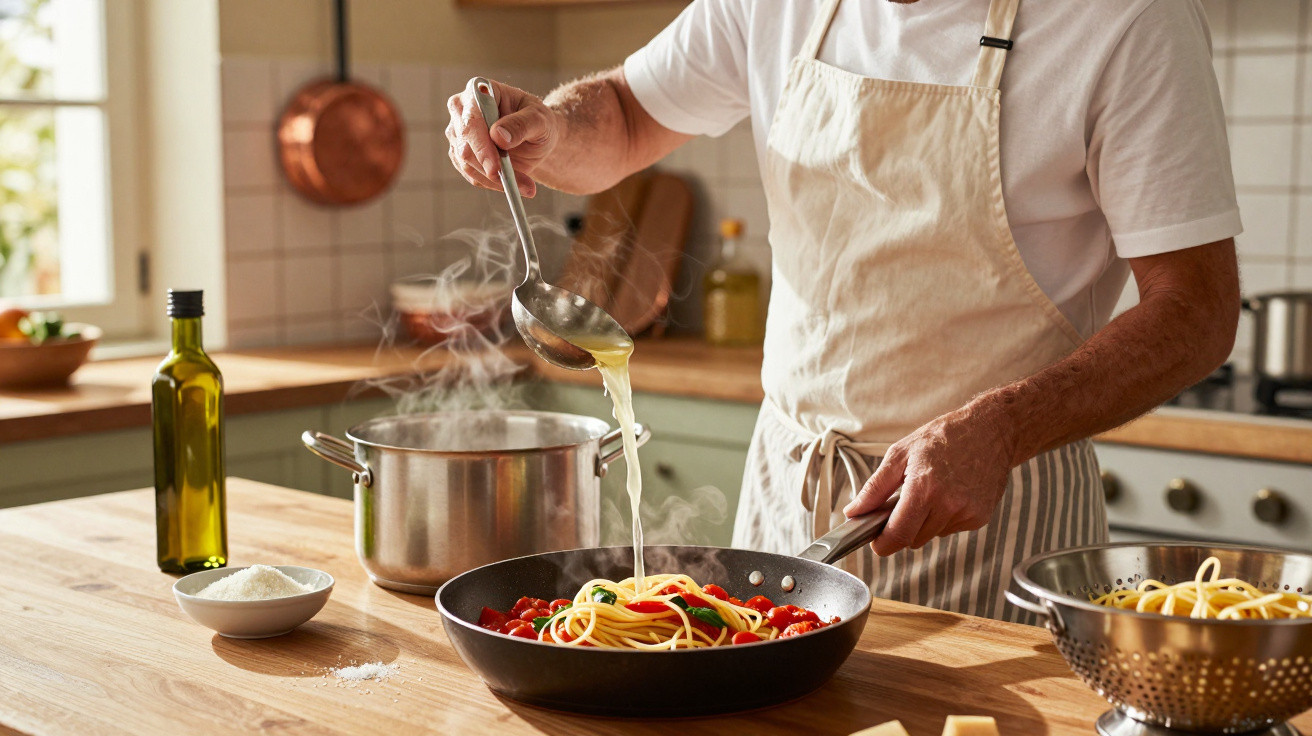
In Italy, the country where pasta reigns supreme, pasta cooking water does not end up down the sink. Chefs explain that it can genuinely transform a sauce.
In an article devoted to best practice when cooking pasta, an Italian food website reiterates a sacred rule, supported by chefs’ comments: never throw away the cooking water. The online publication explains why this cloudy liquid, often overlooked outside Italy, is essential to a sauce’s texture, flavour and ability to cling to pasta.
Why Italian chefs always save pasta cooking water
For the Italian cooks consulted by the website, the message is straightforward: cooking water is as much a part of the recipe as the pasta or the sauce. Rather than being mere “waste” to discard, it is an ingredient in its own right.
Cooking water, rich in starch and salt, works as a genuine binding agent between pasta and sauce.
As pasta cooks, it releases starch, some of which remains in the water. This starch content is precisely what matters so much to chefs:
- it gently thickens the sauce without requiring flour or cream;
- it helps the sauce coat the pasta instead of sliding to the bottom of the plate;
- it lets you adjust an overly thick sauce without watering it down as plain water would.
Italian cooks also point out that the water is salted from the outset. Reusing it maintains a consistent flavour between pasta and sauce, something neutral water cannot achieve.
What pasta cooking water really changes in a sauce
The Italian website sets out the practical effects of this water on a range of sauces, from the simplest to the most elaborate. Chefs focus on two key elements: emulsification and texture.
A natural emulsion without cream
Many Italian recipes rely on an emulsion, a stable blend of fat - olive oil, butter or pancetta fat - and liquid. Pasta cooking water has a central role here.
With a little cooking water, the fat, liquid and starch combine to create a glossy, smooth and even sauce.
This happens, for instance:
- in pasta with garlic and oil, where cooking water turns a simple base of infused oil into a sauce that coats the pasta;
- in “cacio e pepe” pasta, where cheese and pepper combine with starchy water to create a creamy sauce with no milk or cream added;
- in traditional Italian carbonara, where cooking water, used sparingly, helps the egg-and-cheese mixture coat the pasta without becoming lumpy.
The chefs quoted by the publication caution against using cream to “rescue” a sauce. In their view, using cooking water properly is often enough to create a rich, creamy texture while preserving the recipe’s original flavour.
A sauce that properly clings to pasta
Professionals also highlight another significant benefit: adhesion. Without starch, sauce stays separate from the pasta. With cooking water, it clings to every piece.
Italian chefs point out that the sauce should come up with the pasta on the fork, rather than remain at the bottom of the plate.
This coating effect is especially apparent with:
- short pasta shapes such as rigatoni, penne and fusilli, whose ridges and hollows hold a starch-bound sauce more effectively;
- tomato-based sauces, which become smoother and hold together better;
- cheese sauces, which turn silkier and less heavy.
The chefs’ recommended approach is precise: pasta should finish cooking in the frying pan or saucepan containing the sauce, with small ladlefuls of cooking water added gradually until the desired consistency is reached.
How to use pasta cooking water correctly
The cooks consulted by the Italian website describe an almost systematic method that works for most pasta dishes.
- Salt the water well from the beginning: this is the water used to adjust the sauce, so it must not be bland.
- Set aside one or two ladlefuls before draining: chefs keep a bowl of cooking water beside them, just in case.
- Drain without rinsing: rinsing would remove the starch from the pasta’s surface, working against the intended result.
- Finish cooking the pasta in the sauce: allow one to two minutes in the frying pan or saucepan, adding cooking water little by little.
- Make final adjustments at the last moment: if the sauce thickens as it stands, another splash of cooking water restores its creaminess.
Chefs stress the importance of using small amounts. Too much pasta cooking water would make the sauce thin and tasteless. The aim is to hydrate, emulsify and bind, not to dilute.
Common mistakes identified by Italian cooks
The food publication lists several habits chefs consider counterproductive:
- discarding all the water without keeping some aside for the sauce;
- rinsing pasta in cold water, which removes the surface starch;
- cooking pasta in water for too long, then mixing it with sauce without adding any starchy water;
- relying solely on cream or cheese to thicken the sauce, without using cooking water.
Conversely, Italian chefs say that using cooking water well gives greater control over texture while also reducing the need for heavy fats.
Uses for pasta cooking water beyond pasta
The Italian website also mentions several additional uses known to cooks, helping to avoid wasting this starchy water altogether.
| Culinary use | Role of the cooking water |
|---|---|
| Soup or minestrone | Adds body and a subtle cereal-like flavour |
| Bread or focaccia dough | Replaces part of the water and contributes a little starch |
| Stir-fried vegetables | Deglazes the frying pan without using wine or stock |
These uses remain secondary to its main purpose: perfecting pasta sauce. Chefs point out that the water keeps only for a limited time. It should be used straight away, while still hot.
How French cooks use pasta cooking water
In France, the method described by Italian chefs is increasingly promoted by cookery schools, restaurants and food programmes. Professional cooks widely use these principles, which are close to the long-established technique of thickening sauces with starch.
In French restaurants, the idea of using a starchy liquid to bind a sauce is well known, even if it is less instinctive in home kitchens.
In family kitchens, pouring cooking water away is still common, but pasta recipes directly inspired by Italian tradition now encourage people:
- to reserve a ladleful of cooking water every time they make pasta;
- to finish cooking pasta in a frying pan or casserole rather than only in the pan of water;
- to use less cream in favour of an emulsion of cooking water, fat and cheese.
French catering schools already teach the general principle: starch, whether it comes from flour, cornflour or pasta, acts as a binding agent. Italy makes this particularly visible through pasta cooking water, but the mechanism is the same.
Practical tips for successful pasta at home
For UK readers wishing to follow the advice reported by the Italian publication, a few simple pointers can provide useful guidance.
- Salting: Italians salt the water generously so that the pasta has flavour. Because the cooking water is then reused, the sauce also benefits from this seasoning.
- Cooking time: taking pasta off the heat one or two minutes before the time stated on the packet allows it to finish cooking in the sauce with the cooking water.
- Gradual addition: it is better to pour in the cooking water a little at a time while stirring, rather than all at once.
- Observation: the right consistency is visible. The sauce should coat the pasta without leaving a pool at the bottom of the plate.
Behind this simple action - not tipping the water down the sink - lies a set of techniques and habits that Italian chefs regard as the foundation of a “real” pasta dish. For them, the difference between an ordinary dish and a finished one often comes down to this: a ladleful of cloudy water added to the frying pan, quietly transforming the sauce.

















Comments
No comments yet. Be the first to comment!
Leave a Comment