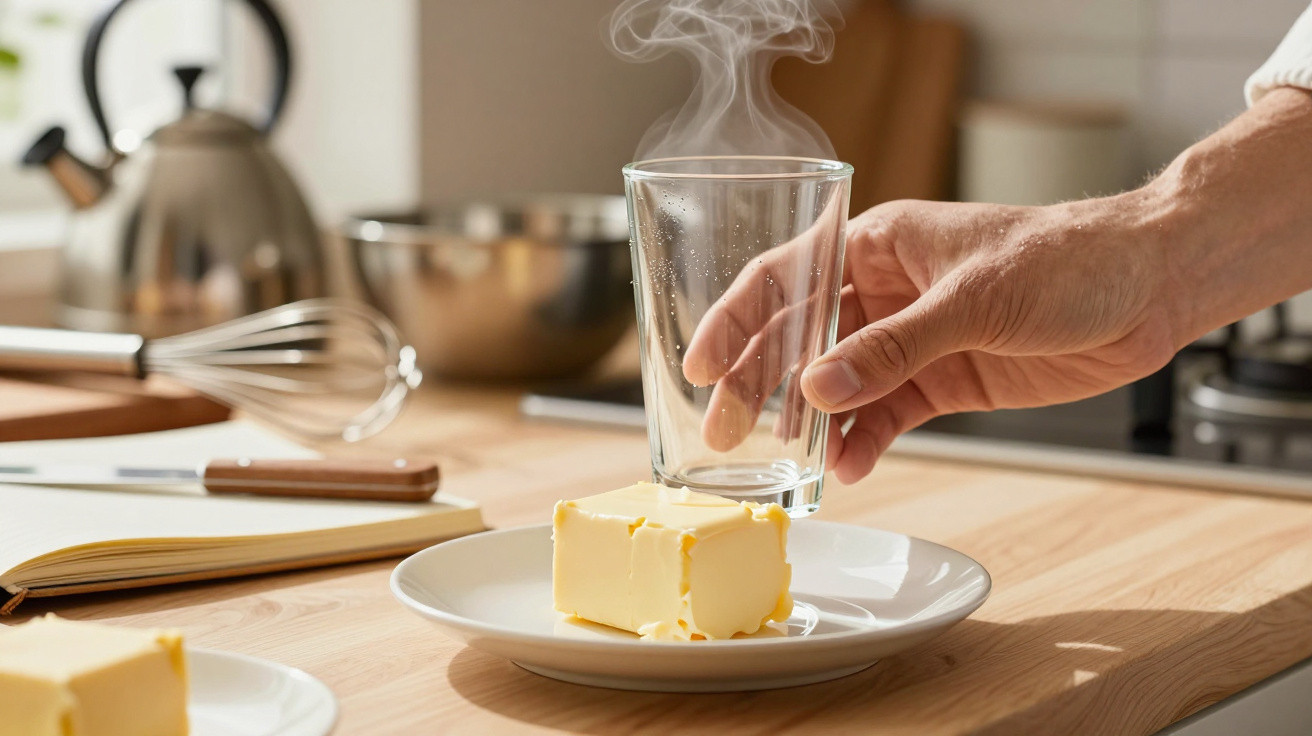
You are halfway through making a batch of biscuits when you realise the butter is still fridge-hard. The oven has been preheated, the sugar is in the bowl, and you are holding a block of butter firm enough to use as a building material. You look at the microwave, fully aware of the risk: leave it in a second too long and, instead of softened butter, you have a puddle.
On some days, that is enough to make the entire baking plan quietly disappear.
Yet one tiny, almost ridiculously easy kitchen technique can transform the situation.
Why hard butter can derail your baking
When a recipe calls for “softened butter”, it is not being fussy. It means a precise consistency between a solid fridge block and a glossy liquid. When you press it with a finger, it should leave an obvious indentation, without sinking through as though it were ice cream.
Get this stage wrong and biscuits spread too quickly, cakes turn dense, and toast is left with uneven streaks of butter instead of one smooth coating.
We have all had the thought: “I’ll just use it cold, it’ll be fine.” Then you try to cream near-frozen butter with sugar, and the mixer flings butter pieces around the worktop. Rather than combining, the sugar simply scrapes against it. The mixture remains grainy and lumpy, and once the butter eventually softens, the batter has been overmixed.
The opposite mistake is just as easy. You microwave the butter, get sidetracked by a notification, and return to melted edges with a soft centre. That uneven heating will cause problems for your biscuits later.
There is a straightforward piece of science behind this minor kitchen crisis. Butter is an emulsion containing fat, water and milk solids, and its structure shifts with temperature. At around 18–21°C (64–70°F), its fat crystals are soft enough to capture tiny air pockets during mixing. Those pockets of trapped air help biscuits rise and give cakes their tender texture.
At much lower temperatures, the fat is too firm to retain air. At much higher ones, it becomes so liquid that the structure collapses. The issue, then, is not impatience; it is working outside butter’s remarkably narrow comfort zone.
The quick butter-softening method pastry cooks swear by
This method solves the problem without melting or panic: the warm-glass trick. Cut your cold block of butter into cubes measuring roughly 1–2 cm, then arrange them in one layer on a plate.
Take a large glass or a small bowl that will fit over the cubes. Fill it with very hot tap water and leave it for 30–60 seconds. Empty out the water, then promptly dry the inside.
Turn the warmed glass upside down over the butter cubes, creating a miniature sauna. Leave it alone for 3–5 minutes. The enclosed, gentle warmth softens the butter evenly from the outside in, without pushing it into melted territory.
Lift the glass and press one cube with your finger. It should give easily and show that ideal dent. If it remains too hard, cover it again for another few minutes. Anyone who cooks frequently will soon learn to judge the timing instinctively.
This technique brings a quiet sense of relief because it eliminates the microwave worry of constantly asking, “Is it melted yet?” There is no standing over it, stopping, turning or guessing. Instead, you create a small warm space in which the butter can soften at its own speed.
“The goal isn’t speed at all costs, it’s control,” says every experienced home baker who’s nuked one too many sticks into oblivion.
- Step 1: Cut the cold butter into small cubes.
- Step 2: Warm a glass or bowl using very hot tap water, then dry it.
- Step 3: Place the warm glass over the butter cubes for 3–5 minutes.
- Bonus: Repeat in short intervals if the butter is still too firm.
Other useful shortcuts and pitfalls to avoid
Sometimes, you do not even have 5 minutes. That is when many people grate butter as if it were cheese. It is surprisingly effective: use the coarse side of a box grater, grate the cold butter, and scatter the shreds in the mixing bowl. At room temperature, they soften in roughly a minute.
It may seem slightly ridiculous the first time you do it, but the increased surface area is genuine science in action.
Another popular option is the rolling-pin method. Put the cold butter between two sheets of baking paper, gently hit it with a rolling pin, and then press it flat. The aim is not to make it paper-thin, but simply pliable. Remove the paper afterwards, then fold or cut the butter into pieces.
The result is a soft, flexible slab that works particularly well in pastry and biscuit dough.
The consistent danger is overly direct heat. Resting butter on a radiator, beside a hob flame or under a hot lamp can sound inventive, until the edges turn liquid while the centre remains stubbornly cold. Microwaving creates the same problem. One area melts while the inside stays firm, leaving an odd combination of textures that will not cream evenly.
In truth, nobody uses these methods every single day. But after losing a batch of biscuits because the butter half-melted, you begin to appreciate slow, controlled shortcuts.
A small butter habit that improves everything you bake
The wider point of softening butter faster is not really about the clock. It is about removing a little everyday kitchen friction. One simple technique can make the difference between “Ugh, forget it, I’ll buy cookies” and “Actually, I’ve got this.”
That modest difference appears in unexpected ways: butter spreads more easily on toast during busy mornings, a last-minute birthday cake rises properly, and chocolate chip biscuits suddenly resemble the pictures.
You do not need professional equipment or flawless planning. You only need one or two techniques that work in real, slightly chaotic life. The warm-glass technique, grated-butter hack and rolling-pin flattening are all reminders that your ingredients and your time deserve more than guesswork.
The next time you open the fridge to find an immovable block of butter, you may feel the familiar irritation building, before remembering there is a faster route from “solid block” to “soft enough”.
Perhaps that is the understated pleasure of these small kitchen techniques. They do more than save recipes: they return a little control on an ordinary day when everything feels rushed.
All at once, softened butter in five minutes becomes more than a method. It is a small, practical reminder that something warm and good can still be made from the coldest, most inconvenient moment.
| Key point | Detail | Value for the reader |
|---|---|---|
| Warm-glass method | Place a warmed glass over butter cubes for several minutes | Softens butter evenly without melting |
| Alternative shortcuts | Grate or flatten butter to help it soften faster | Provides flexible choices according to available time and tools |
| Avoiding direct heat | Do not microwave butter or put it near intense heat sources | Prevents spoiled texture and unsuccessful baking results |

















Comments
No comments yet. Be the first to comment!
Leave a Comment