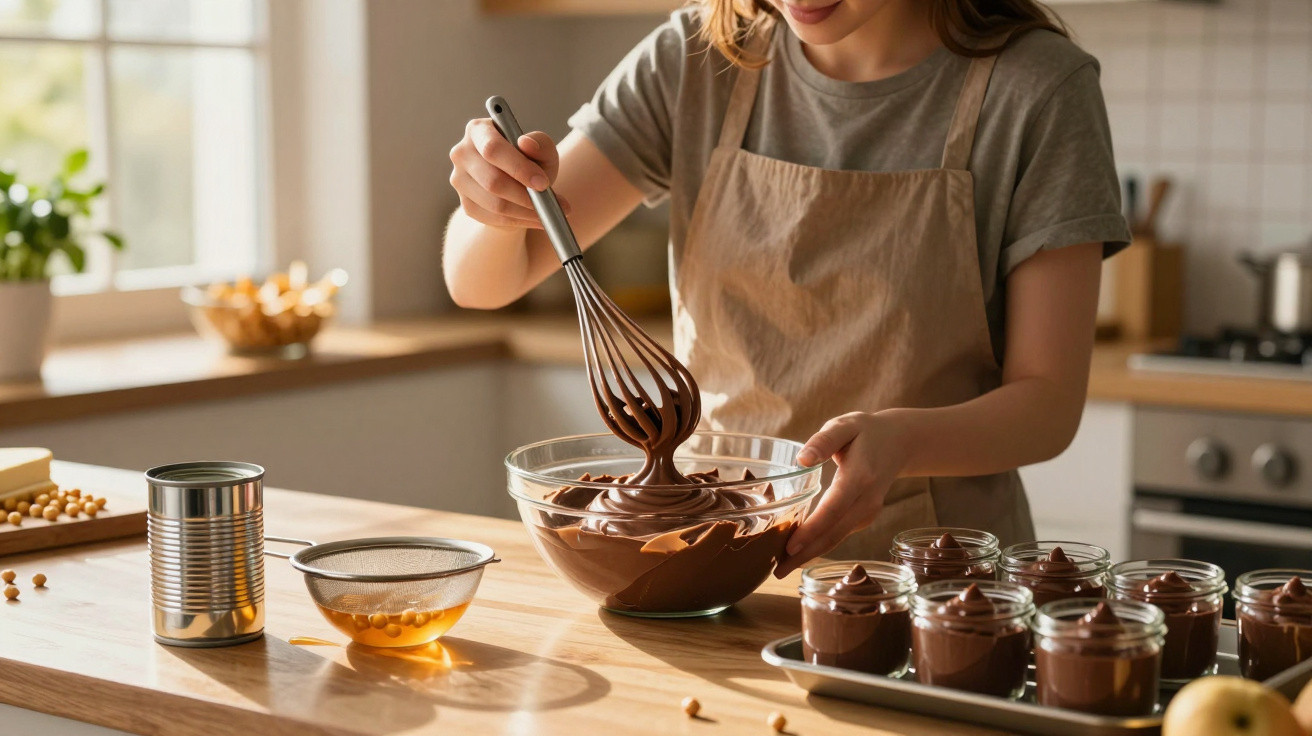
The amber-coloured liquid at the bottom of a tin of chickpeas nearly always ends up down the sink. Yet that everyday habit deprives home cooks of a remarkable ingredient that can be whipped into peaks and completely change a dessert.
On a Sunday afternoon, with an opened tin in front of you and a slightly urgent desire to make something sweet, the routine is familiar: drain the chickpeas, keep the pulses for hummus, and let their liquid run away. It looks cloudy, a little thick and hardly glamorous. Nothing about it suggests an airy pudding. But a few minutes with a whisk can turn it into a firm, glossy white cloud, ready for melted chocolate or red berries. We all know the moment when an almost empty cupboard calls for improvisation. Here, that improvisation has a name: aquafaba. It is a quiet little revolution.
Chickpea water contains a texture pastry cooks know well
In vegan pastry kitchens and family homes alike, aquafaba is intriguing because it resembles whipped egg white. When beaten, chickpea cooking liquid traps air, creating a soft foam that gradually becomes denser and almost silky. At first, it is difficult to believe: this liquid, usually kept for sauces or discarded, seems far too ordinary to become a meringue. Yet, after a few minutes with an electric mixer, the transformation happens before your eyes. The mixture expands, turns paler and holds its shape in the bowl. It is the sort of discovery that makes you see an ordinary tin in a new light.
Its popularity grew during the mid-2010s, when vegan cooking enthusiasts began sharing their experiments online. One useful guideline soon emerged: three tablespoons of aquafaba are roughly equivalent to one egg white. That measurement makes it possible to prepare chocolate mousses, financiers, macarons and pavlovas without eggs. Some vegan bakeries now use it as a standard ingredient, particularly in desserts where lightness matters as much as flavour. For a mousse serving four people, the liquid from one 400-gram tin is often enough. There is no need for a cupboard full of unusual ingredients.
This ability comes from the proteins, starches and soluble compounds released as chickpeas cook. They do not replicate egg exactly, but they stabilise air bubbles in a sufficiently similar way to make many desserts achievable. Sugar then helps the foam become firmer, just as it does in a traditional meringue. There is one small difference to accept: before it is worked, aquafaba has a vegetal smell that can occasionally be quite noticeable. Once it is combined with chocolate, vanilla, lemon or coffee, that scent almost entirely disappears. The result often surprises even the most sceptical people.
How to make aquafaba mousse without turning dessert into a failed experiment
Choosing the right liquid matters greatly. Opt for tinned chickpea water, ideally unsalted or lightly salted, as it is generally more concentrated than the liquid produced when chickpeas are cooked at home. Pour it into a completely clean mixing bowl, then whisk at high speed for five to eight minutes. Once stiff peaks form, gradually add sugar if the recipe calls for it. For a chocolate mousse, fold in the melted chocolate once it has cooled to lukewarm, using a spatula and taking care not to knock out the air. The movement should be gentle and almost unhurried. An airy mousse does not respond well to rough handling.
The most common mistake is adding chocolate that is still piping hot to the whipped aquafaba. The foam immediately collapses, leaving you with a creamier, denser mixture than intended. It is not ruined: it may still taste very good, just be less light. Wait until the chocolate feels lukewarm before folding it in. Another helpful trick is to chill the liquid for an hour before whipping it, especially during summer. Let us be honest: hardly anyone does that every day. But when friends are coming over or a child asks for pudding, this small detail can make all the difference.
A successful mousse depends on a few straightforward principles, rather than trying to recreate a display-case patisserie with absolute precision.
“Aquafaba does not try to imitate egg: it brings its own lightness, more delicate but very pleasant.”
Keep these habits in mind before reaching for the whisk:
- use a bowl with no trace of grease;
- choose good-quality dark chocolate with around 60 to 70% cocoa;
- leave the mousse to chill for at least two hours;
- add a touch of lemon or vanilla if the smell of the liquid bothers you.
Chilling does much of the work, helping the mixture set more distinctly without making its texture heavy.
A small anti-waste habit that also changes the way we cook
Keeping this liquid instead of throwing it away will not save the planet on its own, and nobody claims otherwise. Even so, the habit reflects something broader: a wish to cook with what is already available, without making extra purchases or wasting resources that still have a use. One tin of chickpeas can become a savoury meal and then a dessert. There is something uplifting about that double life, especially on evenings when money is tight but you would still like to put an attractive plate on the table. Cooking becomes more liberating when leftovers stop being treated as automatic waste.
| Key point | Detail | Added value for the reader |
|---|---|---|
| Aquafaba can be whipped into peaks | Whisked chickpea liquid traps air | Replace egg whites in several desserts |
| The right measurement | Around 3 tablespoons for 1 egg white | Easily adapt a familiar recipe |
| The key to success | Lukewarm chocolate and chilling time | Achieve a light, stable mousse |

















Comments
No comments yet. Be the first to comment!
Leave a Comment