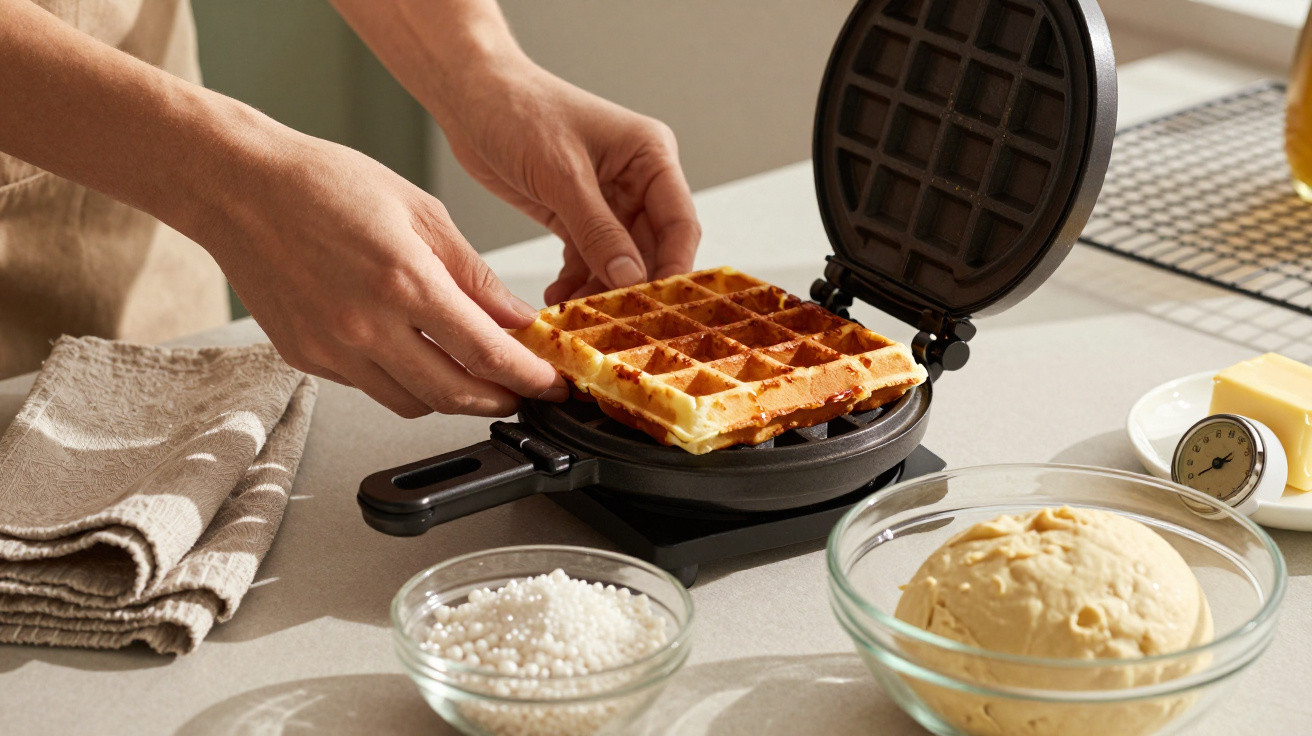
For years, many people assumed that all it took was a runny batter, a good appliance and that was it: golden, crisp, perfect waffles.
Belgium sees things differently.
Anyone who has eaten a genuine Belgian waffle on the street, still warm and fragrant with butter, often returns home disappointed: the homemade version rarely turns out the same. It is too fluffy, quickly goes soft and resembles a thick pancake. What most people do not realise is that the secret lies not only in the appliance or a “magic recipe”, but in one particular step inherited from the Liège tradition, which completely changes the result.
Why homemade waffles often turn out soft
The scenario is familiar: batter thoroughly mixed, waffle maker hot and the kitchen scented with vanilla. Then comes the first bite, and the disappointment. The crust disappears within minutes, while the texture becomes slightly rubbery and uninspiring.
The mistake starts with the base: using pancake or crêpe batter and expecting the texture of a Belgian waffle. These are different preparations. The Liège waffle, the most iconic version sold on Belgian streets, begins with a sweet bread dough similar to brioche, rather than a liquid batter.
“Anyone who wants a waffle that is crisp outside and soft and chewy inside needs to think like a baker, not a pancake cook.”
That shift in approach leads to the Belgian step that changes everything: the precise moment when the special sugar is added to the dough.
What makes a Liège waffle different
A Liège waffle is rich, buttery and dense, with crunchy pieces of sugar throughout and a caramelised outer layer. It bears no resemblance to the light, uniform versions often served in hotels.
Ingredients that make the difference
This distinctive texture relies on classic bakery ingredients:
- Plain bread-making wheat flour
- Plenty of softened butter
- Warm milk
- Whole eggs
- Fresh baker’s yeast
- Pearl sugar in large granules
- Vanilla flavouring and a pinch of salt
The most intriguing detail is the sugar: it is neither caster sugar nor ordinary granulated sugar. Belgian pearl sugar comes in large pieces that largely withstand the heat, creating little bursts of crunch within the dough.
“You can make waffles without pearl sugar. But it will not be the same Liège waffle that stays in the memory of anyone who has travelled to Belgium.”
The classic mistake: treating waffles like pancakes
Many online recipes instruct you to combine everything at once - dry ingredients, liquids and sugar - then pour a thin batter into the machine. The result comes nowhere near the Belgian original because one vital element is missing: long fermentation and a bread-like structure.
The dough needs time, not haste
With the Belgian method, the process is different:
- Dissolve the fresh baker’s yeast in warm milk and leave it to activate for a few minutes.
- Combine the flour, eggs, vanilla, salt and yeast milk to make a heavy dough.
- Knead thoroughly, by hand or with a mixer, until the dough is smooth and elastic.
- Add the softened butter in pieces, working it in until the dough pulls away from the bowl.
- Leave it covered to rise for around 2 hours, until it has doubled in size.
No pearl sugar is added at this stage. That is where the Belgian trick so often overlooked comes in.
“I was adding the sugar at the wrong time”
The step that changes everything seems counterintuitive: pearl sugar is added only after the first rise, once the dough has expanded.
This is the point at which many people spoil the recipe by mixing in the sugar from the outset. The outcome is predictable. The sugar dissolves during fermentation, does not caramelise properly and fails to create a crisp texture. The finished waffle is sweeter, but lacks the essential bite.
“The Belgian method is to incorporate pearl sugar only at the end, once the dough has fermented, using quick, gentle movements.”
The correct sequence is straightforward:
- Flatten the risen dough with your hands to release excess gas.
- Sprinkle the pearl sugar across the dough.
- Mix quickly, just enough to spread the granules without overworking the dough.
- Divide it into balls of around 70 to 80 g.
- Leave them to rest for a further 10 to 15 minutes before putting them in the waffle maker.
This keeps the crystals intact. On the hot plates, some melt and become caramel on the outside, while others stay crunchy within the waffle.
Temperature: from the iron to the caramel
Once the dough is portioned into balls, the waffle maker takes centre stage. Simply switching it on and waiting is not enough.
| Factor | Effect on the waffle |
|---|---|
| Temperature between 180 °C and 200 °C | Ensures thermal shock and rapid caramelisation |
| Properly preheated plates | Prevents the dough from cooking slowly and drying out |
| Carefully adjusted cooking time | Controls the balance between crust and soft centre |
As the piece of dough lands in the middle of the hot plate, sugar touching the iron begins to melt, creating a golden, glossy and slightly sticky coating. Inside, the centre remains soft, with strands of dough reminiscent of brioche.
How to stop the crust going soft within minutes
Another pitfall that produces a soft waffle occurs immediately after it leaves the machine. Many people stack them or cover them with a cloth to “keep them warm”. Steam escaping from the dough becomes trapped, condenses and softens the crust.
“To preserve the contrast between a caramelised crust and a soft interior, a waffle needs to breathe, not sweat.”
A few simple measures make a considerable difference:
- Place cooked waffles on a cooling rack without stacking them.
- Wait one or two minutes before taking a bite, allowing the caramel to set.
- Avoid closed containers while the waffles are still hot.
The following day, the best way to bring back the texture is to use an oven or toaster. A quick reheat restores the buttery aroma and revives some of the crispness. A microwave, by contrast, tends to make everything rubbery.
Common mistakes and how to correct them
Certain issues appear time and again during the first attempts. Understanding their causes makes it easier to get them right quickly.
- Pale waffle with no crust: the iron is not hot enough or the cooking time is too short.
- Excessively burnt sugar: the temperature is too high or there is too much pearl sugar on the surface.
- Dry, heavy dough: the rise was too short, there is too little butter or too much flour.
- Raw centre: the dough balls are too large for the power of the machine and need longer cooking.
What exactly is pearl sugar?
This ingredient can seem unusual to anyone who has never encountered it. It is sugar pressed into large, tightly compacted granules. It does not dissolve easily, even when exposed to liquid or moderate heat.
It is sold under several names, including “pearl sugar”, “sugar pearls” and “coarse granulated sugar for decoration”. In specialist bakeries and cake-decorating shops, it is usually the same type used to top sweet breads and chouquettes.
Where this product is not readily available, a makeshift alternative is to break sugar cubes into small pieces. The result is not identical, but it creates crunchy pockets that are closer to the original than caster sugar.
How to adapt the recipe to everyday life without losing the Belgian effect
For anyone short of time in the morning, one option is to make the dough the previous evening, without the pearl sugar, then let it rise slowly in the fridge. The next day, take it out and allow it to lose its chill, mix in the sugar granules, then continue with the dough balls and cooking.
Another option is to make a large batch at the weekend, cool the finished waffles on a rack and freeze them separately. When it is time to eat them, place them straight in the oven or toaster. The buttery flavour and contrasting textures return with good fidelity.
With a little practice, the kitchen starts to evoke a street corner in a Belgian city: the scent of fermented dough, melted butter and caramelised sugar. And the opening question - “why did my waffles go soft?” - gives way to a far more pleasant one: who will be the next person to ask for “just one more” in the café queue?

















Comments
No comments yet. Be the first to comment!
Leave a Comment