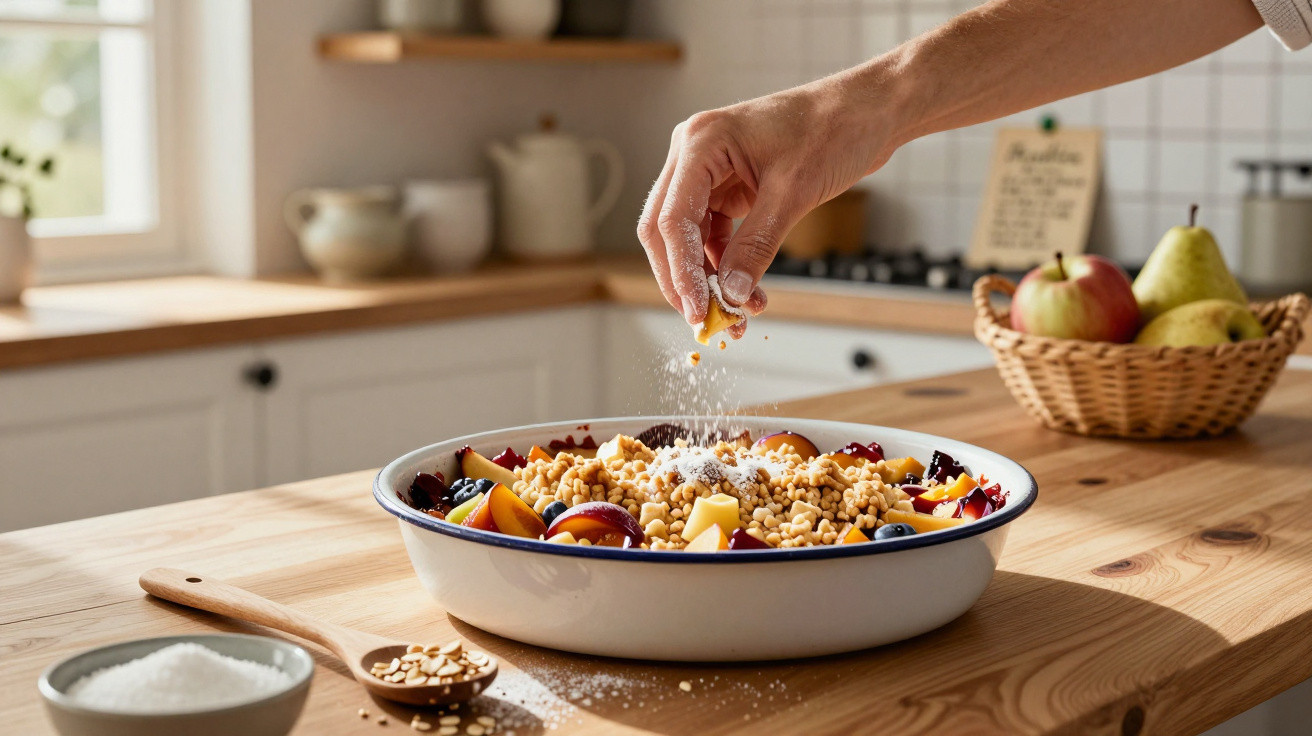
The aroma arrives before anything else: warm, sweet and faintly toasted, drifting down the corridor of a compact converted farmhouse. It is the sort of scent that suggests somebody believes pudding should recall childhood, rather than resemble a food laboratory creation. On the kitchen table sits a chipped ceramic baking dish, still fizzing at its edges, with a spoon already pushed through the topping. There is no garnish, sauce or sprinkle of gold dust - only fruit, flour, sugar, butter and the understated assurance of a recipe with nothing to prove.
Across TikTok, Instagram Reels and cosy food blogs, versions of the same dish are appearing again and again, presented in worn pans and on vintage crockery. Videos show it steaming beside a window, eaten while wearing mittens and passed around between friends in oversized jumpers. One straightforward farmhouse dessert is suddenly everywhere once more.
And it is beating the algorithm while barely trying at all.
The quiet return of the farmhouse fruit crumble
Browse your feed this week and you will probably see it before you consciously notice it. It is a rustic fruit crumble, sometimes labelled “grandma’s recipe”, sometimes rebranded as “dump dessert”, and sometimes simply described as “that easy thing with fruit and crumbs on top”. It could not be further from viral cheesecake or meticulously styled macarons. There are no clean edges or mirror glazes - just soft, bubbling fruit beneath an uneven golden layer of crumbs.
That is precisely what makes people want to share it. Crumble resembles everyday life: it dips in the centre, lets out a little syrup and may catch slightly at one corner. Yet everyone around the table still competes for the final spoonful.
One clip, which exceeded a million views within a few days, features a young woman in an oversized flannel shirt in her late grandfather’s former kitchen. She peels apples over the sink and laughs as one drops onto the floor. She tosses the slices into a dish with sugar and a squeeze of lemon, then works flour and butter between her fingers while recalling Sunday farm lunches. There is no elaborate soundtrack or rapid editing, only gentle kitchen sounds and a spoon knocking against the bowl.
The comments fill with other people’s recollections: “My grandma did this with plums.” “We used stale bread crumbs instead of flour.” “I forgot how simple this could be.” What was once a practical way to use leftover fruit has become an emotional time machine.
Food-trend analysts highlight a straightforward pattern. When daily life feels crowded by screens, subscriptions and limitless options, pared-back recipes begin to stand out. A crumble is about as low-tech as a pudding can be: fruit, sugar, fat, flour and heat. It requires neither a thermometer nor a stand mixer, and the whole recipe can fit on a sticky note.
There is an additional appeal in its imperfection. Against a backdrop of heavily filtered dishes, a slightly lopsided crumble feels quietly defiant. It says that a person baked it, rather than a brand, and seeing that gives the brain a little room to relax.
Bringing a farmhouse crumble into a modern kitchen
This pudding is so appealing because it is exceptionally forgiving. Begin with fruit that needs saving: marked apples, yielding pears or the final handful of frozen berries at the bottom of the bag. Cut it up, mix it with one or two spoonfuls of sugar, and perhaps add a pinch of cinnamon or vanilla. Tip it casually into a baking dish; there is no need to arrange it neatly.
For the topping, use equal quantities of flour and sugar with cold butter diced into small cubes. Rub the mixture between your fingertips until it resembles damp sand, leaving a few larger pieces behind. Sprinkle it over the fruit like an untidy snowfall. Bake it in a hot oven until the topping turns golden and the fruit juices rise and bubble around the sides. Nothing more is required: not precision, but attention.
The main danger is thinking too hard about it. Add ten spices, three sugars and specialist flours, and its appeal quickly disappears. Work with what is already in the cupboard. White sugar works perfectly, brown sugar adds cosiness, and oats provide chew. Each route ends with warm fruit beneath a crisp topping.
Another frequent mistake is allowing it to bake too dry. When the fruit has little juice, pour a small splash of water or orange juice into the dish before baking. This is supposed to be a little untidy. A crumble that doesn’t ooze a bit when you scoop it out is just pretending to be something else. Put more faith in the bubbling edges than in the timer.
Those bringing this pudding back tend to describe it less as a recipe than as a ritual.
“I started making crumble again because I was tired of chasing perfect,” explains Léa, 32, who left Paris for a small house in the countryside. “It’s the one dessert where you literally cannot fail in a way that matters. Worst case, you get warm fruit with sweet bits on top. Nobody complains about that.”
- Pick fruit you genuinely enjoy – Apples, pears, peaches, plums, berries and even rhubarb all work. Use fresh or frozen fruit; it does not have to look photogenic, only taste good.
- Introduce a little contrast – Lemon juice, a small amount of grated ginger or a pinch of salt in the topping brings everything to life.
- Experiment with the crunch – Replace some flour with oats, nuts or crushed biscuits for extra texture, or leave it classically sandy.
- Serve it warm rather than boiling – Let it stand for 10 minutes. The juices will thicken, the flavours will develop, and you are less likely to burn the roof of your mouth.
- Do not worry about presentation – Eating it directly from the dish with one shared spoon is entirely acceptable. Honestly, hardly anyone makes individually plated puddings every day.
Why this “poor” dessert now feels luxurious
What is striking is that a dish created to prevent waste can now feel like self-care. Baking a crumble on a wet Tuesday is not merely about using fruit that has seen better days. It gives people permission to slow down, peel apples by the sink and fill the home with an aroma that signals somebody cared enough to switch on the oven.
It is a small refusal of the default delivery-app order - a way of saying, “I can still feed myself something warm that started as almost nothing.” For a generation brought up on industrial snacks, that feels unexpectedly radical.
| Key point | Detail | Value for the reader |
|---|---|---|
| Simple ingredients | Fruit, flour, sugar, butter, plus optional oats or nuts | Affordable, easy to find and requires no special shopping trip |
| Flexible method | Suitable for fresh, frozen or slightly tired fruit | Cuts food waste and adapts to whatever is already in the kitchen |
| Emotion over perfection | Rustic appearance, family-style serving and a cosy atmosphere | Less pressure, more enjoyment, and easier to bake and share |

















Comments
No comments yet. Be the first to comment!
Leave a Comment