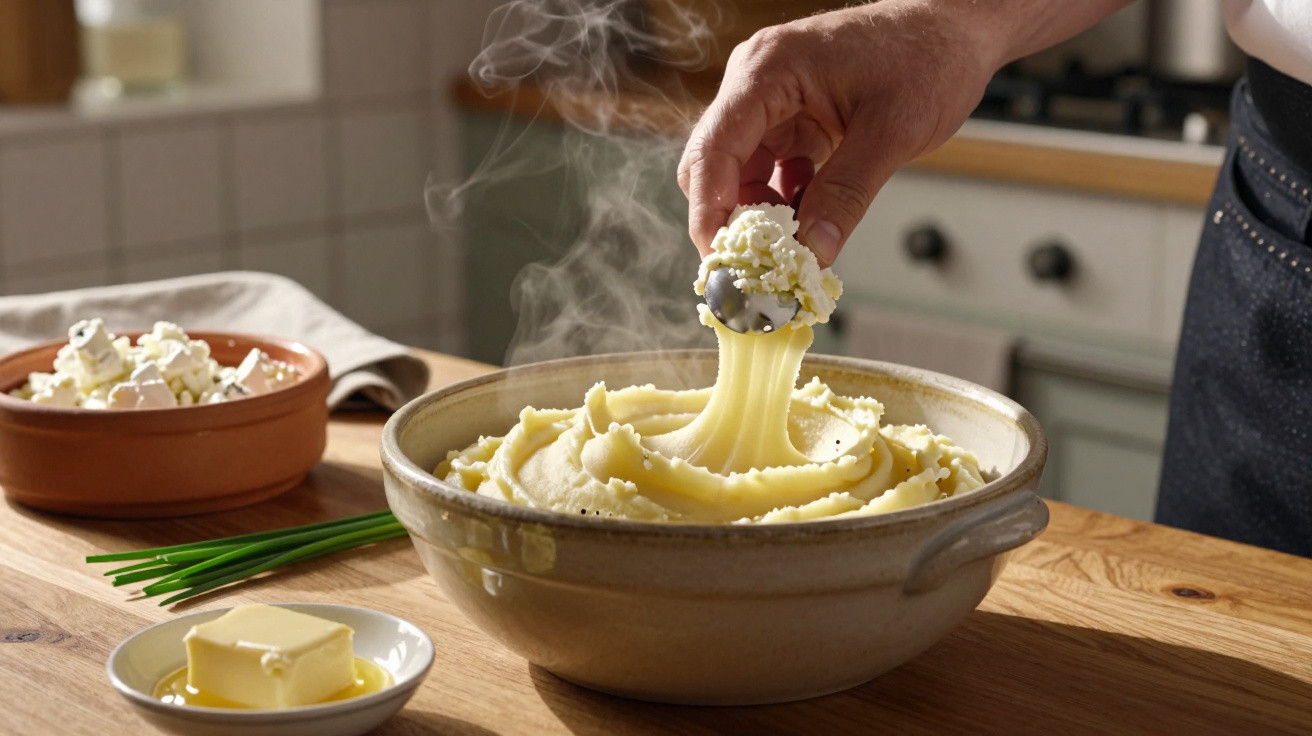
On a weeknight, the saucepan is still steaming on the worktop and the potatoes are waiting to be dealt with, already slightly overcooked. We all know the moment: you pour in some milk, add a large knob of butter, then stir without really knowing whether the mash will be silky, heavy or merely passable. Yet an overlooked tub in the fridge can change everything: plain cream cheese. Used in both chefs’ kitchens and busy family homes, this trick creates a smoother, brighter mash that is often less sickly. No complicated method or hard-to-find ingredient is required. You simply need to see what is already in your kitchen differently. The result is surprisingly good.
The tub of cream cheese that elevates ordinary mashed potato
The same situation plays out in countless kitchens: you look for milk, find only a splash left, and the butter is still rock-hard. That is often when cream cheese-such as Saint Môret, Philadelphia, Carré Frais or plain spreadable cheese-comes into play almost by chance. One or two generous spoonfuls bring the supple consistency expected from good mash, without drowning it in fat. It is easier to spoon, while the flavour of the potato remains clearly recognisable.
For 1 kg of potatoes, allow around 100 to 150 g of cream cheese, depending on the result you want. In bistro kitchens, some cooks have long used it to rescue slightly dry mash, particularly when service speeds up and the texture needs to remain perfect for several minutes. The cream cheese melts gently into the hot crushed potatoes and, when added at room temperature, will not form lumps. It is a small point, but one that makes all the difference at the table.
The idea is straightforward: cream cheese contains water, fat and milk proteins-the three components normally combined through milk and butter. Its slight tang also lifts even the flouriest potato varieties, which can sometimes taste a little bland. The mash becomes less one-dimensional on the palate, with an almost airy feel when handled gently. The key is not to use a great deal, but to stir it in while the potatoes are still piping hot.
The chefs’ method for soft, light mashed potato
Start with floury potatoes such as Bintje, Agria or Manon: they mash easily and take up the cream cheese well. Cook them in salted water, starting from cold, then drain thoroughly before returning them to the empty saucepan over a low heat for thirty seconds. This removes excess moisture, which could otherwise make the mash soft and watery. Mash the potatoes using a potato masher, add the cream cheese in stages, then loosen with a little hot cooking water or light stock if needed.
The most common mistake is reaching for a hand blender to save time. We have all done it, especially after a long day when the children are already asking whether dinner is ready. However, the blades release the starch and turn the mash into an elastic, almost sticky paste. A potato masher or food mill takes only two extra minutes, if that. Honestly, nobody really does this every day, but on the evening you want memorable mashed potato, the effort is worthwhile.
Cooks also recommend tasting before adding much salt, as cream cheeses vary in both saltiness and acidity. A pinch of nutmeg, a few grinds of black pepper or a touch of roasted garlic can complement the dish without disguising it.
“Good mashed potato should taste of potato above all else: cream cheese is there to round it out, not to conceal it.”
- For 1 kg of potatoes: 100 to 150 g of plain cream cheese.
- Add it off the heat or over a very low heat to retain its creaminess.
- Keep some hot cooking water aside to adjust the consistency.
- Avoid sweetened, flavoured or overly reduced-fat versions, which are often less stable when heated.
An everyday cream cheese trick with more possibilities
This cream cheese mashed potato is not intended to replace the childhood version, rich with whole milk and salted butter. Instead, it offers another way to cook with what is actually in the fridge, without heading to the supermarket for one missing ingredient. Served with roast meat, homemade breaded fish or simply pan-fried vegetables, it retains the comforting quality expected of an evening meal. It also welcomes a few variations: chives, grated Parmesan, mild mustard or lemon zest alongside a fish fillet.
There is something reassuring about this small habit too: it shows that even a very traditional recipe is never entirely fixed. Leftover cream cheese can prevent waste and breathe new life into a dinner that initially seemed uninspiring. The best mashed potato is not necessarily the richest; it is often the one that vanishes from the saucepan before everyone has even been served. Everyone can find their preferred amount, then keep this useful trick in mind for evenings when there is no milk but the craving for comfort remains.
| Key point | Detail | Benefit for the reader |
|---|---|---|
| Replace milk and butter | Use 100 to 150 g of plain cream cheese for 1 kg of potatoes | Creamy mashed potato from one fridge ingredient |
| Protect the texture | Mash the potatoes with a potato masher, never a blender | Avoid sticky, elastic mashed potato |
| Adjust without making it heavy | Loosen with a little hot cooking water or light stock | Achieve the desired consistency without adding too much fat |

















Comments
No comments yet. Be the first to comment!
Leave a Comment