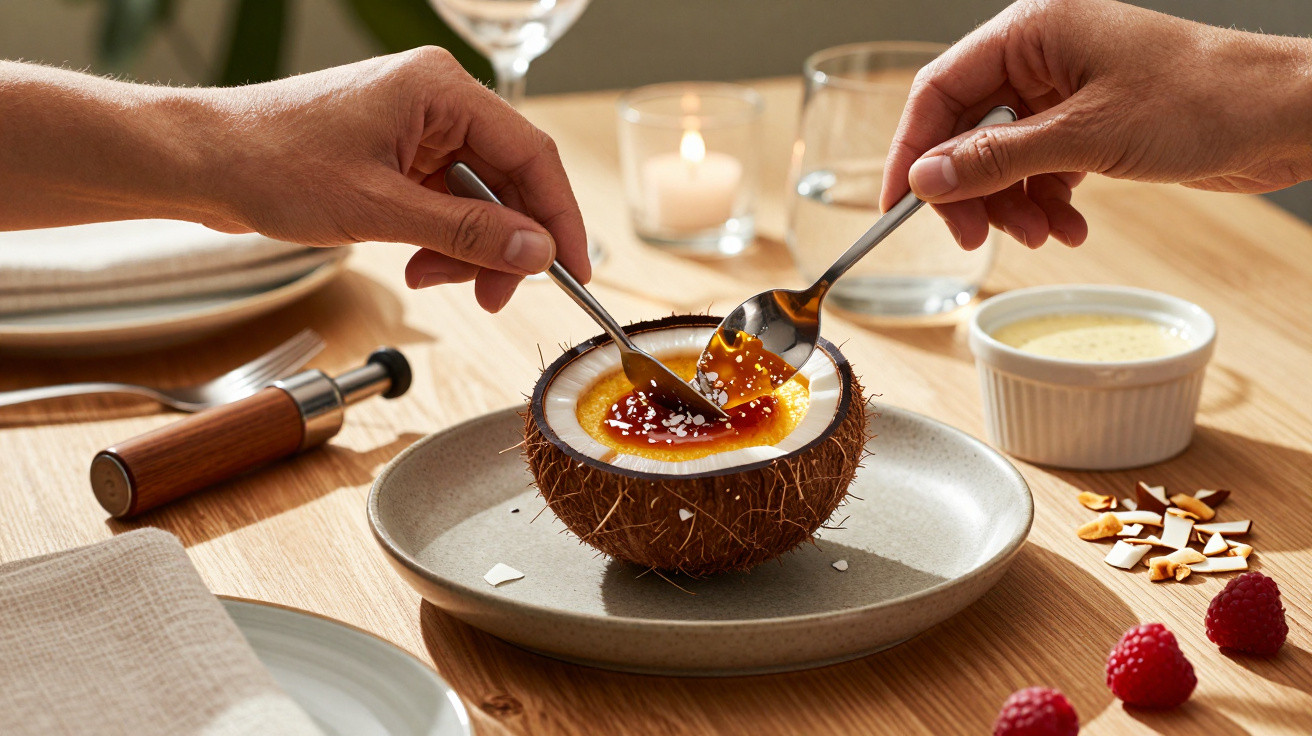
The table is laid, candles are glowing and the playlist is queued. Yet one small question remains: will this evening feel memorable, or merely pleasant and soon forgotten? Guests now scroll through countless ‘wow’ recipes before they have even chosen an outfit. They have watched lava cakes, piled-high cheesecakes and rainbow freakshakes. Expectations are high, every photo is polished, and the pressure is genuine.
Some hosts meet it with a pricey bottle of wine. Others spend hours perfecting an elaborate main course. Increasingly, though, the true centrepiece arrives quietly at the end: one plate, one spoon and a dessert that looks as though it has travelled directly from Instagram to the dining table. It requires no extraordinary patisserie training or hard-to-find ingredients. Just a dessert that shifts when touched, shines in photographs and leaves everyone quiet for three seconds.
Think of it as the season’s trending star: a molten heart dessert that quite literally melts every other dessert away.
The dessert that takes over the evening
Home entertaining is changing. Rather than formal meals with several courses, people want one or two dishes that feel like an occasion in themselves. This trendy dessert has become precisely that kind of moment. Picture a smooth, gleaming chocolate shell or a fine meringue casing, concealing a soft, flowing middle that gives way beneath warm sauce or the first spoonful.
It is part pudding, part performance. The host sets it down, phones come out and someone bends across the table to film the ‘melting’ moment. For a few seconds, everyone experiences the same childlike ‘wow’. Then the enchantment ends, spoons go in, and the room fills with that subtle, unmistakable sound of people properly enjoying something together.
Ask around and the same tale comes up repeatedly. A friend of a friend tried an easy melting chocolate dome for a birthday supper. She tucked small scoops of ice cream and berries beneath a thin chocolate shell, then poured hot salted caramel over the top. Gradually, the shell sank and split open, like a flower blooming backwards. Nobody remembered the roast chicken; the following day, all anyone discussed was ‘that insane dessert’.
On TikTok and Reels, clips of comparable ‘meltdown’ desserts collect millions of views. Their appeal is not extravagance, but the fact that they seem both magical and achievable. Restaurants are creating their own versions, although home-made ones often feel cosier, a little imperfect and more appealing. The figures may demonstrate engagement, certainly. The expressions around the table reveal something different: genuine warmth.
This dessert’s impact goes beyond the sugar rush. It creates a small transformation before your eyes. At first, there is something tidy and sculptural, almost too beautiful to eat. Then heat reaches it, or a knife breaks through, and the filling appears: molten chocolate, a silky centre or a puddle of sauce. It visibly proves that what lies beneath can be more sumptuous than the exterior. Guests are not simply watching a pudding collapse; they are watching a moment unfold.
A subtle psychological effect is involved, too. When diners watch a dessert alter shape in front of them, they become part of its creation rather than passive eaters. This shared miniature spectacle eases any tension at the table. Jokes work more readily and conversation gathers pace. An ordinary spoon signals that it is fine to get slightly messy now. The dessert has already done so first.
How to make a molten heart dessert at home
Let’s be specific. The easiest version of this trendy dessert is a molten chocolate heart cake, baked in individual ramekins. It is a rich dark-chocolate mixture containing only enough flour to support the outside, while leaving the middle runny. The essential skill is baking it long enough to firm the edges, but not so long that the centre stops being a pool of chocolate.
Begin by melting good-quality dark chocolate with butter. Beat in the sugar, followed by the eggs one at a time, until the mixture is glossy and almost satin-smooth. Gently fold through a spoonful or two of flour and a pinch of salt. Divide it between generously buttered ramekins, filling each around two-thirds full, then refrigerate for at least 30 minutes. This brief chilling period is a valuable secret: it slows the rate at which the centre cooks and helps keep the heart beautifully molten.
Many people assume these ‘fondant’ desserts require the precision of a pastry chef. They do not, although they do reward close attention. Keep track of the baking time. In most ovens, 9 to 12 minutes at a medium-high temperature will be enough. The surface should appear set and matte rather than glossy, while still giving a slight wobble when the ramekin is nudged. Leave them for one minute, carefully loosen the sides with a knife, then turn them out on to plates. Once the first guest cuts in and the centre spills out, the whole table will lean closer.
A few familiar errors happen time after time. The most obvious is overbaking: instead of a flowing centre, you are left with a firm brownie. It will still be tasty, but the theatrical moment disappears. Another common problem is leaving preparation until just before guests arrive. Rather than enjoying the gathering, you end up stressed and dusted in flour. Prepare the mixture earlier that day, refrigerate it and bake only at the last minute. Your future self will be grateful.
There is also a myth of perfection. Social media has surrounded these desserts with immaculate finishes and dramatically slow pours. Everyday cooking does not work that way. One cake may split in an odd place, while another may flow more heavily from one side. That is completely fine. A little unevenness makes it feel authentic, home-made and generous. Let’s be honest: nobody really makes this every day. It is for a night when you want a treat, and treating yourself includes avoiding life as a kitchen robot.
Your choice of textures can make the experience even gentler. Serve the hot cake with something cold: vanilla ice cream, yoghurt sorbet or even a spoonful of thick, lightly sweetened cream. The contrast in temperature tells the palate, ‘Wake up, something fun is happening.’ Add crushed nuts or cacao nibs for a touch of crunch, ensuring each mouthful stays interesting from beginning to end.
“I used to think a good dinner was all about the main course,” confided a London home cook I met. “Now my friends arrive already whispering: ‘Did you make the melty thing again?’ It’s become our little ritual.”
For an easy reference before your next dinner, here is a short cheat sheet to screenshot:
- Make the batter ahead of time, then bake at the last minute for a relaxed, showtime atmosphere.
- Choose good dark chocolate (at least 60%) for depth and a clear, intense melt.
- Give every cake something cold, something crunchy and something attractive alongside it, such as berries or a dusting of sugar.
- Trial the baking time once before serving guests, so you can find your oven’s ideal timing.
- Ask one guest to make the first cut and capture the ‘lava’ moment; it becomes dessert’s unofficial opening.
Why this dessert remains in people’s memories
The amusing part of this trend is how swiftly it leaves the plate yet remains in the conversation. Guests do not say, ‘The sugar balance was well-calibrated.’ They say, ‘That dessert was insane,’ or ‘I can’t stop thinking about that chocolate thing.’ A straightforward molten heart cake, melting dome or soft-centred tart becomes an emotional shortcut to an evening that felt unlike the ordinary.
On a deeper level, this type of dessert suits the current mood. We are tired, somewhat overloaded by screens and eager for something that feels both special and human in scale. Liquid nitrogen and gold leaf are unnecessary. What you need is warmth, something that changes before your eyes and a host willing to say, ‘It might crack, but let’s see what happens.’ That modest risk forms part of the flavour.
From a purely practical perspective, this dessert approach is remarkably efficient. Keep the main course uncomplicated - roast chicken, a generous pasta dish or a tray of vegetables - and allow pudding to provide the ‘wow’. It is affordable, does not require a professional kitchen and scales easily: two people on a Tuesday, eight at a birthday or twelve for a long, untidy Sunday lunch. Somewhere between the shell cracking and the first spoonful of warm chocolate, the evening quietly moves from polite to unforgettable.
We have all experienced that point when the plates have been cleared, the evening could finish, and then somebody produces ‘one last thing’ that transforms the entire mood. That is the strength of this trendy dessert. It gives an everyday dinner a heart, both literally and figuratively. And yes, it melts - quickly enough to disappear, but slowly enough to stay in the memory.
| Key point | Detail | Benefit for the reader |
|---|---|---|
| A dessert spectacle | A molten centre or shell that breaks down under heat creates a powerful visual effect. | Give guests a ‘wow’ moment that is easy to film and share. |
| Simple technique | Batter prepared in advance, brief baking and an intentionally runny centre. | Reduce kitchen stress while still achieving a restaurant-worthy result. |
| Emotional impact | The dessert acts as a ritual, breaks the ice and creates lasting memories. | Turn an ordinary dinner into a warm, memorable experience. |

















Comments
No comments yet. Be the first to comment!
Leave a Comment