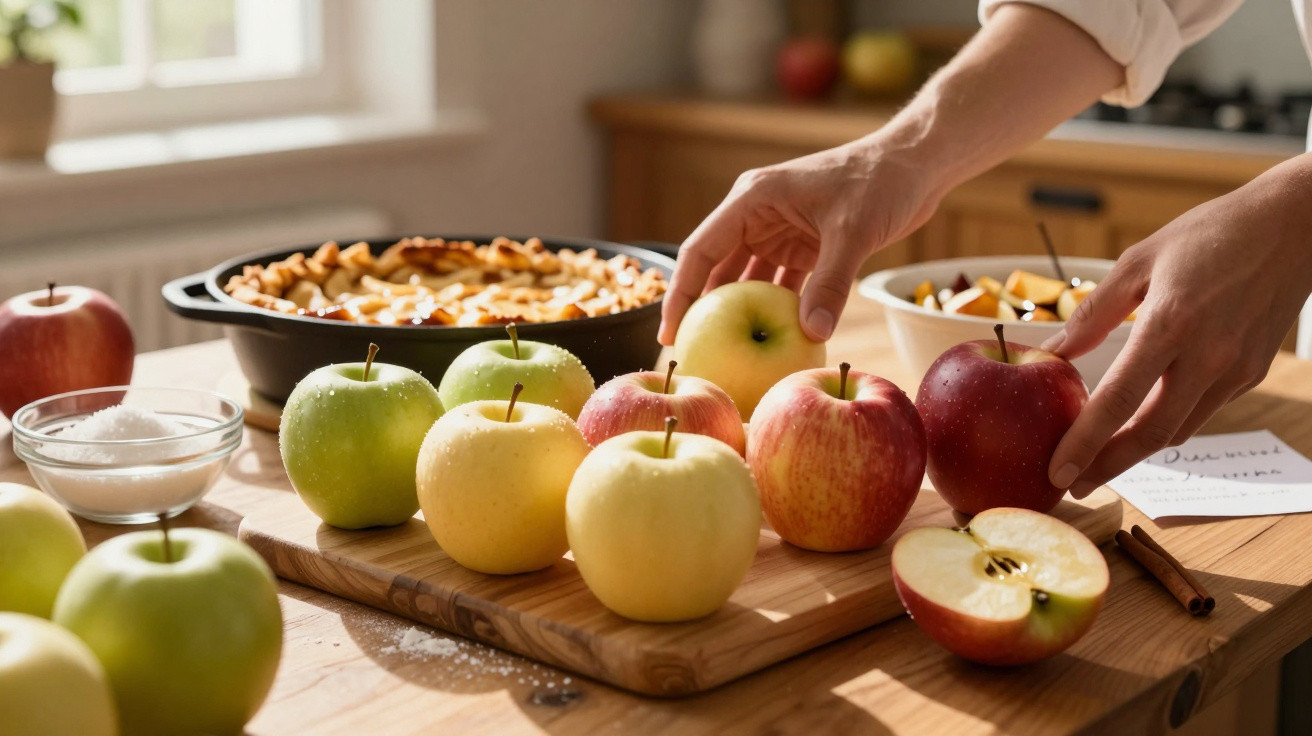
“For crumble or for tart?” she asks the stallholder, laughing and panicking in equal measure. The crates spill over with red, yellow and green fruit, with names that sound like distant relatives: Braeburn, Gala, Honeycrisp, Golden, Reinette. You pick up a bag “for a pie” and cross your fingers, as you always do.
Later, in the kitchen, the apples turn to mush in the oven. The pastry is good and the aroma is wonderful, but the first serving slumps across the plate like hot apple purée. Your guests offer polite smiles. You return them, wondering, “Same recipe, same oven… so what went wrong?”
The understated answer is already waiting in the fruit bowl.
Why the “wrong” apple spoils an otherwise perfect dessert
The first thing to understand is that apples react very differently to heat. Certain varieties retain their form like tiny soldiers, while others quickly surrender and melt away. Neither behaviour is inherently good or bad. It simply means every apple has its own character, while every dessert has particular demands.
An apple pie needs slices that stay intact. Apple sauce needs fruit that breaks down. A tarte Tatin requires caramelised apples, not a pan of soup. If you use a random assortment “because that’s what was on offer”, you are effectively taking a gamble on texture and flavour. The oven, however, never lies.
The issue is therefore seldom the recipe itself. It is the casting.
Picture a film set. A crisp, layered mille-feuille needs a firm, mildly sharp apple with a distinct taste, such as Granny Smith or Braeburn. A comforting Sunday-afternoon crumble suits softer, fragrant apples that yield to the heat, including Golden Delicious or McIntosh. Give them the opposite roles and the result feels off, even when the recipe remains unchanged.
Professional pastry chefs know this instinctively. Some will even combine two or three varieties in one dessert: one for structure, another for fragrance and a third for acidity. That is why their tart portions cut neatly and have real depth, whereas a version made from “whatever’s in the fruit bowl” can taste flat. The figures support this too: food laboratories measure the number of minutes each variety retains its shape at 180°C, and the variation is considerable.
Your palate notices these contrasts, even when you cannot quite describe them. Sweet yet dull. Tart yet lacking substance. Lovely aroma but no bite. As soon as you begin matching each dessert to its appropriate apple, those vague reactions start to make sense.
The simple method: matching dessert types with apple types
Here is the straightforward supermarket shortcut that nobody properly explains: divide desserts into three groups, then choose the apple to suit. The first group includes desserts requiring structure: traditional apple pie, thin apple tarts, galettes and apple turnovers. For these, choose apples that remain firm and easy to slice. Granny Smith, Pink Lady, Braeburn and Honeycrisp work well, as does any crisp, dense apple that feels weighty in your hand.
The second group covers desserts that benefit from softness, such as crumble, clafoutis-style puddings, cobblers and apple tiramisu. These recipes welcome apples that soften and blend into the batter. Golden Delicious, McIntosh, Jonagold, Cortland and Boskoop are all excellent choices. The third group is about melting textures: compotes, apple butters and jams. Here, almost any aromatic, slightly floury apple can work beautifully, particularly in a mixture.
Once you recognise these three categories, shopping becomes less of a guessing game and more of a calm little strategy.
Try a small experiment on a rainy Saturday. Slice one Granny Smith, one Golden and one Gala into equal pieces. Arrange them on a baking tray, keep the pieces the same size, and bake them at the same temperature for 15 minutes. Remove them and test each one with a fork. Granny Smith resists. Golden yields halfway. Gala sits somewhere between the two, though it is slightly indistinct.
You have just seen fruit science at work in your own kitchen. Suddenly, you can understand why your last crumble tasted pleasant but looked like baby food, or why your tart seemed watery despite its lovely pastry. It is not your fault. It is the chemistry beneath that glossy skin. Once you notice it, it stays with you.
That is the moment when apple shopping becomes enjoyable rather than stressful.
There is another factor that many people overlook: the balance between sugar and acidity. A good dessert apple rarely succeeds through sweetness alone. That small flash of tartness makes butter, sugar and pastry feel more lively. Granny Smith is bold and unmistakably sour. Braeburn and Pink Lady sit more comfortably in the sweet-sharp range. Golden Delicious can become almost sickly when overripe, so it benefits from spice, lemon juice or a sharper variety alongside it.
Texture is equally important. Dense, heavy apples hold together during baking, whereas lighter, mealy varieties fall apart quickly. The next time you choose an apple, look beyond its colour. Feel its weight in your palm, press the flesh gently and smell around the stem. That 30-second routine can reveal whether you have found the star of your next tart or simply a perfectly decent snack.
Practical pairings: from tarte Tatin to an easy weekday crumble
For a clear tarte Tatin rule, begin here: at least half your apples should be firm and slightly tart. Braeburn and Golden make an ideal pairing. Braeburn keeps its pieces whole in the caramel, while Golden softens enough to fill the spaces with flavour. For a classic American-style pie, pair Granny Smith with a more aromatic apple such as Jonagold or Pink Lady. Together, they bring sharpness, fragrance and substance to every slice.
For an uncomplicated weekday crumble, select softer apples. Golden Delicious, McIntosh or any local cooking apple will soften quickly and absorb the cinnamon and sugar. If you prefer recognisable pieces of fruit, include 30% firm apples in the mixture. For a spoonable texture that is almost like a pudding, use 100% soft apples. You’re allowed to prefer one or the other, no matter what the recipe says.
The key is to choose the texture you want first, and only then select the variety.
We have all opened the fruit drawer to find three sad, wrinkled apples looking back at us. They may seem useless, but they are not. They are ideal for compote, apple butter or speedy pan desserts where appearance is irrelevant. Peel them, remove any damaged parts and cook them with a splash of water, lemon and sugar. In no time, something “almost rubbish” becomes a topping for yoghurt or pancakes, or a rustic layered dessert glass for guests.
The usual mistakes? Choosing only sweet apples for a dessert that is already sweet, then ending up with a one-dimensional result. Peeling everything automatically and losing flavour and structure from varieties that actually work well with their skins on. Or putting fridge-cold apples straight into the oven, which affects cooking times. Let’s be honest: nobody really does this every day, but taking apples out 20 minutes before baking makes a real difference.
Your kitchen, your pace, your small shortcuts. The aim is not perfection; it is understanding.
“The day I stopped buying ‘just apples’ and started saying ‘these are for pie, these are for snacking’ was the day my desserts finally tasted like the ones in my head.”
To simplify matters, keep a small cheat sheet in your mind when you are in the shop. Or put it on the fridge. Or save it in the notes app you open in the fruit aisle as the queue grows behind you. Here is the compact version to remember:
- For pies & tarts: Granny Smith, Braeburn, Pink Lady, Honeycrisp
- For crumbles & cakes: Golden Delicious, McIntosh, Jonagold, Boskoop
- For compotes & butters: Any soft, very ripe apple, preferably mixed varieties
Keep this close at hand and your next apple dessert will feel less like a lottery ticket and more like a deliberate choice.
Sharing the same apple, telling a different story
Once you begin thinking “for every dessert, its apple”, you may also notice something more subtle: each dessert changes the way people experience it. A tart made with sharp Granny Smith apples makes guests slow down and discuss the contrast between crisp pastry and firm fruit. A soft, spiced cobbler crowned with melting vanilla ice cream brings silence first, followed by long, nostalgic conversations. The fruit is the same, but the message changes.
There is a particular intimacy in saying, “I chose this apple for you.” Perhaps a friend dislikes sour flavours, so you rely on Golden and add extra lemon zest instead. Perhaps your grandfather grew Boskoop, and every autumn you seek them out for one slightly imperfect crumble. These choices do not appear on a recipe card. They live in memories, in the way hands reach automatically for another helping.
The next time you pick up an apple at the market, you may feel a small change in perspective. It is no longer merely “red” or “green”. It becomes “this one will keep its shape in Sunday evening’s tart” or “these three, bruised but fragrant, are for the compote we’ll eat on warm toast tomorrow”. It is not a rule, but a quiet personal ritual. Perhaps that is what makes a kitchen feel like your own, even when the pie collapses slightly and everyone laughs before eating it anyway.
| Key point | Detail | Benefit for the reader |
|---|---|---|
| Choose by texture | Firm for pies and tarts; soft for crumbles and compotes | Reduces disappointing dessert textures |
| Mix varieties | One apple for structure, one for fragrance and one for acidity | Creates a more complex flavour with minimal effort |
| Use tired apples | Save them for compotes, butters and quick fillings | Less waste and more improvised desserts |

















Comments
No comments yet. Be the first to comment!
Leave a Comment