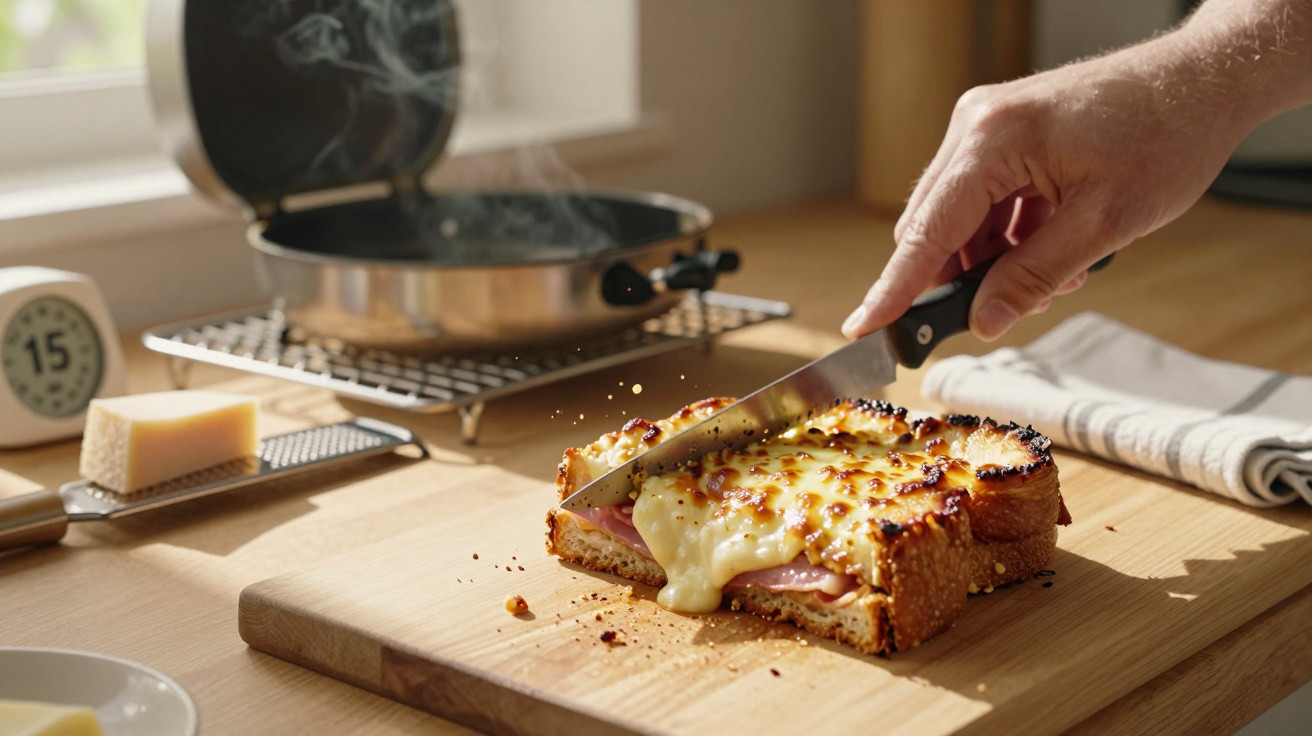
You can certainly make a croque-monsieur at home in 15 minutes. The challenge is achieving that café-standard crackle: the sort that breaks beneath the knife and makes everyone at the table glance over.
I set the pan on the hob, heard the grill flare to life, and took soft slices of pain de mie from the packet with the automatic movements of someone who has made too many rushed suppers. I was after bistro-level crispness without the bistro-level wait. Neighbours laughed through thin walls while the scent of butter travelled quickly-the everyday world unfolding between two slices of bread.
Within two minutes, the pan was sizzling. The first turn made a crackling sound like a vinyl record. Once it reached the table, the room fell into the particular quiet that comes when a dish is exactly right. The exterior had the feel of glass.
The crunch you hear before the first bite
Cyril Lignac’s croque-monsieur trick works because it transforms one element: the crust. It does not change the filling or require countless extra stages; it simply focuses on the outside. Once the surface becomes a paper-thin golden shell, every other flavour seems more vivid.
Take a bite of a bistro croque and pay attention. Your teeth first meet firmness, followed by a neat snap, before the creamy centre responds. That contrast in texture is deliberate. It comes from heat, fat and protein meeting in the proper sequence and at the right speed.
Most of us have served a sandwich that emerges pale and timid: the cheese has melted, but the bread has lost the battle. Lignac’s technique solves that problem at its origin. By using an intense sear and a tiny layer of cheese on the exterior, he turns the bread into a crisp layer that keeps the steam where it should be-inside.
Cyril Lignac’s 15-minute crispy method
The technique is remarkably straightforward: make a Parmesan crust around the outside. Assemble your croque as normal with ham, a handful of grated Comté or Emmental, and a tablespoon of béchamel if desired. Butter the outer sides lightly, then press each buttered surface into a light coating of finely grated Parmesan. Place it in a very hot pan for 60–90 seconds on each side, then finish it under a fierce grill for 2–3 minutes. Leave it to rest for one minute. That is all there is to it.
Small details make a difference. Heat the pan until a drop of water skates across it like mercury. Use béchamel sparingly to avoid trapping excessive steam. When time is tight, leave the béchamel out altogether; the cheese will do the work. Pick bread that is slightly less fresh, or toast it briefly first. Realistically, hardly anyone does that every day, but the result is immediate when you do.
The usual pitfalls are low heat and overly thick layers of fat. Spread on a fine layer of butter rather than plastering it on. Keep the pan dry, as Parmesan releases its own oil. If you prefer using only the oven, heat a baking tray in advance so the base sears as soon as it touches the tray.
Hot pan, thin fat, firm flip-this is how the crust finds you.
- Parmesan crust: 1 tablespoon in total, finely grated.
- Very hot pan: 1–2 minutes on each side.
- 15 minutes, from start to finish: prepare the sandwich while the pan heats, then finish under the grill.
Why it works-and how to adapt it
Parmesan is ideal because it is dry, rich in protein and full of umami. In high heat, its proteins brown quickly and bond with the buttered bread to create a lacy, caramelised layer. This layer acts as a barrier, stopping moisture from soaking through while giving the knife a satisfyingly clean route. Eat this hot; it waits for no one.
For a little drama, make a “cheese skirt”. Scatter a teaspoon of Parmesan straight into the pan, then place the sandwich on top. The cheese turns into frico, creating a crisp halo that curls around the edges. For extra depth, add the faintest smear of Dijon inside. For a softer melt, combine Comté with a little mozzarella. The same principle always applies: minimal fat, intense heat and a short cooking time.
When cooking for a group, take an assembly-line approach. Brown the sandwiches in the pan, move them to a preheated baking tray, and grill them in batches. A one-minute rest preserves the crust and allows the filling to settle. Serve with an orange and endive salad and some crisp cornichons for balance without any unnecessary effort.
There is something wonderfully democratic about a croque-monsieur. You can make one while only half-focused on a Tuesday and still feel quietly pleased with yourself. Lignac’s method needs neither specialist equipment nor culinary qualifications. It only requires heat, attention and a tablespoon of grated cheese.
Use smoked ham, or add paper-thin mushrooms sautéed with thyme. Brush the bread with brown butter rather than regular butter for a nuttier finish. Alternatively, keep it stripped back: bread, cheese, Parmesan crust, done. The crunch will carry from the next room, and people will come to investigate.
The real achievement is not perfection but consistency. Once a recipe becomes second nature, it is no longer merely a recipe-it becomes a rhythm. Make it once this week, then make it again the next. Adjust the heat, swap the bread, and share that crackle with someone in need of a small victory.
| Key point | Detail | Benefit for the reader |
|---|---|---|
| Parmesan on the outside | Press buttered bread into finely grated Parmesan | Creates a quick golden shell that remains crisp |
| Pan-to-grill finish | Sear for 1–2 minutes on each side, then grill for 2–3 minutes | Fully melts the cheese without leaving the bread soggy |
| Thin fat, fierce heat | A light butter coating and a very hot surface | Limits greasiness and maximises crunch |

















Comments
No comments yet. Be the first to comment!
Leave a Comment