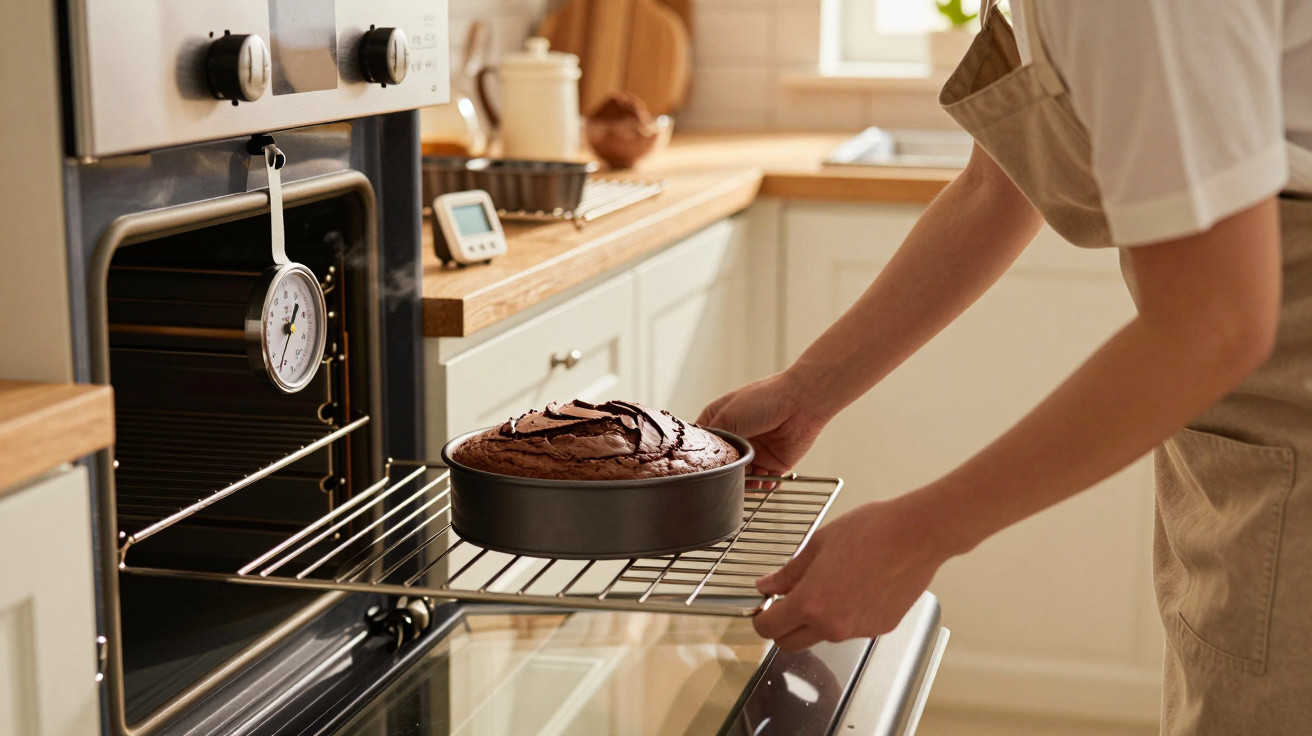
The chocolate cake comes out of the oven with a beautifully domed crust, its scent filling the kitchen as everyone waits for the first slice. Then the knife cuts in with a faint crack. The disappointment is instant at the first taste: the crumb breaks apart, sticks slightly to the roof of the mouth and practically calls for a glass of milk. We all know that moment when we blame the butter, eggs or flour, even though the recipe has worked perfectly before. Yet the true culprit is often sitting right there, door shut and still warm: the oven. A temperature that is off, uneven heat or just a few extra minutes can turn a meltingly soft dessert into a rather miserable cake. And that one detail changes everything.
An oven that is too hot dries out chocolate cake before its centre is cooked
When a chocolate cake turns out dry, the first instinct is usually to look for the mistake in the mixing bowl: too much flour, too little fat or the wrong chocolate. However, an oven set to 180 °C can genuinely reach 195 °C, or even more depending on the model. At that heat, the surface firms up quickly, moisture evaporates and the middle has to cook without losing its soft texture. The result can be misleading: the cake looks ready very early, with an attractive crust, while the inside is already starting to dry out. Chocolate does not always forgive this rush of heat.
In a family kitchen, the comparison is particularly revealing. The same batter, divided between two identical tins, can produce completely different textures if one cake is baked in a poorly calibrated oven. Several studies conducted by appliance manufacturers suggest that some domestic ovens differ from their actual temperature by 10 to 20 °C. That is far from insignificant when a recipe calls for 25 minutes of baking. Five extra minutes at high heat can be enough to lose the soft centre expected from a good chocolate cake.
The principle is straightforward: the water in eggs, butter, milk or cream escapes under the effect of heat. The harsher the oven, the faster that evaporation occurs. Sugar and chocolate may create an impression of richness, but they cannot rescue batter that has baked for too long. The recipe is not always the problem, even when it appears slightly dry on paper. A chocolate cake copes better with gentle, carefully watched baking suited to its tin than with a brutal spell in an overheated oven.
Simple steps to prevent a dry, crumbly texture
An oven thermometer is probably the least glamorous item in the cupboard, but it can save many a tea-time treat. Place it on the shelf, preheat the oven for around 20 minutes and check the true temperature before putting the cake in. If your oven runs too hot, simply lower the setting by 10 to 15 °C. For a classic chocolate cake, baking at around 160 to 170 °C using conventional heat is often gentler. The cake takes its time, the crust stays thin and the centre retains more moisture.
Where you place the tin matters too. Too close to the bottom element, and the base burns before the middle is pleasant; too close to the top, and the surface crusts over and cracks at speed. The middle shelf remains the safest option. Let us be honest: nobody really follows this every day, especially on a Wednesday evening when children are already asking when it will be ready. Still, remembering this guide avoids a large proportion of baking mishaps. It is also worth resisting the urge to open the door every three minutes: each drop in temperature disrupts the bake.
A knife tip inserted into the centre is helpful, but it is not foolproof for a chocolate-rich cake. A completely dry blade can mean it has already baked too far, whereas a slight moist residue is often ideal.
“For a soft cake, you are not looking for a dry blade: you want a blade that comes out with a few crumbs that are still tender,” goes a rule often repeated by pastry chefs.
Keep these pointers in mind:
- test for doneness five minutes before the stated baking time;
- choose conventional heat rather than fan-assisted heat for delicate batters;
- leave the cake to rest in its tin for ten minutes, not an hour.
The tin, fan-assisted heat and stated baking time: the overlooked details that change everything
A chocolate cake is never quite the same depending on the tin you choose. In a wide, shallow tin, the batter spreads out, bakes quickly and dries more easily; in a deep tin, the centre remains protected for longer. Dark metal also absorbs more heat than a light-coloured tin or silicone mould. As a result, a recipe that is perfect in a 20-centimetre tin can become disappointing in a large family baking dish. The time given in a recipe is a guide, not a contract. It is worth remembering that distinction.
Fan-assisted heat can give an impression of control because it circulates hot air. It is often very useful for biscuits or roasted vegetables. For a chocolate cake, though, the fan can speed up the drying of the edges, particularly in a powerful oven. If you use it, lower the temperature by around 10 to 20 °C and start checking the cake earlier. Another common mistake is leaving the cake in the switched-off oven with the door ajar, for fear that it will sink. That habit keeps cooking it gently, and it often ends up drier than before.
The best cake is sometimes the one you take out with a little anxiety because the centre looks only just set. As it cools, residual heat finishes the job and the texture settles. Then leave it to become warm rather than hot before turning it out, and protect it under a cake dome or in an airtight container if you are not eating it straight away. A cake left exposed to the air loses its softness, even if it was flawless when it came out of the oven. Baking often comes down to these small acts of care, not a magic formula.
| Key point | Detail | Added value for the reader |
|---|---|---|
| Check the real temperature | A domestic oven may display 180 °C while actually heating to 195 °C. A thermometer placed on the shelf lets you measure the difference, then adjust the dial without changing the recipe. | You stop randomly altering the amounts of chocolate, butter or flour. The very same recipe can regain its softness from the next bake. |
| Adapt the baking mode | Conventional heat is often gentler for deep cakes. With fan-assisted heat, lowering the setting by 10 to 20 °C limits the rapid drying of the edges. | You achieve more even baking, with a less hard crust and a centre that remains tender, even in a fairly fierce oven. |
| Observe rather than blindly following the timer | Baking time depends on the tin diameter, its colour, the oven’s power and the amount of batter. Starting the test a few minutes early genuinely changes the outcome. | You learn to spot the right moment: set edges, a slightly soft centre and a blade marked with moist crumbs rather than perfectly dry. |
The next time a chocolate cake comes out slightly dry, it may be worth not discarding the recipe too quickly. It may not be at fault, any more than your technique or the quality of the chocolate. Instead, think of the oven as a living element: sometimes temperamental, and one that needs to be understood. A simple thermometer, moving the shelf up or down one level, or taking the cake out earlier can transform the result. There is something rather reassuring about that idea: perhaps you have not failed at all; you are simply learning how your kitchen works. It is an experience worth sharing with everyone who still thinks their dessert needs more butter.

















Comments
No comments yet. Be the first to comment!
Leave a Comment