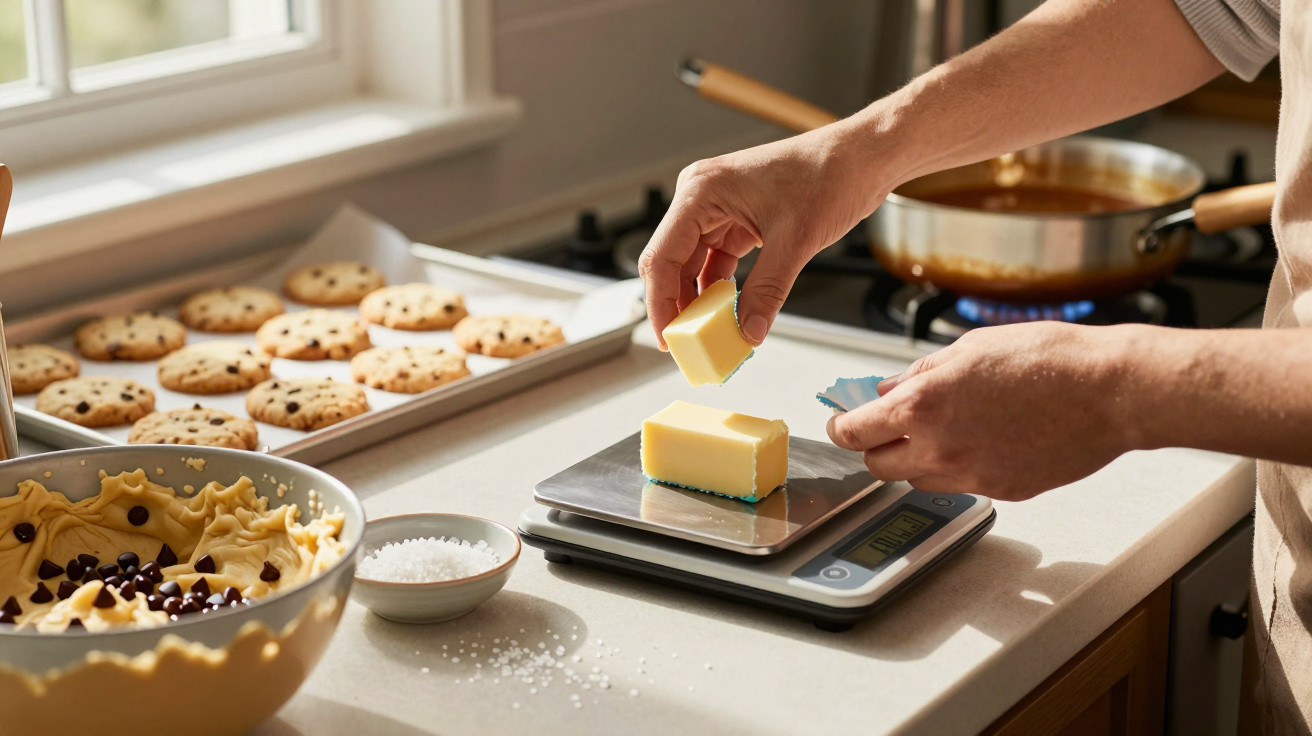
On a familiar Sunday morning, while pastry dough chills in the fridge and coffee still scents the kitchen, the same question often arises: should you reach for unsalted butter or the lightly salted block? The difference may look negligible on paper. Yet in shortcrust pastry, a financier or a batch of cookies, it can alter that final mouthful-the one that makes someone at the table raise an eyebrow. We all know the feeling of a cake that is pleasant but not quite unforgettable: too restrained, overly sweet or simply lacking character. Pastry chefs do not select butter out of regional habit; they consider balance, texture and the subtle dimension that lingers on the palate. The choice is more nuanced than it first appears.
Unsalted butter remains the standard for precision baking
In a pastry kitchen, unsalted butter is still usually the default, particularly for creams, layered desserts and delicate doughs. Its practical benefit is straightforward: it enables the baker to control the salt content to the nearest gram, with no unexpected differences between brands. Where a recipe already includes chocolate, ground almonds, praline or a biscuit base, that accuracy prevents the flavours from becoming muddled. Unsalted butter does not demand attention; it supports the recipe quietly, which is precisely its role in technical patisserie.
Consider a buttercream for filling a strawberry gateau: just a few extra pinches of salt can upset the balance between the strawberries’ sweetness and the cream’s gentle acidity. The danger may be small, but it exists, because lightly salted butter does not always contain the same level of salt from one product to another. In France, lightly salted butter generally contains between 0.5 and 3 grams of salt per 100 grams, whereas unsalted butter contains very little. At production scale, this small distinction quickly becomes a working rule.
Unsalted butter also gives a clearer expression of individual flavours. In a honey madeleine, vanilla sweet pastry or sponge-finger biscuit, it lets you identify exactly what you are tasting. Salt, by contrast, works as an enhancer: it can bring out sweetness, soften a trace of bitterness and add definition to fat. Once it is already mixed into the butter, however, the baker has less control over the quantity. The finest pastry is not necessarily the one with the boldest flavour; it is the one in which every note arrives at the right time.
Lightly salted butter transforms cookies, caramel and rustic pastry
Lightly salted butter comes into its own in generous bakes-the kind eaten while still warm, with a piece torn off between your fingers. In a chocolate-chip cookie, fudgy brownie or kouign-amann, it creates a delicious tension between sweetness and richness. That contrast is what makes you reach for another, even after promising yourself you would have only one. It can also give a chocolate tart’s shortcrust pastry a subtle depth, provided you do not thoughtlessly add salt elsewhere in the mixture.
The safest approach is to check the packet before you begin. If the lightly salted butter has around 1 gram of salt per 100 grams, it will often work perfectly in a cookie recipe, especially one containing dark chocolate or nuts. Where its salt level is higher, it is wiser to reduce or leave out the salt listed among the ingredients. The right butter is determined first by the dessert, rather than by the region where you grew up. And, honestly, nobody truly does this every day.
A common misconception is that lightly salted butter will automatically make a cake taste better. In a light sponge, fruit mousse or crème pâtissière, it can become too prominent and leave an odd, almost metallic sensation after the first spoonful. Instead, reserve it for bakes that welcome contrast: chocolate biscuits, caramel, crumble topping or a rustic apple galette. Good-quality butter, with a fresh aroma and an attractive ivory colour, will often make more of a difference than a rigid choice between unsalted and lightly salted varieties.
“Lightly salted butter should not be a passing trend: it must have a purpose in the recipe,” sums up a principle shared by many pastry chefs.
- Choose unsalted butter for creams, mousses, highly refined cakes and recipes where exact measurement matters.
- Keep lightly salted butter for cookies, caramel, shortbread, chocolate tarts and desserts rich in nuts.
- Taste raw dough whenever the recipe allows, then adjust carefully: a single pinch is often enough.
- Do not swap unsalted butter for lightly salted butter in the same quantity without removing the salt specified in the recipe.
The best butter choice should suit your dessert
Pastry chefs therefore do not settle the unsalted-versus-lightly-salted butter debate with a slogan. Their selection depends on the effect they want: the clarity of vanilla, the intensity of chocolate, the fullness of caramel or the memory of shortbread eaten on a windswept beach. At home, that freedom is rather enjoyable. You can bake two batches of cookies-one with unsalted butter and a pinch of fleur de sel, the other with lightly salted butter-then ask the family to vote without disclosing the secret. The results are often surprising. Some prefer clean, straightforward sweetness, while others look for that small salty jolt which makes sugar less predictable. Baking is better when it remains a space for experimentation, with a little flour on the worktop and preferences that cannot always be debated.
| Key point | Detail | Benefit for the reader |
|---|---|---|
| Unsalted butter | Allows precise control of the salt level | Ideal for creams, mousses and delicate recipes |
| Lightly salted butter | Strengthens the contrast between sugar, fat and chocolate | Perfect for cookies, caramel and indulgent shortbread |
| Useful habit | Check the salt content on the packaging | Prevents an overly salty dessert and preserves balance |

















Comments
No comments yet. Be the first to comment!
Leave a Comment