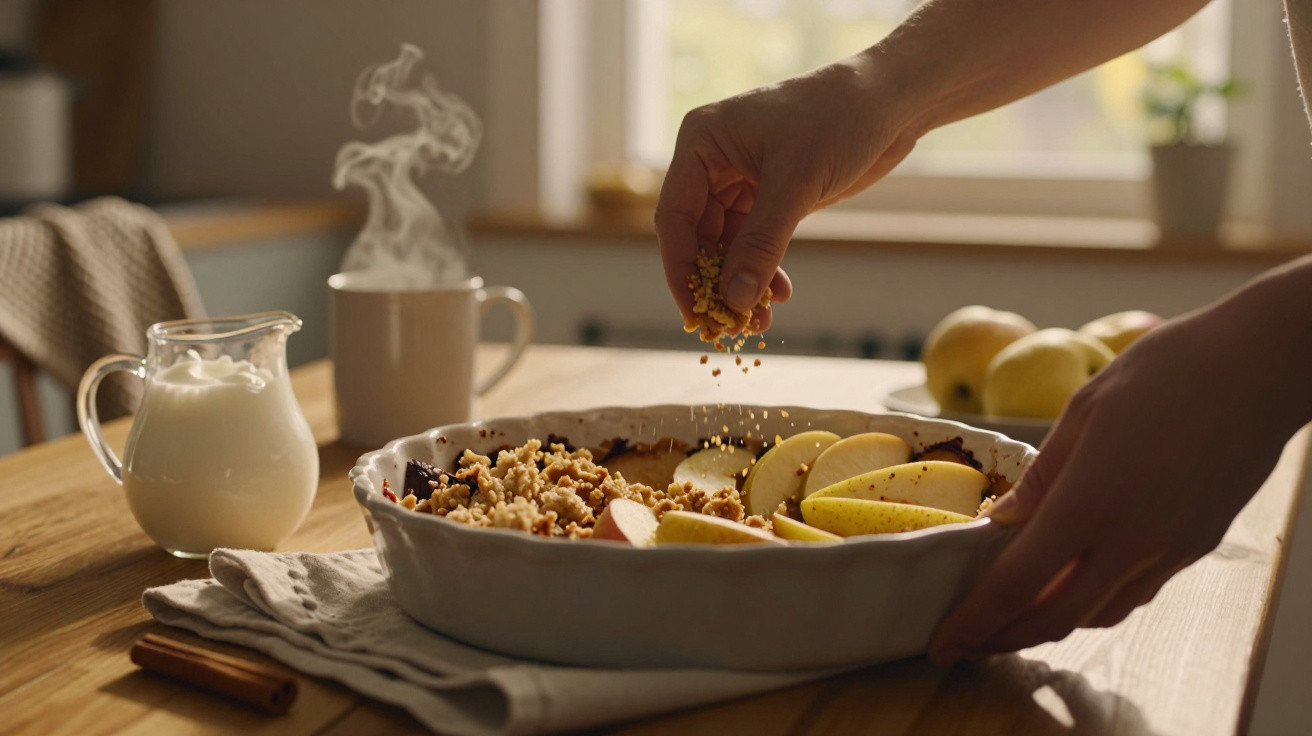
It is 6.40 pm, dinner has barely finished, and someone is already opening the cupboard with that very serious expression that means: “Isn’t there a little dessert?” On the worktop, two slightly forgotten apples sit beside well-ripened pears, the ones bought with the best intentions. Nothing spectacular: simply fruit, butter and a craving for warmth. Apple and pear crumble has a rare gift: it turns the last bits in the fruit bowl into a genuinely comforting moment, without getting out the food processor or making a mess of the entire kitchen. The good news is that a truly crisp topping needs neither complicated techniques nor an endless resting time. Ten minutes of preparation are enough. Then the scent drifting from the oven does the rest.
Apple and pear crumble: the dessert for saving ordinary evenings
We all know the point when fruit begins to lose its shine, yet is still far too good to throw away. A slightly floury apple or an overly soft pear gets an almost miraculous second chance in a crumble. Their juices turn into a light syrup at the base of the dish, while the golden topping delivers the contrast everyone expects with each spoonful. The secret of this quick recipe is wonderfully simple: do not aim for perfection. Uneven pieces actually cook better, as each retains a slightly different texture. A dessert with a rustic edge is often the most generous.
For four to six people, you need only three apples, three pears, 120 g flour, 90 g cold butter, 80 g soft brown sugar and a pinch of salt. Some families add a handful of flaked almonds; in others, cinnamon signals the beginning of autumn. I once watched a grandmother make this dessert in an old chipped dish, chopping the fruit in a hurry and tipping in sugar without weighing it. Twenty-five minutes later, the plates were empty. It was not a chef’s recipe. It was better than that: a recipe people actually make again.
The pairing of apple and pear is no accident. Apple holds its shape well in the oven and adds a slight tartness, particularly a reinette or Boskoop. Pear, meanwhile, softens more quickly and lends the juices an almost floral sweetness. Together, they prevent the dessert from becoming so uniform that it is forgotten after the final mouthful. Add a tablespoon of lemon juice to brighten the fruit and slow down browning. Let us be honest: nobody weighs lemon juice in everyday cooking. A few drops are enough, provided the fruit keeps its own character.
An ultra-crisp crumble topping before the oven has even heated up
Start by preheating the oven to 190 °C, using the fan setting if your oven has one. Peel the apples and pears, remove any tough parts, then cut them into roughly 2 cm cubes and place them in a lightly buttered baking dish. Sprinkle over 20 g of soft brown sugar, a pinch of cinnamon and the juice of half a lemon. For the topping, put the flour, remaining sugar and salt into a mixing bowl, then add the very cold butter, cut into small cubes. Rub it together with your fingertips for two or three minutes: you are looking for crumbs, not a firm ball of dough.
The usual mistake is overworking the mixture in an effort to remove every visible piece of butter. In fact, those small pieces are exactly what makes it crisp: they melt in the oven, create tiny gaps in the topping and give it a pleasingly crumbly bite. If your hands are warm, use two forks or put the bowl in the fridge for five minutes. It is not essential, merely helpful on days when the kitchen already feels like a greenhouse. Scatter the crumbs over the fruit without pressing them down. The crumble needs room to breathe, otherwise it turns into a soft, rather sad crust.
Baking for 25 to 30 minutes will usually be enough: the top should be deeply golden, almost amber around the edges, while the fruit bubbles gently beneath. Leave it to stand out of the oven for ten minutes, a small step that stops you burning your tongue and lets the juices settle.
“A good crumble does not try to be flawless: it should be crisp, a little runny and make you want another spoonful.”
- Add 40 g ground almonds for a more shortbread-like texture.
- Swap 30 g of flour for rolled oats for a more rustic topping.
- Add a little fresh ginger to the pears for a lively note.
- Serve with a spoonful of thick cream or a scoop of vanilla ice cream.
The small serving detail that changes everything
Apple and pear crumble is best eaten warm, while the topping still crackles and the bottom of the dish retains its fragrant heat, lightly steaming up the spoon. A scoop of vanilla ice cream placed on top melts within seconds, with no elaborate presentation needed, and that is often when conversation begins to slow. You can also make it earlier in the day and reheat it for eight minutes at 160 °C. Avoid the microwave if texture matters to you: the fruit copes perfectly well, but the topping does not. The hot-and-cold contrast remains one of those simple details that changes everything.
This recipe welcomes adaptations guided by the market, the season or whatever is in the cupboard. Chopped hazelnuts can replace almonds, a little vanilla can stand in for cinnamon, and a spoonful of honey can soften pears that lack sweetness. There is no need to overload the dish: the fruit should remain at the heart of it, with its flavour and juices. This dessert also encourages you to slow down, if only for a moment, after a day that has been too full. Set it in the middle of the table and let everyone help themselves. There is something comforting, almost childlike, about that gesture.
| Key point | Detail | Added value for the reader |
|---|---|---|
| Carefully chosen fruit | Combining firm apples, such as reinette, with ripe but still intact pears keeps the pieces tender without creating a uniform compote. Lemon and a small amount of sugar are enough to bring out their flavours. | The dessert has more contrast, with gentle acidity, fragrant juices and a pleasing texture from the first spoonful. |
| Very cold butter | The diced butter should be worked quickly with the flour, soft brown sugar and salt. A few visible pieces are desirable: they melt while baking and help form the golden crumbs. | This approach produces a crunchy topping without a food processor, resting time or intimidating technique, even on a busy evening. |
| Unhurried baking | Twenty-five to thirty minutes at 190 °C lets the fruit bubble gently beneath the topping. Ten minutes of resting out of the oven settles the juices and retains the crispness above. | The crumble reaches the table at the right temperature: indulgent but not scalding, with a noticeably better texture. |

















Comments
No comments yet. Be the first to comment!
Leave a Comment