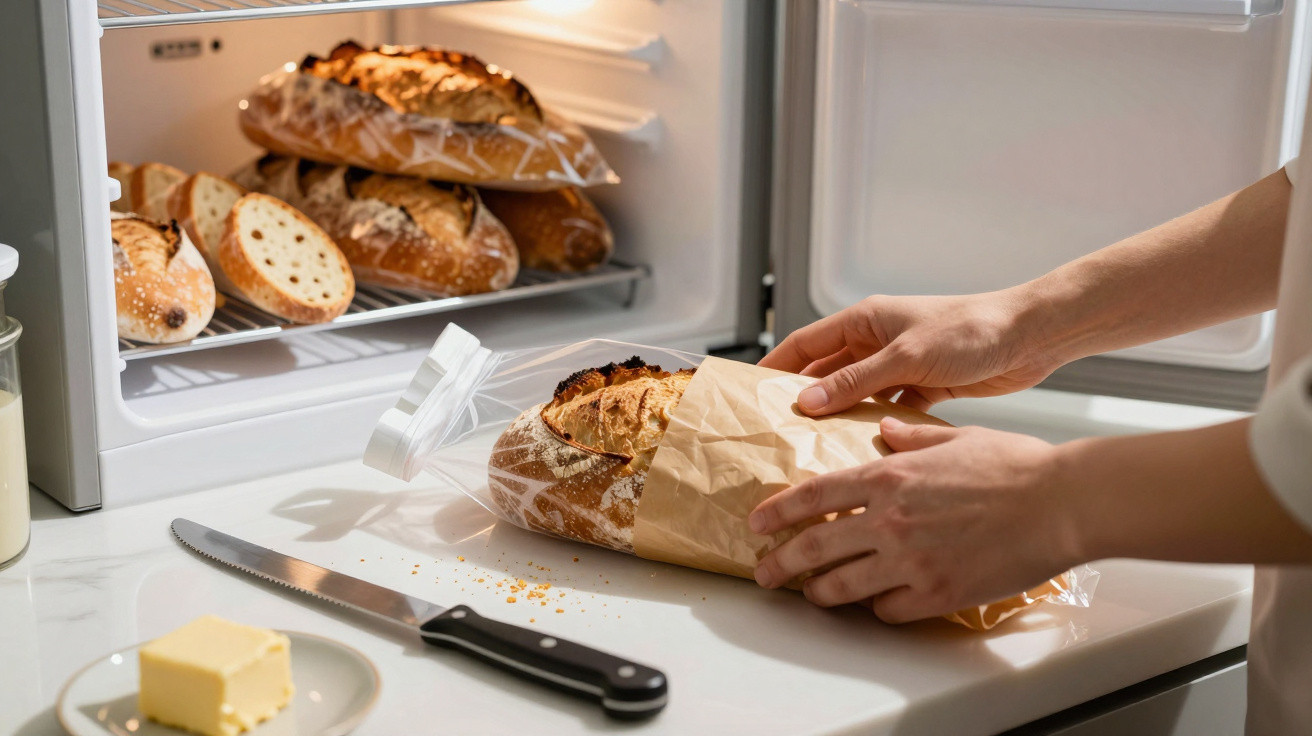
On Sunday evenings, there is often half a baguette left on the kitchen counter, a country loaf that has already been started, or a few slices forgotten in their packet. The choice is uncertain: leave them to go hard by morning, turn them into croutons, or put them in the freezer without much confidence. Yet properly frozen bread can return to the table with a crust that crackles beneath the knife and a soft crumb, almost warm with memory. The trick requires neither complicated equipment nor a baker’s technique reserved for experts. It comes down to a few straightforward steps, often overlooked when you arrive home late with the shopping. The outcome can be genuinely surprising.
Bread does not tolerate guesswork, even in the freezer
We all know the moment: you take a frozen baguette out with the best intentions, only to find a soft crust and a slightly dry crumb. The freezer is not necessarily to blame; the issue often begins much earlier, when the bread is wrapped while still warm or after it has already become too stale.
Bakers frequently bake bread in several batches so that it remains appealing throughout the day. At home, the same principle applies: freezing bread while it is still fresh, ideally on the day it is bought, helps retain its natural moisture and aromas. A baguette purchased at 6 pm and frozen before bed stands a far better chance of recovering its character the next day.
Cold temperatures largely halt the ageing of bread, but they cannot work miracles on a loaf that is already stale. The crumb becomes firm over time because the starch reorganises itself and gradually releases the water it had held; this process moves quickly at room temperature. A freezer does not erase the bread’s past: it simply puts it on hold. That is the crucial distinction.
The straightforward method for a golden, crisp crust
Before freezing, allow the bread to cool completely on a wire rack or the worktop, without enclosing it. Once cold, cut it up to suit your routine: halve a baguette, slice a country loaf, or separate individual rolls. Then place the portions in a tightly sealed freezer bag, gently pressing out the air without crushing the crust.
The bakery paper is not enough to protect bread for several days: it lets freezer air through and encourages that slightly bland taste which is immediately recognisable. A sturdy bag, carefully sealed, makes all the difference. Let us be honest: nobody really does this every day, but an extra thirty seconds prevents an entire baguette from being thrown away the following weekend.
To bring it back to life, the oven remains the most dependable option: allow roughly eight to twelve minutes at 180 °C for a whole baguette, and less for smaller pieces. Lightly dampen the crust under a trickle of water, without soaking the bread, then put it in the oven while still frozen.
“A little water on the crust and high heat: that is the combination that restores bread’s crunch, not an endless defrost on the worktop.”
- For a baguette: 10 to 12 minutes in the oven at 180 °C.
- For slices: 3 to 5 minutes in the toaster or oven.
- For a whole loaf: 15 to 20 minutes, depending on its weight and density.
Small habits that truly improve the taste
It is tempting to let bread defrost for hours, particularly early in the morning when the kitchen is still quiet. However, this wait softens the crust and can sometimes leave the bread feeling damp, almost rubbery. Putting it straight into the oven creates a clearer contrast between the dry exterior and the tender crumb.
A microwave can help with a slice eaten on the go, but its effect lasts only a few minutes: the bread turns soft, then quickly hardens as it cools. This option is best kept for very occasional emergencies. For morning toast, slicing portions in advance gives real freedom: you take out only what you need, and no more.
Bread can stay in the freezer for two to three months without noticeably losing its qualities, provided it is well protected. Simply write the date on the bag, especially if you tend to build up speciality loaves, leftover baguette and rustic round loaves at the bottom of the drawer. This modest organisation cuts waste without taking away the pleasure of a good impromptu meal.
| Key point | Detail | Added value for the reader |
|---|---|---|
| Freeze fresh bread | Put it in the freezer on the day of purchase, once fully cooled | Better preserves the crumb, flavour and natural moisture |
| Adjust portion sizes | Cut baguettes and loaves before packing them | Makes it possible to take out only the amount needed |
| Bake without defrosting | Put frozen bread in the oven with a little water on the crust | Restores a crisp exterior and a softer crumb |

















Comments
No comments yet. Be the first to comment!
Leave a Comment