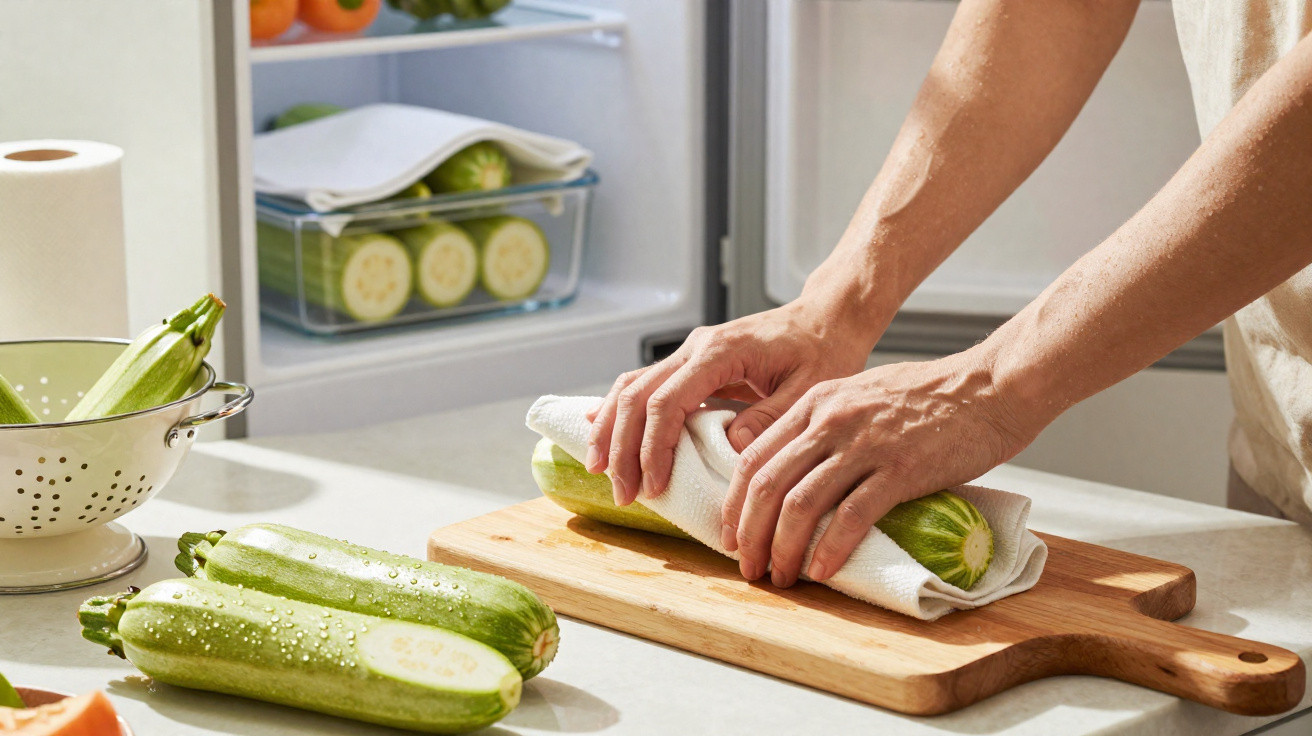
Fresh from the supermarket on Saturday, firm and glossy; by Wednesday, soft, spotted and nearly mouldy: that is the reality in many refrigerators. Courgettes are among the vegetables that are more delicate than their sturdy appearance suggests. Store them incorrectly and you are throwing money away – particularly in 2026, when the weekly food shop has become noticeably more expensive.
Why courgettes deteriorate so quickly in the fridge
Courgettes like cool conditions, but not extreme cold. Their ideal temperature is around 4°C in the lower part of the refrigerator, meaning the salad drawer. This is where their texture and flavour remain most stable. If temperatures drop lower, the flesh suffers: cell structures break down, marks appear on the skin, and the vegetable becomes watery and bland.
There is also a second, frequently overlooked enemy: excessive moisture. Condensation on the fridge wall, sealed plastic bags without ventilation holes, or tiny droplets of water on the skin all create ideal conditions for mould spores and bacteria. Within just a few days, a firm courgette can become a mushy candidate for the bin.
Another factor works quietly in the background: the ripening gas ethylene. Some fruits release particularly large amounts of it, causing sensitive vegetables to age more quickly.
Storing courgettes beside apples, bananas, melons or tomatoes dramatically speeds up their ageing – often by several days.
Courgettes should therefore have their own space in the salad drawer, away from fruit with high ethylene emissions. Every extra third or fourth day they remain usable directly cuts food waste – and eases pressure on the household budget.
The most important rule: never store courgettes while wet
The key rule for storing courgettes in the refrigerator may sound obvious, but it makes the biggest practical difference:
Never put a wet or freshly washed courgette into the fridge.
Many people wash vegetables as soon as they return from the shops, dry them only roughly, then place them in the salad drawer. That is precisely what causes trouble. The thin layer of water on the skin, combined with the fridge’s naturally high humidity, acts like an accelerator for decay. The first soft patches often appear after only two or three days.
How to store fresh courgettes correctly
A few simple steps can significantly improve the condition of courgettes in the fridge:
- Do not wash them after buying them; only rub away visible dirt with a dry cloth.
- If necessary, gently dry them with clean kitchen paper.
- Remove courgettes from tight plastic wrapping so they can “breathe”.
- Keep them in the salad drawer at about 4°C – not in the coldest part of the refrigerator.
- Place them in a lightly perforated plastic bag or a ventilated container, ideally with a layer of kitchen paper to absorb moisture.
Using this method, courgettes will generally keep in the fridge for five to seven days without difficulty. If they were genuinely fresh – for example, bought directly from a market – they can even last up to ten or fifteen days in the salad drawer without their texture and flavour suffering significantly.
A delicate special case: cut courgettes
Once a courgette has been cut, it becomes considerably more fragile. The exposed cut surface dries out, discolours and provides an ideal target for micro-organisms.
A partially used courgette therefore needs slightly different handling:
- Cover the cut surface with cling film, or place it straight into a small airtight container.
- Anyone wishing to avoid film can use a reusable silicone cover instead.
- Use cut pieces within two days where possible, and no later than three days.
For eating raw, such as in carpaccio or salads, pieces are best during the first one or two days after cutting. After that, they are still well suited to stir-fries, bakes or soups.
When there are too many: freeze courgettes cleverly
In high summer, many gardens are practically overflowing with courgettes. Anyone receiving new ones as gifts every week, or harvesting them, can barely keep up with cooking them. That is when the freezer becomes useful.
Step-by-step guide to freezing courgettes
- Wash and dry the courgettes, then cut them into cubes or slices as preferred.
- Blanch the pieces in boiling water for two to three minutes.
- Transfer them immediately to ice-cold water to stop the cooking process.
- Drain thoroughly and pat as dry as possible.
- Arrange them in a single layer on a board or tray and pre-freeze them in the freezer.
- After around one hour, transfer them to freezer bags or containers, seal well and label them.
This pre-freezing step ensures that the pieces freeze separately rather than sticking together in the bag as one solid block. At -18°C, their quality remains good for around three months on average. The texture does change after defrosting – the pieces are more like pre-cooked vegetable cubes – but the flavour is reliably retained.
Frozen courgettes like these are ideal for:
- Vegetable soups and stews
- Bakes and gratins
- Stir-fries and wok dishes
- Pasta sauces with a vegetable base
Making courgettes last longer: drying, pickling and preserving
Anyone wanting to keep courgettes not merely for a few weeks but for many months can turn to methods such as drying or pickling. Thin slices can be dried in a food dehydrator or an oven at a low temperature. Once fully dried, they keep for several months and can later be “brought back to life” in stews or made into vegetable crisps.
Another popular option is courgettes pickled in oil or vinegar. Stored in sterilised jars in a cool place, this creates a supply that lasts for six to twelve months – ideal when there is an excessive summer harvest but you still want to enjoy some of the surplus in winter.
Common courgette storage mistakes – and how to avoid them
| Mistake | Result | Better approach |
|---|---|---|
| Washing straight after shopping and putting them wet into the fridge | Rapid mould growth and soft patches | Store unwashed and wash only before using |
| Keeping them loose in the fridge next to apples and bananas | Faster ripening and ageing | Store separately from high-ethylene fruit in the salad drawer |
| Closed plastic packaging with no ventilation holes | Trapped warmth and condensation | Open the packaging or use perforated bags or containers |
| Leaving cut courgettes uncovered in the fridge | Drying out and rapid germ growth | Cover the cut surface or use a container, then consume promptly |
Why proper courgette storage matters even more in 2026
Food prices have risen noticeably in recent years. Fresh vegetables such as courgettes have become significantly more expensive than they once were. Over several months, every half or whole courgette thrown away adds up to an amount that many households now notice very clearly.
The one central rule – never store them wet – combined with a few easy habits when organising the fridge, noticeably reduces these losses. Anyone who consistently keeps courgettes dry, ventilated and away from fruit will see the difference not only in the salad drawer, but also in a less full bin.
As a bonus, the flavour and bite of meals improve too. Firm, juicy pieces brown more effectively, release less water into the pan and retain more flavour. In straightforward everyday dishes such as roasted vegetables, pasta with courgette or quick pan-cooked meals, the difference between “just about usable” and “truly fresh” becomes especially clear in the kitchen.

















Comments
No comments yet. Be the first to comment!
Leave a Comment