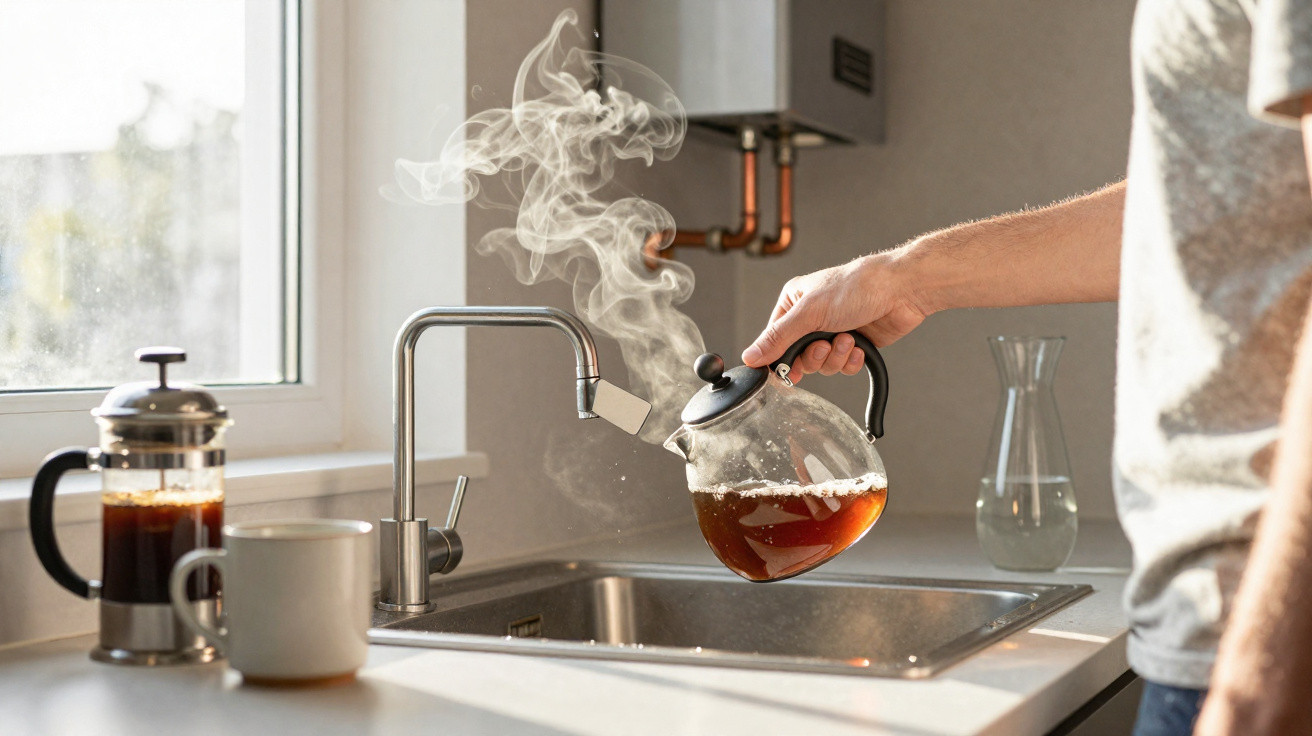
Across kitchens in France, this time-saving habit is so routine that few people regard it as a decision at all. However, health bodies warn that this apparently innocuous practice affects both the water that reaches your cup and what your body may take in over the years.
What French health authorities are actually warning about
France’s Ministry of Health, the national food safety agency Anses, and regional health agencies have consistently issued the same advice: do not use hot tap water for drinking.
Only cold tap water is monitored as drinking water; hot tap water is treated as a technical service, not a beverage.
Although this may sound like an administrative distinction, it determines the way water is assessed. Cold water supplied directly by the mains is tested against stringent drinking-water requirements. By contrast, hot water has first travelled through household pipework and either a water heater or storage tank. These sections of the installation are not subject to equivalent controls.
French authorities specifically advise using cold tap water for everything that will be consumed, including drinks, baby bottles, coffee, tea, soup, pasta and rice. The principle is straightforward: begin with water certified as safe to drink, then warm it yourself.
Why hot tap water isn’t simply cold water at a higher temperature
Within a home, hot and cold supplies commonly start from the same source. What separates them is the journey they take afterwards. Hot water remains in contact with a wider range of materials, at temperatures that can accelerate chemical and bacterial activity.
Three key issues make hot tap water a poorer choice for your cup:
- More contact with pipes and fittings that may release metals
- Water remaining stagnant in the heater or storage tank
- Temperatures that support the growth of certain bacteria
Some older properties still have pipes and joints containing lead. More modern systems are more likely to include copper and nickel. When water stands in this plumbing, small quantities of these metals can dissolve into it, and heat speeds up the process.
Tests show that at around 25°C, water can contain roughly twice as much dissolved lead as the same water at 15°C.
In other words, a hot tap provides more than water at another temperature. It supplies water that has spent longer in your domestic plumbing, acquiring a different chemical composition along the way.
Metals in water: why temperature matters for health
Lead is the primary public-health concern. Anses advises households that the maximum permitted level of lead in drinking water is 10 micrograms per litre. The limit is already very low because no level of exposure is considered safe, particularly for pregnant women and young children.
Lead may affect neurological development, blood pressure and kidney function. Repeated exposure to even small amounts matters, and metals consumed through a daily tea or coffee routine can accumulate over many years.
Copper and nickel are also relevant. Too much copper may irritate the digestive system and, at high concentrations, harm the liver. Nickel commonly triggers allergic reactions in people who are sensitive to it.
Warming water does not eliminate these substances. While boiling destroys many microbes, dissolved metals remain. As water evaporates during boiling, the concentration of metals in the liquid left behind can even increase slightly.
Boiling makes water safer microbiologically, not chemically; metals stay put, and their proportion can increase as water volume shrinks.
What happens inside your water heater
Most households have either an instantaneous water heater or a storage tank, such as a cylinder or hot-water tank. Each can create particular concerns if its water is used in a coffee machine.
Stagnant water and bacteria
In a storage tank, heated water can remain unused for hours and sometimes for days. Temperatures are commonly maintained at around 55–60°C, both to prevent scalding and reduce energy consumption. This range can suit certain bacteria, notably Legionella, which may multiply in standing, lukewarm water.
The main Legionella concern is inhalation of fine droplets, for example while showering, rather than drinking water. Nevertheless, the wider point still applies: this part of the system is intended for hygiene and convenience, including showering and washing up, rather than as a food-grade supply.
Materials not selected for drinking water
Cold-water mains and public distribution systems are closely regulated, whereas internal hot-water circuits vary considerably. Old solder, seals, flexible hoses and tank coatings may all release small amounts of metals or other substances, particularly when heat and stagnation are involved.
That does not mean hot water from the tap is poisonous. It does mean that, over time, it does not satisfy the same safety expectations as monitored cold water.
Simple habits that make your coffee safer
Health agencies are not telling people to redesign their kitchens. Instead, they recommend several easy steps that take barely a minute and can reduce exposure.
- Fill your kettle, coffee maker or espresso machine reservoir with cold tap water every time.
- If the tap has not been used for several hours, run the cold water for 30 seconds to two minutes, particularly in older properties.
- Use this initial flow, or ‘purge’ water, to wash up, rinse the sink or water plants.
- Heat the freshly run cold water in a kettle, on the hob or in your machine’s boiler.
- Pregnant women and young children should be especially careful to use only thoroughly flushed cold water for cooking and drinks.
That tiny delay before brewing - letting the cold tap run and then heating it - reduces metal levels and often improves taste.
Many coffee lovers already avoid hot tap water for another reason: taste. Water stored in a tank or carried through a network of hot pipes can take on unpleasant flavours. Fresh cold water generally produces a cleaner, better-balanced cup.
Does this matter if your plumbing is new?
Newer buildings usually carry a lower risk of lead exposure. As lead has progressively been removed from installations, modern systems mostly use copper, plastic and stainless steel. Even so, authorities give the same guidance: use cold water for consumption and hot water for washing.
| Installation type | Main concern | Recommended habit |
|---|---|---|
| Old building with possible lead pipes | Lead dissolving, especially in warm or stagnant water | Run cold water longer, never use hot tap for drinks |
| Recent building with copper/nickel | Metals released after stagnation, taste issues | Short flush of cold water, then heat |
| Home with large storage tank | Water stagnation, bacterial growth, material leaching | Reserve hot water for hygiene only |
Even in a newly built flat, water that has remained in the heater overnight is not monitored in the same way as cold mains water. Changing this habit costs virtually nothing, while the benefits for health and flavour build over time.
What ‘drinking water’ really means in this context
Public guidance often refers to water intended for human consumption. Although the term may seem technical, it covers anything you ingest: drinking water, ice cubes, soups, smoothies, cooked vegetables and baby milk.
When agencies state that only cold tap water is controlled as drinking water, they are defining the limit of their legal remit. Water must meet strict standards at the meter. Once it enters a private hot-water system, the situation becomes less clear-cut, involving different materials, temperatures and periods of stagnation.
How this plays out in everyday scenarios
Consider two otherwise identical households in an older building with some remaining lead connections.
In the first household, the parents routinely use hot tap water to boil the kettle more quickly. That water has stood overnight in contact with the pipework and heater. Every morning, the children have cocoa prepared with this hot water. Each cup contributes a small amount of lead, creating exposure that is low but repeated and long term.
In the second household, the family lets the cold tap run briefly before filling the kettle. The water they use has just come in from the mains, where levels are monitored and generally much lower. Boiling will not remove metals already in the water, but the cleaner starting point means the coffee and cocoa contain less of them.
Neither household will notice an immediate difference. Over the years, however, this small routine change affects the total quantity of metals each person consumes, particularly the youngest members of the family.
Other small choices that stack with the hot-water issue
Using cold tap water alone for drinks and cooking is only one element of reducing exposure. Other everyday choices also play a part:
- Descale your kettle and coffee machine regularly, so limescale does not retain contaminants or interfere with temperature regulation.
- Avoid very cheap, untested metal kettles and coffee makers that could release metals when heated strongly.
- Find out whether your building is known to have lead pipes, and ask your local authority or landlord about any scheduled replacements.
- Vulnerable groups may consider a certified filter on the cold kitchen tap, while continuing to avoid hot tap water.
None of these actions is dramatic in isolation. Taken together, they provide a low-key strategy for reducing risk without changing your lifestyle, only the route water follows before reaching your cup.
For anyone dependent on that first coffee to feel human, the government’s advice is simple: keep the ritual but turn on a different tap. That extra minute of patience is better spent by your kettle than your nervous system.

















Comments
No comments yet. Be the first to comment!
Leave a Comment